
Aethelgard's Resonance: Power, Peril, and Player Division
Arcane Forge Studios' Chronicles of Aethelgard: Sundered Isles Edition introduces the Resonance System. This innovative mechanic promises deep character immersion but sparks vigorous debate among veteran GMs and players alike.
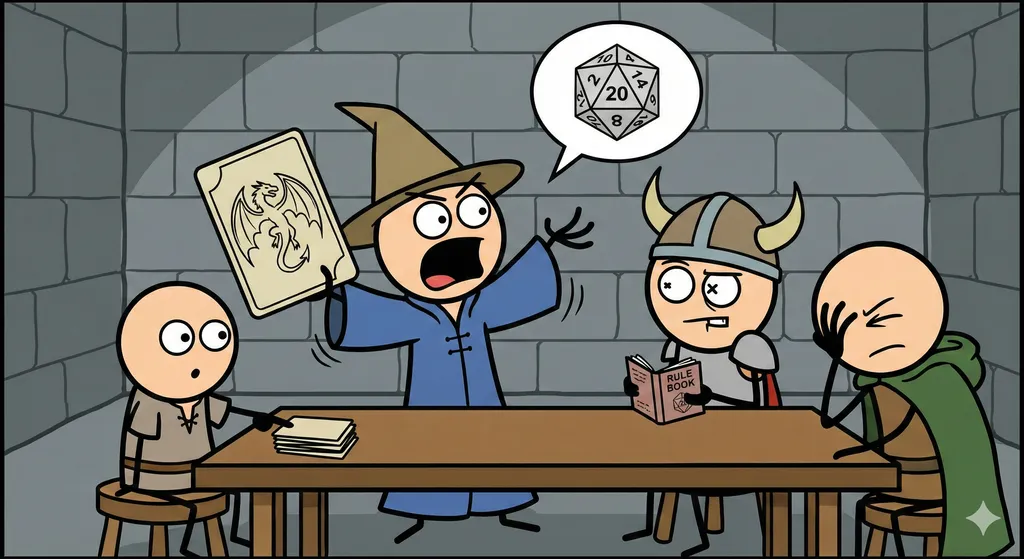
Arcane Forge Studios’ latest iteration, Chronicles of Aethelgard: Sundered Isles Edition, has ignited the TTRPG community, not with a whimper, but with the clashing of opinions surrounding its ambitious new “Resonance System.” As veteran Game Masters, we at The Crit Sheet understand that true innovation often comes with a healthy dose of contention, and Aethelgard’s latest offering is no exception.
At its core, the Resonance System in Chronicles of Aethelgard is an elegant, yet demanding, mechanic designed to intertwine character progression with the very fabric of the Sundered Isles’ shattered reality. Characters gain Resonance points by interacting with specific ley line conduits, communing with elemental spirits, or performing powerful magical feats. These points are not merely a resource for spellcasting; they are a currency of connection to the world’s primal energies. Accumulating Resonance unlocks potent new abilities, allowing spellcasters to bend the elements with unprecedented force and martial characters to channel raw power into devastating strikes. The system proposes a genuine sense of growth, where players feel their characters becoming extensions of the world itself.
However, this power comes with a weighty cost: Discordance. Each point of Resonance gained without proper attunement contributes to a character's Discordance track. As Discordance accumulates, players must contend with escalating penalties, ranging from minor cosmetic mutations and personality shifts to debilitating disadvantages on rolls, and even permanent corruption that can alter a character’s fundamental alignment or physical form. Think of it as a metaphysical stress meter; the more you draw from the wellspring of power, the more likely you are to be tainted by its raw, untamed nature. Mitigating Discordance requires performing arduous attunement rituals – often multi-session quests involving perilous journeys to ancient sites or dangerous negotiations with primordial entities. This isn't just a simple stat check; it's a narrative hook, embedding consequences directly into the story arc.
The lore underpinning the Resonance System is equally compelling. The Sundered Isles were once a unified continent, rent apart by a cataclysmic magical event known as the Great Sundering. This event didn't just shatter landmasses; it tore holes in the veil between realities, exposing the world to raw, untamed elemental and astral energies. Characters who utilize Resonance are, in essence, drawing power directly from these cosmic wounds. Discordance, then, isn’t just a mechanical penalty; it’s the physical and spiritual manifestation of the world’s lingering trauma bleeding into the character. The greater the power, the deeper the connection to the world's pain. This provides a rich narrative context for every mechanical choice, making each point of Resonance gained or Discordance suffered feel meaningful and deeply rooted in the setting’s tragic history. It transforms characters from mere adventurers into living conduits, their very existence a reflection of the world's brokenness and its potential for terrifying rebirth. Players exploring the deeper mysteries of the Sundered Isles will find themselves wrestling not just with external threats, but with the very forces shaping their internal landscape.
So, is the Resonance System good for the game? This is precisely where the community finds itself at an impasse. For groups that thrive on high-stakes narrative, player agency in consequence, and a gritty, morally complex fantasy, the Resonance System is a triumph. It elevates magic and power acquisition beyond mere numerical progression, forcing players to make genuinely difficult choices about the cost of their abilities. It provides GMs with an endless wellspring of plot hooks and character arcs, where the internal struggles of the heroes are as vital as the external conflicts. This system demands more from both players and GMs, pushing them to integrate mechanics deeply into the narrative, fostering a truly unique table feel. For those who enjoy a more straightforward heroic fantasy, or prefer less systemic overhead, the constant threat of Discordance and the necessity of attunement quests might feel like an unnecessary burden, slowing down the pace or introducing too much uncertainty. It’s a system designed for a specific kind of player, one who embraces the perilous journey of power rather than simply seeking its rewards. For those willing to engage with its complexities, the depth it offers is unparalleled, transforming every spell cast and every ability used into a meaningful narrative beat.
Top Pick: Chronicles of Aethelgard Core Rulebook
Essential for understanding the Sundered Isles' deep magic
Check Price on Amazon →Engage with the community discussions on Arcane Forge's official forums to see how other GMs and players are integrating (or struggling with) this fascinating system.
Related Stories
Hobbit-Homicide: Merryshire Detective Club's Intriguing Blend
Merryshire Detective Club promises a unique TTRPG experience, blending pastoral fantasy with classic murder mystery. We deep-dive into its mechanics, lore, and
Beyond the Stat Block: Mastering Vocal Emotion at Your Table
Campaign Mastery’s insights into vocal tones offer a potent, often overlooked, layer to TTRPGs. This deep dive explores how voice elevates mechanics, enriches l
Fanatical's Menagerie: A GM's Strategic Haul for 5E
Fanatical's 'Menagerie of Adventures RPG bundle' offers 28 D&D 5E-compatible books at 94% off. This deep dive explores how this diverse collection empowers Game