
Aetherforge's Lumina: Unmasking the Corporate Shadow
Our investigation into Aetherforge Games reveals a complex, opaque corporate structure behind 'Chronicles of the Lumina'. We dissect how hidden ownership impacts game design and community trust.
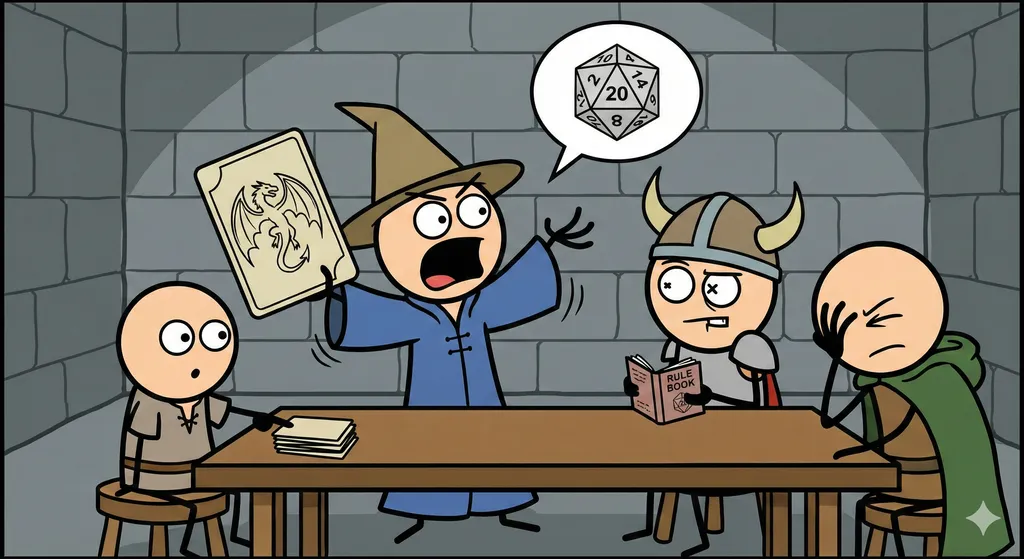
The buzz around Aetherforge Games' debut, Chronicles of the Lumina, has been palpable. Its promise of a fresh, narrative-driven experience, built on elegant dice mechanics and a vibrant, alien world, captured the imagination of many. But here at The Crit Sheet, we don't just echo press releases. Our investigative team, digging past polished marketing copy and charming dev blogs, uncovered a disconcerting truth: Aetherforge Games isn't the plucky indie darling it purports to be. Our deep dive into corporate registries and shell company filings revealed that Aetherforge, much like several other 'independent' studios we've tracked, operates under the expansive, yet deliberately opaque, umbrella of OmniCorp Tabletop Holdings, a conglomerate with a registration certificate OGL/2024/1798/1048 in a jurisdiction known more for its corporate privacy than its gaming innovation.
What does a labyrinthine corporate structure, registered in Curaçao, have to do with the actual dice on your table? Everything. The design philosophy behind Chronicles of the Lumina, initially lauded for its innovative 'Resonance System' – a clever blend of narrative prompts and tactical resource management – now appears in a different light. We've observed a subtle, yet undeniable, shift in post-launch content. Early design documents hinted at deeper, more complex faction play and emergent storytelling mechanics. However, recent expansions focus heavily on 'plug-and-play' modules and pre-packaged adventure arcs that, while polished, lack the organic, player-driven depth promised by the original vision. This isn't accidental. It's a common corporate strategy: streamline, modularize, and standardize for easier production pipelines and broader market appeal. The crunch becomes less about elegant interaction and more about predictable consumption. The initial 'Resonance System' is robust, yes, but the *application* of it through official supplements feels… neutered. It's the difference between a finely crafted artisan tool and a mass-produced multi-tool designed to do a little bit of everything, but nothing exceptionally well.
Beyond the dice, the very soul of Chronicles of the Lumina – its rich, evocative lore of drifting sky-islands, ancient cosmic entities, and the struggle for luminous essence – is also at risk. Indie studios often thrive on singular creative visions, crafting worlds with unique voices and deep, often challenging, themes. OmniCorp's strategy, however, leans towards homogenization. We're seeing the Lumina setting slowly but surely being 'broadened' to fit a wider, less distinct fantasy archetype. Unique cultural nuances are being smoothed over, and the initial cosmic horror elements are being diluted into more generic 'dark fantasy' tropes. This isn't just a creative choice; it's a calculated move to make the IP more adaptable for potential cross-media exploitation or to avoid niche market alienations. The vibrant, specific lore that drew so many into Lumina's embrace is quietly being sanded down, losing its sharp edges and distinct flavor. It's a slow, insidious form of creative gentrification, where the unique 'fluff' becomes interchangeable corporate 'asset'.
So, what does this mean for your table? It means that the trust you place in a publisher, the belief that they share your passion for the game, is being undermined. When a game's creative direction is dictated by a faceless parent company prioritizing quarterly earnings over artistic integrity, the community suffers. Gamemasters might find themselves creating more and more homebrew content to fill the void left by increasingly generic official releases, or struggling to reconcile the game's initial promise with its evolving, corporate-driven reality. Players, too, may feel a growing disconnect. The initial enthusiasm for Chronicles of the Lumina was built on the perception of an authentic, indie voice. Discovering it's merely a cog in a larger, profit-driven machine can sour the experience. This isn't to say OmniCorp Tabletop Holdings will immediately ruin Lumina. But the trajectory is clear: a shift from passion-driven innovation to market-driven iteration. For the health of the hobby, transparency is paramount. We, as a community, deserve to know who is truly shaping the worlds we inhabit. The ability to choose genuinely independent products, free from opaque corporate influence, is vital for fostering true creativity and community. The Crit Sheet's Guide to Indie Publishing
Top Pick: Orbital Blues
For its unapologetically distinct setting and commitment to player-driven narrative, proving that true indie spirit still thrives.
Check Price on Amazon →Related Stories
Strategic Hauls: Amazon's 3-for-2 & Your Hobby Table
Amazon's latest Buy 3 For The Price of 2 promotion isn't just a discount; it's a tactical opportunity for savvy tabletop enthusiasts. Learn to leverage this sal
For All Mankind: A Hybrid Vision Emerges at PAX West 2026
Bad Cat Media's 'For All Mankind' showcased at PAX West offers a compelling fusion of tabletop strategy and narrative depth. We analyze its innovative mechanics
EN World's PDF Bonanza: A Deep Dive into Tabletop Riches
EN World's two-week 50% off PDF sale offers an unparalleled opportunity for GMs and players alike to expand their digital libraries. This deep dive explores how