
Aetherium Echoes: The 'Pizza Adjective' Method for Deep Worldbuilding
Unpacking a potent worldbuilding technique for TTRPGs, we explore how 'pizza adjectives' can transform generic settings into vibrant, memorable realms. This deep dive into Aetherium Echoes reveals how GMs can elevate their narrative with evocative, setting-specific descriptions.
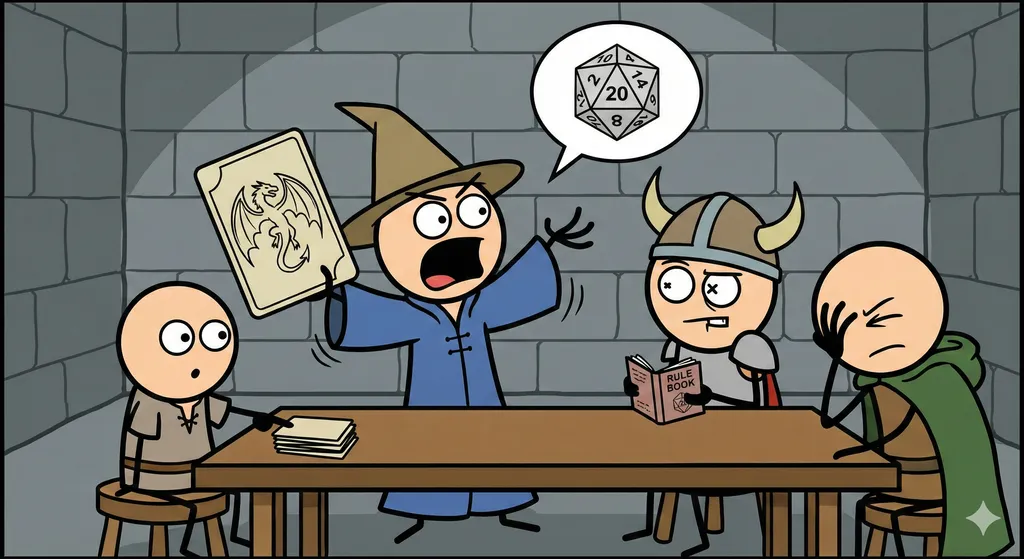
“Aetherium Echoes: The Shardfall Chronicles” from Obsidian Gate Games has always been lauded for its ambitious setting – a world fractured by arcane cataclysm, where reality itself is patchwork. Yet, even in such a rich tapestry, the challenge remains: how does a Game Master truly convey the alienness and unique texture of a post-Shardfall existence without resorting to endless exposition? A recent, brilliant discussion originating from Campaign Mastery, dubbed the “pizza adjective” technique, offers a surprisingly elegant and profoundly effective answer, transforming generic descriptions into potent worldbuilding tools.
At its core, the “pizza adjective” method is deceptively simple: take a common, mundane noun – a “pizza,” a “tavern,” a “sword” – and adorn it with unique, setting-specific descriptors that fundamentally alter its perception. It forces the GM to consider what makes this particular pizza, tavern, or sword distinct in this particular world. For “Aetherium Echoes,” where reality is literally infused with the remnants of a shattered magical civilization, this technique becomes an indispensable lexicon builder.
Instead of merely describing a “road,” a GM might portray a “shard-cobbled trade-path, its lumina-moss glowing faintly in the twilight, tracing the path of a fallen celestial fragment.” Here, “shard-cobbled” immediately tells us about the available materials and the world's history, while “lumina-moss” suggests unique flora and light sources. The “fallen celestial fragment” hints at the very genesis of the Shardfall, providing lore in a single descriptive phrase. This isn't just flavor text; it's active worldbuilding.
The practical application involves a three-step process for GMs: 1. **Identify the Generic:** Pinpoint a common object, location, or concept (e.g., “bridge,” “merchant,” “spellbook”). 2. **Infuse with Setting:** Brainstorm adjectives or short phrases drawn directly from your world's unique lore, materials, magic, or biology. Think about what makes your world different. Is there a dominant magical energy? A peculiar geology? A strange historical event that left its mark? 3. **Construct the Unique:** Combine the generic noun with these specific modifiers. A “bridge” becomes a “gloom-wood cantilever, lashed with sun-vine ropes and humming with trapped elemental static.” A “merchant” transforms into a “dust-cloaked Wayfarer, hawking chime-fruit and whisper-silks from a cart pulled by a six-legged skitter-beast.”
This process builds an implicit understanding of the world. Players learn about gloom-wood, sun-vines, elemental static, chime-fruit, and skitter-beasts not through an info-dump, but through their sensory experience of the game world. It's the ultimate “show, don't tell” for environmental and cultural storytelling. The original inspiration, detailed on Campaign Mastery, highlights how this method makes the exotic accessible and memorable.
In the fractured realms of “Aetherium Echoes,” the Shardfall was not merely an event; it was a fundamental reshaping. Bits of the ethereal plane, crystallised magic, and alien flora and fauna rained down, creating biomes of stark contrast. The “pizza adjective” technique perfectly reflects this. Consider a simple meal: the “grain-flat,” a staple across many cultures. * In the Verdant Spires, where life teems and magic flows freely from the earth, one might encounter a “sun-kissed grain-flat, topped with bioluminescent spire-berries and served with a dollop of vital-sap cream.” This immediately tells us of lushness, magical light, and unique botanical resources. * Travel to the Ashfall Wastes, however, and the “grain-flat” becomes a “cinder-baked grain-wafer, studded with iron-grit and served alongside a bitter, irradiated root-brew.” The contrast is stark, painting a picture of harsh survival, dangerous resources, and a world scarred by fallout.
These descriptions are not just window dressing; they are narrative cues. The spire-berries might have minor healing properties; the iron-grit in the wafer might subtly strengthen the eater, or perhaps cause minor internal discomfort. The vital-sap cream could be a sought-after magical ingredient. Every adjective carries a whisper of lore, inviting players to ask questions and engage more deeply with their surroundings.
Does this elevate the game at the table? Unequivocally, yes. The “pizza adjective” method is a GM's secret weapon against genericism. * **Enhanced Immersion:** Players are no longer in “a forest”; they are navigating a “whisper-wood grove, where ancient, gnarled heart-trees weep glowing resin and the air thrums with forgotten echoes.” This level of detail grounds them firmly in the unique reality of “Aetherium Echoes.” * **Player Agency & Discovery:** When every description hints at deeper lore, players are naturally more curious. They might investigate the “glowing resin,” attempt to harvest “whisper-silks,” or try to identify the “trapped elemental static.” This fosters organic discovery and interaction with the world. * **GM Efficiency & Creativity:** While it requires initial thought, the technique quickly becomes intuitive. It streamlines worldbuilding by making every description pull double duty, conveying both the mundane and the fantastic. It encourages GMs to truly think about the implications of their setting, leading to more cohesive and believable worlds. * **Avoiding Exposition Dumps:** Crucially, this method sidesteps the dreaded lore-dump. Players absorb information organically, piece by piece, through the sensory details of their environment, rather than through lengthy monologues.
The only caveat is avoiding overkill. A deluge of overly complex adjectives can become cumbersome, obscuring meaning rather than enhancing it. Like any good spice, it should be used judiciously to highlight, not overwhelm, the core flavor. When applied thoughtfully, however, this technique transforms the mundane into the magical, making every corner of your world feel distinct and alive. It's a testament to how simple linguistic tools can profoundly impact the depth and richness of our shared narrative experiences.
Top Pick: The Crit Sheet's Worldbuilding Toolkit
Essential resources for crafting unique settings
Check Price on Amazon →Related Stories
Chronos Weavers: Time's Edge on Your Tabletop
Aetherforge Games' Chronos Weavers introduces a TTRPG where players manipulate time, risking paradoxes via a "Causality Track." This deep dive explores its inno
Through the Hedgerow: A Deep Dive into Rustic Fantasy Legacies
Hedge-Lore Publishing's Through the Hedgerow RPG offers a unique journey through history, focusing on a singular location shaped by magic and time. We analyze i
D&D 5e's K-Pop Idol Sourcebook: A Crit Sheet Deep Dive
Starlight Tome Studios introduces 'Harmonic Crescendo,' a D&D 5e sourcebook turning adventurers into K-Pop idols. We break down the mechanics, lore, and table p