
Archivist's Handbook: Elevating TTRPG Traps & Puzzles
Jeff Ashworth's Archivist's Edition offers GMs potent tools for crafting intricate challenges. This deep dive explores how it elevates dungeon design and player engagement, moving beyond mere damage.
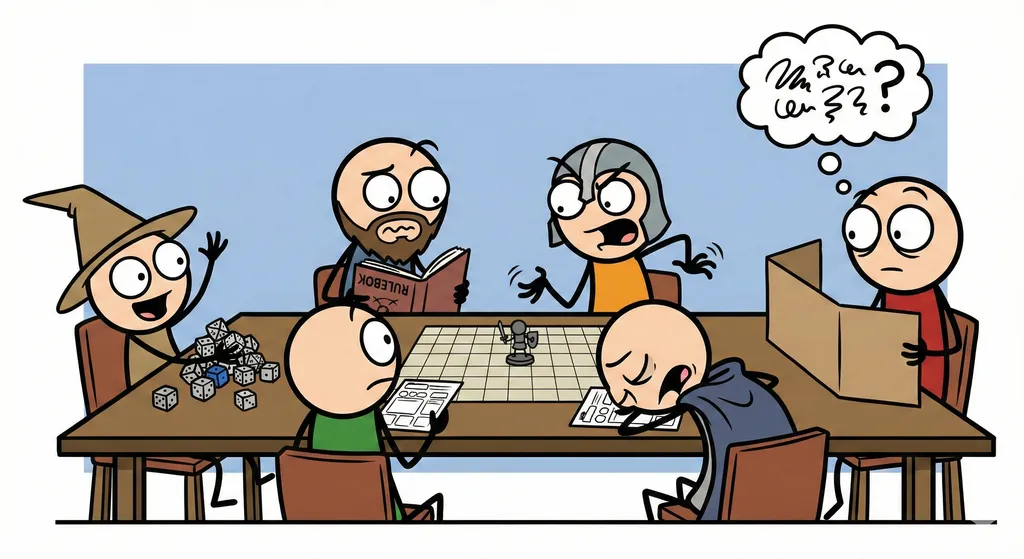
The Game Master’s Handbook of Traps, Puzzles and Dungeons – Archivist’s Edition, published as part of the acclaimed Game Master Series by Zephyr Publishing, isn't just another tome of dungeon dressing; it's a masterclass in challenging player agency and strategic thinking. For those of us who cut our teeth on pit traps and pressure plates, this collection by Jeff Ashworth promises a fresh perspective on the very foundations of TTRPG adversity.
At its core, the Archivist’s Edition dissects the anatomy of a challenge. It moves far beyond the 'roll for damage' trap, instead offering frameworks for multi-stage hazards that demand tactical thought and resource management. Consider the 'Glyph of Sundering': not merely an arcane explosion, but a trap that shatters light sources, imposes disadvantage on ranged attacks, and summons elemental echoes of shattered rock – a far cry from a simple firebolt. Puzzles, too, are elevated from standalone riddles to integrated narrative challenges. Ashworth provides structures for multi-part conundrums where success isn't just about an Intelligence (Investigation) check, but about deciphering obscure clues, manipulating environment interactables, and often, engaging in social encounters to gather vital information. This isn't about a single DC; it's about a series of cascading decisions. The true genius lies in its modularity. GMs can pluck a concept – say, a 'Mirror Maze of Reflection' – and scale its complexity, adding illusory monsters, teleportation hazards, or even moral dilemmas based on mirrored selves. It offers guidance on balancing these elements, ensuring that even a veteran party of 5th Edition adventurers finds themselves genuinely tested, rather than simply taxed. The book implicitly understands that a truly great trap or puzzle isn't about punishing players, but about presenting interesting choices with meaningful consequences.
Beyond the pure mechanics, the Archivist’s Edition functions as a profound wellspring of narrative inspiration. Each entry, whether a cunning trap or an elaborate dungeon, isn't presented in a vacuum. Instead, it’s imbued with suggestions for its contextual placement, its potential creators, and the history it might represent. A 'Sunken Library' isn't just a collection of waterlogged rooms; it's the drowned archive of a forgotten civilization, its puzzles reflecting their esoteric knowledge, its traps designed to preserve secrets from the unworthy. This approach encourages GMs to weave these challenges directly into the fabric of their world. Imagine a society obsessed with the purity of thought, whose defenses are entirely psychic mazes, or a cult dedicated to entropy, whose sanctuaries are constantly shifting, decaying labyrinths. The handbook nudges GMs to ask 'why?' – Why was this trap built? Who was it meant to deter? What story does this puzzle tell about its architect? This integration elevates encounters from mere obstacles to critical plot points, enriching the campaign's lore and player investment. A particularly fascinating section details how specific monster types might construct their lairs, offering insights into their psychology and preferred methods of defense, transforming a generic goblin cave into a reflection of their crude yet effective tribal cunning.
So, how does the Archivist’s Edition translate to the actual tabletop experience? In short: splendidly. For the Game Master, it's a potent antidote to creative burnout, offering not just ideas, but fully fleshed-out concepts ready for adaptation. It significantly reduces prep time for crafting truly memorable encounters, freeing GMs to focus on the improvisational magic of the session. More importantly, it empowers GMs to construct challenges that genuinely engage players on multiple levels. The 'gotcha' trap, the bane of many a tabletop, is replaced by intricate systems that reward keen observation, clever deductions, and collaborative problem-solving. Players aren't just rolling dice; they're actively debating strategies, combining spell effects, and leveraging their character's unique proficiencies in ways that feel impactful and rewarding. The sense of accomplishment when a party collectively unravels a complex puzzle or navigates a truly deadly dungeon is palpable. It fosters a table where success feels earned, failure feels meaningful, and every encounter feels like a bespoke narrative moment rather than a generic obstacle. This handbook isn't just about making your dungeons harder; it's about making them smarter, more immersive, and ultimately, more fun for everyone involved. Check out the full Game Master Series for even more worldbuilding tools.
Top Pick: The Game Master's Book of Random Encounters
Excellent companion for spontaneous challenges
Check Price on Amazon →Related Stories
Blood Vaults of Sister Alkava: A Masterclass in 5e One-Shot Design
Bill Slavicsek's Blood Vaults of Sister Alkava, published by Kobold Press, delivers a tightly-crafted 5th Edition adventure. This deep dive explores its mechani
D&D's Shifting Sands: From Lamordia's Horrors to Corporate Realities
The latest EN World podcast touched on D&D's gothic horror, the rise of industry unions, and D&D-branded toilet paper. We dissect how these disparate topics ref
The Klein Wand: A Deep Dive into Non-Euclidean Magic
Campaign Mastery's October 2026 Blog Carnival introduced The Klein Wand, an artifact challenging traditional magic item design. We dissect its unique mechanics,