Beyond the Dice: Mastering 40K's Positional Chess Game
Goonhammer's latest "40K Fundamentals" article dissects the critical interplay of movement and positioning in Warhammer 40,000. We examine how these core skills elevate gameplay from mere dice rolls to strategic mastery.
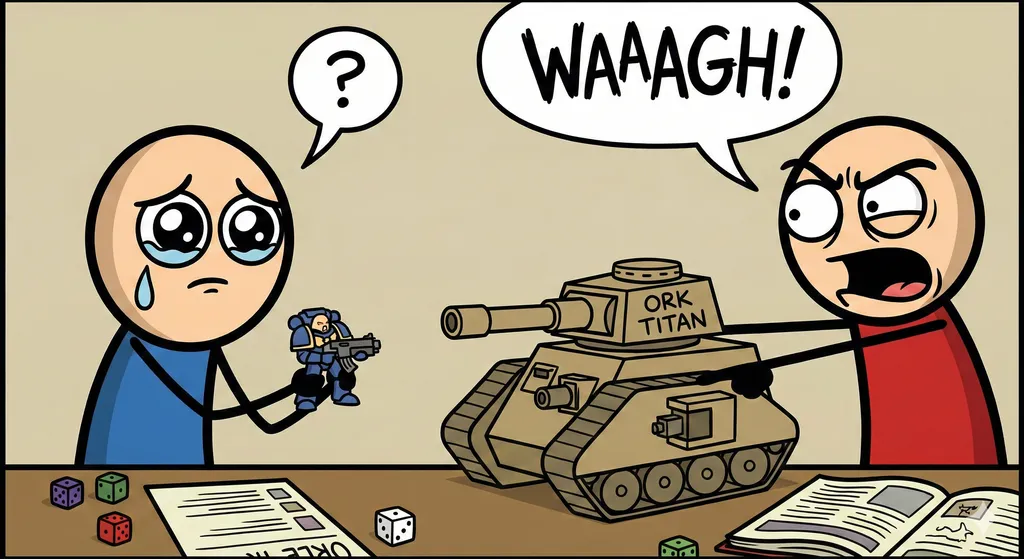
In the grim darkness of the far future, where the roar of bolters and the clash of chainswords define existence, true victory in Warhammer 40,000 isn't always about the biggest gun or the luckiest dice roll. Games Workshop’s venerable war game often boils down to something far more fundamental: the subtle art of not getting shot in the face. This bedrock truth is precisely what Garrett at Goonhammer explores in their latest "40K Fundamentals" piece, "Staging, Developing, and the Subtle Art of Not Getting Shot in the Face," a deep dive into the often-overlooked yet utterly critical skills of positioning and movement.
Goonhammer's analysis cuts straight to the core of 40K's tactical crunch. Unlike a pure skirmish game where every model acts independently, Warhammer 40,000 operates on a grander scale, but individual model and unit placement remains paramount. The Movement Phase isn't just about shuffling plastic; it's a strategic dance where every inch matters. Garrett meticulously unpacks the concept of 'staging' – deploying units in a way that dictates the flow of the early game, setting up advantageous firing lanes, and denying your opponent similar opportunities. This isn't just about moving into cover; it's about understanding threat projection, knowing your units' effective ranges, and positioning them to either deliver maximum firepower or weather an incoming storm. A well-staged unit can control vital objective markers, funnel enemy advances, or provide crucial overwatch.
'Developing,' as the article explains, is the evolution of this initial staging. It’s about adapting to the opponent's moves, creating new threats, and exploiting weaknesses as the game progresses. Consider the intricate interplay of terrain. Obscuring terrain and Dense Cover aren't just visual elements; they are tactical choke points and safe havens that dictate movement paths and engagement ranges. A unit with a 2+ save in cover is a different beast entirely than one caught in the open. Understanding your unit's movement characteristic, advance rolls, and charge ranges allows you to project future threats and anticipate enemy responses. It’s about creating overlapping fields of fire, screening your valuable characters, and ensuring your heavy hitters have clear lines of sight while remaining protected. This layered approach to movement, from initial deployment to dynamic mid-game adjustments, is the real 'chess game' of 40K.
From a lore perspective, this mechanical depth perfectly encapsulates the brutal realities of the Warhammer 40,000 universe. Every battle in the Imperium is a desperate struggle for survival, often against overwhelming odds. Commanders aren't just abstract generals; they are individuals making life-or-death decisions on the battlefield, where a single misplaced squad can mean the difference between holding a vital sector and a catastrophic rout. The emphasis on positioning reflects the grim necessity of tactical acumen in a galaxy where resources are scarce and lives are cheap. A Space Marine Captain doesn't simply charge headlong; he assesses the battlefield, directs his forces to exploit cover, and maneuvers to bring his superior firepower to bear while minimizing casualties. The intricate dance of advance and retreat, the desperate scramble for cover, the calculated risk of an exposed flank – these aren't just rules interactions; they are narrative touchstones that immerse players in the brutal, strategic warfare that defines the 41st millennium. The lore emphasizes the preciousness of every soldier, even in a galaxy of billions, making strategic movement not just a game mechanic, but a visceral representation of a commander's responsibility.
For the veteran player and the aspiring tactician alike, Goonhammer's focus on these 'fundamentals' is an invaluable contribution to the Warhammer 40,000 community. It elevates gameplay beyond the mere rolling of dice and the memorization of datasheets. When players truly grasp the nuances of staging and developing, games become less about who rolled better and more about who outmaneuvered whom. This isn't just about competitive play; it profoundly enhances the narrative experience too. When a meticulously planned flanking maneuver pays off, or a desperate retreat into dense cover saves a key unit, the story of the battle unfolds with far more drama and agency. It fosters a deeper appreciation for the tactical depth Games Workshop has baked into the system, even if it's sometimes obscured by the sheer volume of rules.
This kind of analytical content empowers players to take control of their games, reducing the feeling of helplessness that can sometimes arise from a string of bad rolls. It transforms the tabletop into a true strategic arena, where every decision, every inch moved, contributes to the evolving narrative of battle. Articles like this one are crucial for raising the skill ceiling of the player base, encouraging thoughtful, deliberate play, and ultimately making every game of Warhammer 40,000 Core Book a more engaging and rewarding experience. It reminds us that while the dice introduce an element of chaos, true mastery lies in mitigating that chaos through superior generalship.
Related Stories
10th Ed Meta: T'au's Ascendance & Imperial Surge
Goonhammer's "Competitive Innovations" report highlights T'au's continued dominance in 10th Edition Warhammer 40,000. Surprising strong showings from Salamander
Chaos Ascendant: 10th Edition's Shifting Power Dynamics
Goonhammer's latest competitive breakdown highlights a surge of Chaotic power in Warhammer 40,000. We dissect the tactical brilliance driving this meta shift an
AdeptiCon 2026: Mechanicus' Data-Sync Protocol Elevates the Cog
Games Workshop's AdeptiCon 2026 preview unveiled a potent new detachment for Warhammer 40,000's Adeptus Mechanicus. The 'Omnissian Conclave' introduces intricat