
Beyond the Railroad: Arcane Loreworks' Crossroads Compendium
Arcane Loreworks' new Crossroads Compendium promises to revolutionize adventure design, offering GMs a powerful toolkit to empower player agency. This deep dive explores how its modular framework provides dynamic, emergent narratives for any TTRPG.
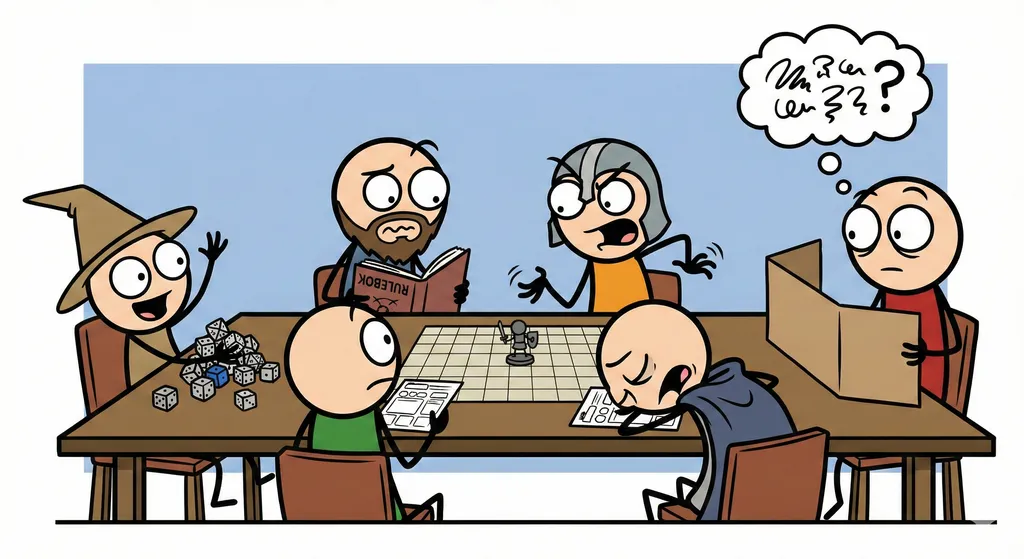
The age-old GM lament of 'how do I avoid railroading?' has a compelling new answer with the announcement of Arcane Loreworks' groundbreaking new release, The Crossroads Compendium: A Generative Adventure Framework.
At its heart, the Compendium isn't a pre-written adventure; it's an elegantly designed engine for emergent narrative. Arcane Loreworks introduces the 'Nexus Node' system, a collection of intricately linked story seeds, character motivations, and environmental triggers rather than a linear plot. GMs select a core conflict, then populate their campaign space with these modular Nexus Nodes. Each node presents a choice, a challenge, or a discovery, and critically, the *players'* actions and decisions directly determine which subsequent nodes activate and how the overarching narrative evolves. For instance, a 'Deserted Outpost' Nexus Node might contain clues to a lost artifact, a hidden cult, or a dangerous predator. The players' approach – stealth, investigation, or direct confrontation – dictates which of these threads become primary, or even if new, unforeseen elements emerge.
The true genius lies in the 'Consequence Matrix' – a series of interlocking tables and prompts that allow GMs to instantly generate reactions to player choices, whether intended or not. Failed skill checks don't just stop progress; they trigger unforeseen complications, new opportunities, or shift allegiances within the world. Success isn't just mission accomplished; it might open up entirely new quest lines or attract unwanted attention. This system, paired with 'Dynamic Threat Scaling,' which adjusts encounter difficulty and stakes based on party composition, previous successes, and even the current emotional tone of the game, ensures that every session feels tailored and responsive. It’s a masterclass in giving GMs the tools to improvise with confidence, transforming abstract player agency into tangible, exciting narrative shifts. Forget static monster blocks; the Compendium offers guidance on evolving antagonists, their motivations shifting in response to the heroes' actions, creating a truly living world. For more detailed insights into its design, check out The Crossroads Compendium on their developer blog.
The 'lore' of The Crossroads Compendium isn't found in a pre-packaged world, but in its profound design philosophy: that the most engaging stories are those forged collaboratively at the table. Arcane Loreworks explicitly states that the framework is genre-agnostic, providing archetypal hooks and adversaries that can be reskinned for high fantasy, grimdark sci-fi, pulpy noir, or cosmic horror with minimal effort. The Compendium provides robust guidance on how to inject existing campaign lore into these modular nodes, effectively making the established world itself a dynamic character rather than a static backdrop. It offers frameworks for creating compelling NPCs whose allegiances and goals shift organically, making them feel genuinely reactive. It’s less about telling *a* story and more about providing the intricate, yet flexible, loom upon which *your* story can be woven, rich with the unique threads of your players' decisions and characters. This approach elevates the GM from a mere narrator to a conductor of emergent epic, celebrating the organic growth of narrative over rigid plotting and fostering a deeper sense of ownership for everyone involved.
So, what does this mean for the table? The fear of 'railroading' often stems from a GM's desire to deliver a satisfying narrative arc, combined with the sheer difficulty of predicting player actions. The Crossroads Compendium doesn't just alleviate this fear; it transforms it into an opportunity. Players will feel genuine agency, knowing their choices have weight beyond a simple binary path, leading to far greater investment and memorable moments. GMs, armed with the intuitive Nexus Node system and the powerful Consequence Matrix, gain the confidence to lean into player improvisation, knowing they have a robust backend to generate meaningful, consistent responses. Prep time, while still necessary for world-building and populating the initial nodes, shifts dramatically from plotting linear events to populating a dynamic space with possibilities and preparing for the *unexpected*. This isn't just another adventure path; it's a paradigm shift in how we approach TTRPG design, fostering truly collaborative storytelling and ensuring every session is unique, even within the same campaign. It's a powerful argument for the emergent narrative, and frankly, it feels like the undeniable future of adventure design for those who prioritize player freedom and GM flexibility.
Top Pick: The Crossroads Compendium
Essential for GMs seeking dynamic, player-driven narratives
Check Price on Amazon →Related Stories
The Faceless Howl: Grimstone Press's Masterclass in Dread
Grimstone Press unveils The Faceless Howl, a horror crawl demanding keen intellect and nerves of steel. This module promises a chilling blend of investigation a
Abyssal Echoes: D&D 5e's Deep Dive Into Submerged Mechanics
Mythic Forge Games' Abyssal Echoes promises to transform aquatic D&D 5e encounters. We dissect its innovative rules for pressure, breath, and movement, and how
Pirate Borg's Humble Haul: A Deep Dive into Grimdark Seas
The latest Humble Bundle offers an unprecedented collection for Pirate Borg, providing a complete arsenal for GMs and players alike. This deal presents a prime