
Beyond the Rulebook: Fueling Your Narrative Engine
The 'You Are What You Eat' philosophy isn't just a truism; it's a foundational principle for every Game Master. We dissect how diverse consumption directly impacts the quality of your TTRPG campaigns.
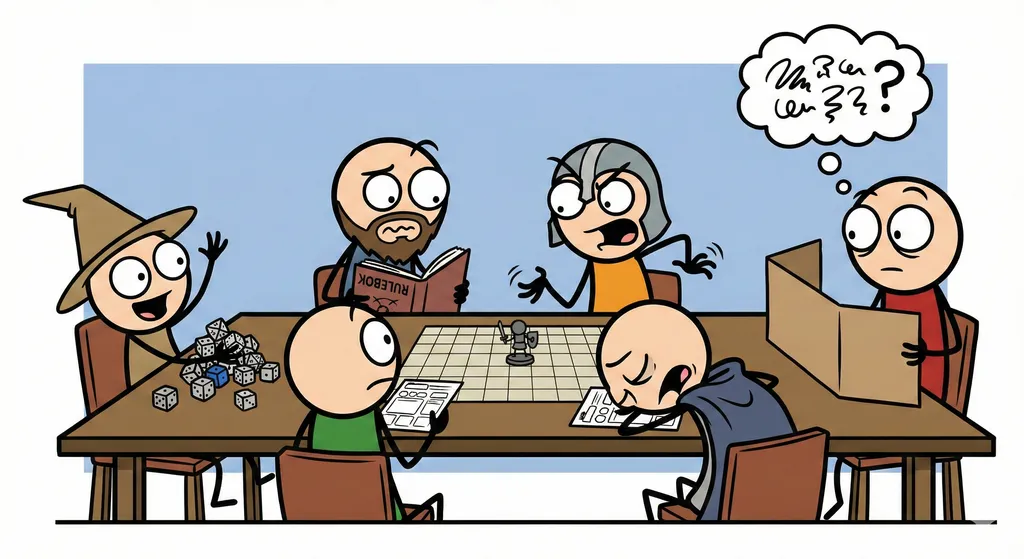
The recent philosophical treatise, 'The Crucible of Narrative: A Game Master's Primer' from Arcane Lorecrafters Inc., isn't a new system in the traditional sense. Rather, it's a profound exploration of the foundational principle behind all compelling TTRPG design: the necessity of consumption for creation. It argues, eloquently and persuasively, that a Game Master's ability to craft engaging worlds, intricate plots, and memorable characters is directly proportional to the breadth and depth of their external influences. This isn't about rote imitation, but about building a rich internal library from which to draw, remix, and innovate.
Let's talk brass tacks – the 'mechanics' of this approach, if you will. The Primer posits that a GM's mind, when properly fed, acts as a sophisticated narrative processor. When designing an encounter, a GM steeped in varied historical accounts might instinctively weave in logistics challenges beyond simple combat, such as supply lines or morale checks influenced by local superstitions. A GM who devours classic literature alongside modern fantasy will possess a broader palette for character archetypes, subverting tropes with a nuanced understanding of their origins. Think of it as an internal 'advantage' roll on every creative challenge: the more diverse the input, the higher the chance of generating truly original output. For example, when building a dungeon, merely thinking about traps and monsters is a novice move. A GM who's read architectural history, urban planning guides, or even survival manuals, will consider ventilation, waste disposal, light sources, and the psychological impact of confined spaces – elements that transform a generic crawl into a living, breathing environment. This systemic intake of non-TTRPG material is a direct boost to your worldbuilding 'stats,' increasing the complexity and verisimilitude of your game without adding a single new die roll. It’s about making your adventure modules less predictable and more organic.
The 'lore' of this consumption philosophy dictates that the richest narratives are not born in a vacuum but are echoes and refractions of countless other tales, histories, and human experiences. Every great fantasy epic draws from mythology, folklore, and historical conflicts. Every compelling sci-fi setting grapples with philosophical questions first explored in ancient texts. The 'Crucible of Narrative' frames this as the GM's personal mythos, a hidden tapestry woven from every book, film, documentary, and even casual conversation they've absorbed. When a player asks about the origin of a strange cult, a GM who's delved into real-world cult psychology, obscure religious practices, or even socio-political movements, can improvise details that feel authentic and deeply unsettling, rather than generic. This isn't about memorizing facts; it's about internalizing patterns, motivations, and the sheer breadth of human (and inhuman) experience. It makes your world feel lived-in, with a depth that extends far beyond the immediate plot points, giving players a sense of genuine discovery.
What does this mean for the table? Everything. A GM who consciously cultivates a wide range of external influences brings an unparalleled richness to their game. Players experience more vibrant settings, encounter more complex NPCs with believable motivations, and navigate plots that twist in genuinely surprising ways. The 'table feel' isn't just about the rules; it's about the intangible sense of immersion, the feeling that the world extends beyond the map and the stat blocks. This approach elevates Game Mastering from merely running a session to a true act of collaborative storytelling, where the GM's well-fed imagination sparks the players' own. It's the difference between a functional game and a truly legendary campaign. For any veteran GM looking to push the boundaries of their craft, or a new GM seeking to establish a robust foundation, this philosophy is not just beneficial — it's essential.
Top Pick: 'The Hero with a Thousand Faces' by Joseph Campbell
Essential reading for understanding narrative archetypes and universal story structures.
Check Price on Amazon →Related Stories
Campaign Pitches: The Unsung Art of the GM
Gnome Stew's 'Pitching Campaigns' offers a masterclass in engaging players from session zero. We dissect the crucial mechanics and lore behind a truly effective
Glyphbound's Shifting Labyrinth: A Dungeon Crawl Reinvented
Labyrinthine Press unveils Glyphbound: Labyrinth of Echoes, introducing a unique species and a groundbreaking rotating dungeon mechanic. This innovative system
Beastkin Bonds: Ironclad Forges Deeper TTRPG Companionship
Ironclad Games' new Beastkin Bonds supplement for Aethelgard Chronicles promises a robust, tactical companion system. We break down the innovative mechanics and