
Chronos Engine: Echoes & Agency in TTRPG Storytelling
Aetherforge Games' Chronos Engine introduces a revolutionary Dynamic Causality System. This mechanic empowers players to collaboratively shape game lore and history.
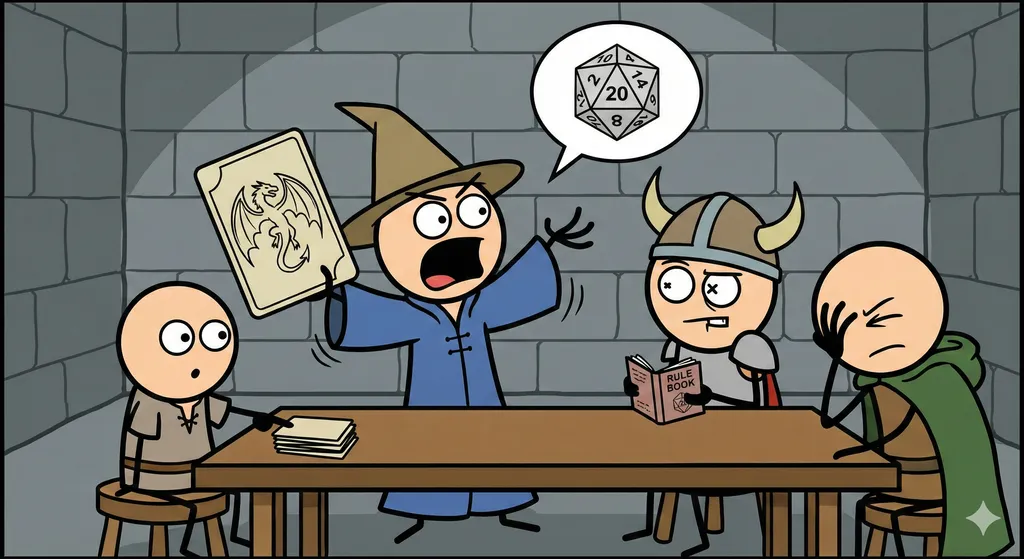
The venerable halls of Aetherforge Games have once again vibrated with innovation, announcing the upcoming 'Chronos Engine: Echoes of the Sundered Star' – a game poised to redefine how we perceive player agency within persistent campaign settings. As a seasoned GM who’s seen countless systems promise a “living world,” I admit a healthy skepticism. Yet, Aetherforge’s new Dynamic Causality System (DCS) isn't just marketing fluff; it's a genuinely intriguing mechanic that merits a deep dive.
At its heart, the 'Echoes System' is a structured resource economy for narrative alteration. It operates on a pool of 'Causality Tokens.' These aren't your typical meta-currency for rerolls or bonus dice. Instead, they represent the accumulated narrative weight of player actions. When a party achieves a critical success against overwhelming odds, executes an extraordinarily creative solution, or makes a choice with profound immediate consequences, the Game Master awards a Causality Token. These tokens are not spent by players for personal gain; they are a communal resource, a testament to the group's collective impact on the unfolding narrative. The true genius emerges at key narrative junctures – the end of a major arc, the defeat of a campaign villain, or the discovery of a pivotal truth. At these moments, the GM, in collaboration with the players, can spend these accumulated tokens to manifest a 'Causal Echo.' A Causal Echo is a retroactive or future-proactive narrative alteration, a tangible shift in the game's established lore or a definitive seed planted for future plotlines. Imagine, for instance, a party consistently using diplomacy to avert conflicts; those accumulated tokens might be spent to reveal a long-lost historical figure was not a warlord, but a master negotiator, altering the foundational myths of a faction. Or perhaps a minor NPC, saved through desperate heroics, is retroactively revealed to be the distant ancestor of a powerful future dynasty, creating a new, player-influenced power broker in the setting. This system is a mechanical underpinning for emergent storytelling, making player choices not just impactful, but *historically significant* within the 'Chronos Engine' universe.
Within the rich lore of 'Chronos Engine: Echoes of the Sundered Star,' the cataclysmic event of the Sundered Star's destruction didn't just shatter a celestial body; it fractured reality itself. The fragments, known as 'chronal echoes,' are not mere memories or temporal distortions, but potential realities, existing in a state of flux until solidified by acts of profound will and power. Player characters in the 'Echoes of the Sundered Star' are often individuals touched by these residual energies, uniquely capable of manifesting these echoes. The game posits that history isn't a fixed ledger but a fluid tapestry, constantly rewoven by the potent deeds and failures of its inhabitants. The Dynamic Causality System provides the in-world justification for this malleability, grounding the mechanics in the very fabric of the cosmos. Players aren't just making choices; they're literally shaping the past and future of the Sundered Star's cosmos, exploring the profound philosophical implications of a universe where truth itself is a consequence of heroic action.
This is where 'Chronos Engine' truly shines at the table. For the Game Master, the DCS provides a robust framework for emergent storytelling, alleviating the immense pressure of inventing every consequence from scratch. The players' own actions, codified by the Causality Tokens, provide the raw material for world-shaping events. It's a structured approach to collaborative worldbuilding that feels organic and earned. For players, the experience is incredibly empowering. Their choices aren't just about overcoming an immediate challenge; they are about etching their legacy onto the very fabric of the game world. No longer are we simply playing *in* a story; we are actively *co-authoring* its very history. This system, with its elegant balance of GM guidance and player agency, pushes beyond the typical “choices matter” rhetoric and delivers a tangible, mechanical method for collaborative worldbuilding that truly resonates. It encourages creative problem-solving and deep roleplaying, knowing that your actions might retroactively define a prophecy or establish a new faction. This feels less like a game and more like a living, breathing chronicle, a testament to what tabletop RPGs can achieve when designers focus on robust mechanics that serve narrative depth. Chronos Engine Core Rulebook is poised to set a new standard.
Top Pick: The Crit Sheet's Worldbuilding Grimoire
For GMs looking to expand their narrative tools beyond the page.
Check Price on Amazon →Related Stories
The One Ring's New Edition & Bestiary: Deeper Shadows for Middle-earth
Free League's acclaimed The One Ring RPG is receiving an updated core experience and a much-anticipated hardcover bestiary. This deep dive explores how these ad
Aethelgard's Simulacra: The Evolution of TTRPG Companions
Mythic Forge Games introduces a groundbreaking companion system in Chronicles of Aethelgard. This deep dive explores how the Simulacra Companion System redefine
Guilded Paths: A Cinematic TTRPG Vision Beyond the Screen
The Guild's crowdfunded film unveils 'Guilded Paths,' a TTRPG designed to extend its narrative universe. We dissect its innovative mechanics and lore, evaluatin