
Competitive Warhammer 40,000: A Deep Dive into the Grimdark Meta
Competitive Warhammer 40,000 offers a rigorous test of strategy and rules mastery, distinct from casual play. This article explores its mechanics, lore context, and whether it's the right fit for your tabletop experience.
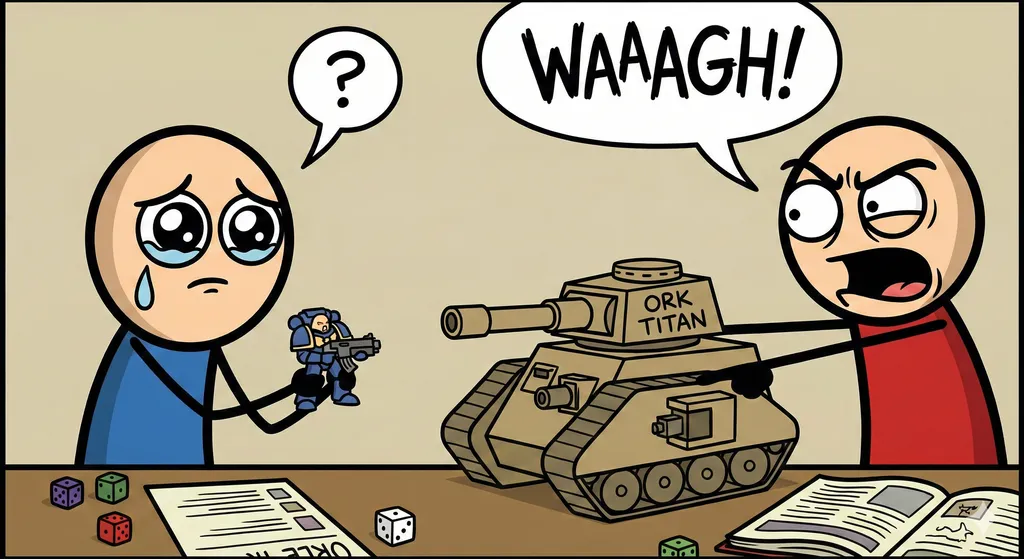
The recent discussions surrounding organized play in Warhammer 40,000 from Games Workshop have reignited a familiar debate within our hobby: what truly defines a “good” game? For many, the first experience with the grimdark future is a relaxed affair, a sprawling narrative unfolding across a kitchen table with forgotten rules and generous take-backs. But as the meta churns and tournament circuits grow, a starkly different facet of the game emerges: competitive Warhammer 40,000.
This isn't your casual, beer-and-pretzels engagement where armies are built for aesthetic appeal or personal whims. Competitive 40K is a rigorous test of strategic acumen, list optimization, and rules mastery, typically adhering to the stringent guidelines of the Grand Tournament (GT) Pack. Armies are meticulously constructed, often chasing the current meta, where every point, every unit, every Warlord Trait and Relic is scrutinized for maximum efficiency. The objective isn't just to table your opponent, but to dominate primary and secondary objectives, often requiring a delicate dance of risk assessment and positional play.
Forget casual rule interpretations; competitive play demands a precise understanding of every stratagem, every core rule interaction, and the nuances of terrain placement. Time limits are strictly enforced, forcing players to execute their turns with efficiency and foresight. The fluidity of “take-backs” evaporates, replaced by a firm adherence to declared actions, demanding a level of focus that can be exhilarating for some and utterly draining for others. It’s a game of inches, where deployment zones become battle lines drawn in blood, and the difference between a minor victory and a crushing defeat often hinges on a single, well-timed charge or a perfectly executed psychic power. This environment fosters a deep understanding of the system, pushing players to explore every tactical permutation and often leading to highly refined, if sometimes homogeneous, army lists.
While competitive play often abstracts the rich narrative of the 41st Millennium into a series of objective markers and scoring matrices, it can also be seen as the ultimate expression of the setting's brutal realism. The endless war, the desperate struggle for survival, the clash of ideologies – these are all sublimated into the strategic choices on the tabletop. An optimized Space Marine list isn't just a collection of powerful units; it represents the cold, calculated efficiency of the Imperium's finest, deployed with surgical precision. A Tyranid swarm, relentlessly advancing and overwhelming, mirrors the terrifying, all-consuming hunger of the Great Devourer.
The competitive arena, in its own way, offers a canvas for players to embody the ruthlessness of their chosen faction. The constant adaptation to new threats (the meta), the desperate struggle for territory (objectives), and the high stakes of each engagement echo the grim and unforgiving nature of the galaxy. It’s a different kind of storytelling, perhaps less personal, but deeply rooted in the core themes of power, conflict, and the brutal calculus of survival. The lore provides the aesthetic and the thematic weight, even when the immediate focus is on dice rolls and command points.
So, is competitive Warhammer 40,000 a worthwhile pursuit? Absolutely, but with a crucial caveat: it is a distinct facet of the hobby, not merely an advanced version of casual play. For those who relish the intellectual challenge of optimizing a list, mastering complex rules interactions, and testing their strategic prowess against equally skilled opponents, the competitive circuit offers an unparalleled experience. The camaraderie found within these communities, the shared pursuit of mastery, and the thrill of high-stakes play can be incredibly rewarding. It fosters a different kind of community, one built on shared ambition and analytical discussion.
However, it's not without its potential pitfalls. The relentless pursuit of the meta can sometimes stifle creativity, leading to “netlisting” and a narrower range of viable army compositions. The pressure to perform can overshadow the joy of the game, transforming what should be a hobby into a demanding second job. Players accustomed to the relaxed pace and forgiving nature of casual games might find the strict timing, unforgiving rule interpretations, and the sheer mental load of competitive play to be overwhelming. It’s essential to approach competitive 40K with a clear understanding of its demands and to manage expectations. It won't always be “fun” in the same way a narrative game is; sometimes it’s a grueling, cerebral contest.
Ultimately, both casual and competitive Warhammer 40,000 offer valid and enriching ways to engage with this incredible universe. Neither diminishes the other. The key is to understand what you seek from your tabletop experience. If you're ready to push your strategic limits and dive deep into the intricate mechanics of the game, the competitive scene offers a formidable challenge. Just remember to occasionally step back, build an army around a cool concept, and roll some dice purely for the narrative. Warhammer 40,000 Core Rulebook
Top Pick: Combat Patrol Boxes
Excellent entry point for both casual and aspiring competitive players, offering balanced forces.
Check Price on Amazon →Related Stories
Nexus of Power: Underworlds' Latest Rivals Deck Unpacked
Goonhammer's review of Warhammer Underworlds: Nexus of Power brings a new strategic layer to the game. This latest Rivals deck promises to shake up the competit
Chaos Rises: 40k's Next Grand Legionary Refresh Looms Large
Whispers of a massive 2026 Chaos refresh for Warhammer 40,000 are circulating, promising new models and rules. We break down what these rumors could mean for th
Splinter, Radical Rat: Unearthing Commander's Newest Sensei
The Spike Feeders showcase a new Commander archetype with Splinter, Radical Rat, stirring the competitive scene. We dissect how this Universes Beyond legend ele