
FARMily Feud: When Homestead Harmony Turns To Cutthroat Chaos
Rustic Realms Publishing’s FARMily Feud injects aggressive player interaction into the cozy farm management genre. This board game challenges players to outmaneuver their siblings for control of the ancestral land.
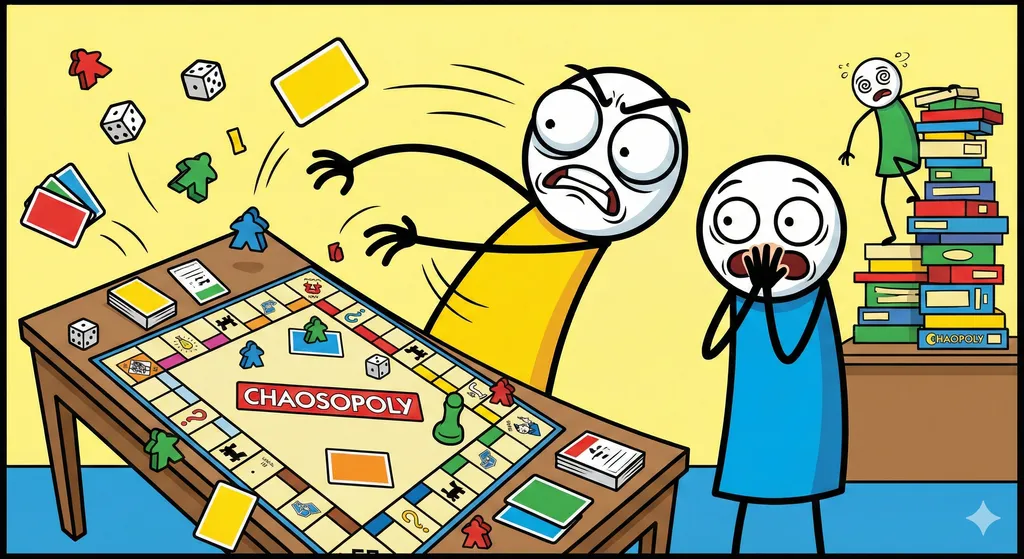
The bucolic dream of inheriting the family farm is a well-worn trope in our hobby, often leading to serene resource-gathering and gentle expansion. But Rustic Realms Publishing’s latest offering, FARMily Feud, isn't just another pastoral management simulator; it's a bare-knuckle brawl over the back forty, a strategic masterclass in sibling rivalry that forces players to confront the true meaning of family… and how much they’re willing to sacrifice to win. As a veteran Game Master, I’ve seen countless games attempt to blend theme and mechanics, but FARMily Feud manages to weave a narrative of bitter inheritance directly into its crunch, making every tractor purchase and every crop harvest a declaration of war.
At its core, FARMily Feud is a worker placement game, but with a twist sharp enough to cut through the thickest family ties. Players start with a small pool of unique family members – their "Siblings" – each possessing a distinct special ability reflecting their personality (e.g., the "Pragmatic Elder" excels at crop yields, the "Conniving Middle Child" at manipulating market prices). The central board represents the ancestral Willow Creek Homestead, divided into various plots: fields for crops, pastures for livestock, the old barn for equipment, and the bustling town square for market actions and local influence. What immediately sets FARMily Feud apart from its gentler peers is the "Dispute Resolution" track. When multiple players place workers on a contested plot, instead of simply blocking, a mini-game of influence or even a dice roll for "Verbal Sparring" ensues. Winning a dispute grants a bonus action or resource, but losing can impose a temporary penalty or even force a worker to return home exhausted. This isn't about efficient engine-building; it's about actively disrupting your opponents' plans.
The real genius lies in the "Legacy Deeds" system. These are public objectives, like "First to harvest 10 Corn" or "Control all Pasture Plots," which grant significant "Legacy Points." However, there are also "Secret Grudges," personal objectives unique to each sibling, often requiring direct interaction or even sabotage against a specific rival. For instance, one sibling might gain points for "Outshining [Another Sibling] in Livestock Production," encouraging targeted competition. This dual layer of public goals and private vendettas creates fascinating strategic tension. Do you openly race for a Legacy Deed, knowing it might reveal your hand, or do you quietly chip away at a Secret Grudge, risking falling behind on the main scoring track? Resource management is tight, with "Family Favor" acting as a crucial currency, allowing players to mitigate negative events, reroll dispute dice, or even activate powerful, one-time "Heirloom" abilities. The market, too, is a volatile beast, with prices fluctuating based on supply and demand, and crucially, on the "Gossip" tokens placed by players in the town square. Spreading rumors about a sibling’s poor harvest can tank their profits, a truly delightful touch of nastiness.
The lore, while seemingly light, is expertly woven into the mechanics. Each sibling's unique ability isn't just a numerical bonus; it tells a story. The "Free-Spirited Youngest" might have an ability to gain a small bonus from *any* plot, reflecting their scattered interests, while the "Obsessive Planner" might get a larger bonus from a single, specialized plot. The very act of contesting a field isn't just about denying resources; it's about claiming the family's heritage, proving who is the rightful successor to Grandpa Elara’s prized pumpkin patch. The "Dispute Resolution" isn’t just a game mechanic; it’s a simulation of those tense, passive-aggressive family dinners where every slight is remembered. The game posits that the true legacy isn't just about wealth, but about who *deserves* to carry on the Willow Creek name, and by extension, who can outmaneuver their kin in a relentless war of wills. This isn't a story of idyllic growth, but of the bitter fight for recognition and control, beautifully rendered through mechanics that reward cunning and foresight.
So, is FARMily Feud good for the game? Absolutely. For players tired of purely solitary engine-building in their Eurogames, FARMily Feud offers a refreshing, albeit confrontational, experience. It forces players to pay constant attention to their rivals, predicting their moves and actively countering them. The asymmetric sibling powers and variable Legacy Deeds ensure high replayability, and the "Gossip" and "Dispute" mechanics provide ample opportunities for memorable, table-flipping moments (metaphorically, of course). It's a game that encourages robust table talk, strategic alliances of convenience, and delicious betrayals. While it might not appeal to those seeking a purely cooperative or low-interaction experience, for anyone who relishes a direct, competitive Eurogame with a strong narrative backbone, FARMily Feud is a masterclass. It's a game about family, yes, but more accurately, it's about the brutal, beautiful chaos that ensues when family stands in the way of ambition. For a truly unique blend of strategic depth and thematic conflict, consider delving into the family drama. a strategic twist
Top Pick: Scythe
For another Eurogame that masterfully blends asymmetric player powers with direct conflict and area control.
Check Price on Amazon →Related Stories
Mythic Baths: Ghibli's Spirited Away Comes to the Table
Karl Lange's Mythic Baths brings the enchanting world of Studio Ghibli's Spirited Away to life as a board game. Players manage the iconic bathhouse, fulfilling
Revenant's Material Ascension: Mindclash Redefines Tabletop Presence
Mindclash Games' Revenant, particularly its Admiral Edition, emerges as a masterclass in component design and integrated storage. This deep dive explores how it
Catan on the Road: Can the Empire Finally Go Truly Portable?
The venerable classic, Catan, attempts once more to shrink its sprawling empire into a genuinely portable format. This new iteration promises to solve the space