
Grant Howitt's 40k Fan Game: Slapstick, Gore, and Giggles
RPG innovator Grant Howitt has unleashed a free Warhammer 40,000 fan game, transforming the grimdark into glorious slapstick. Dive into a deathmatch where Space Marines meet absurd, narrative-driven chaos.
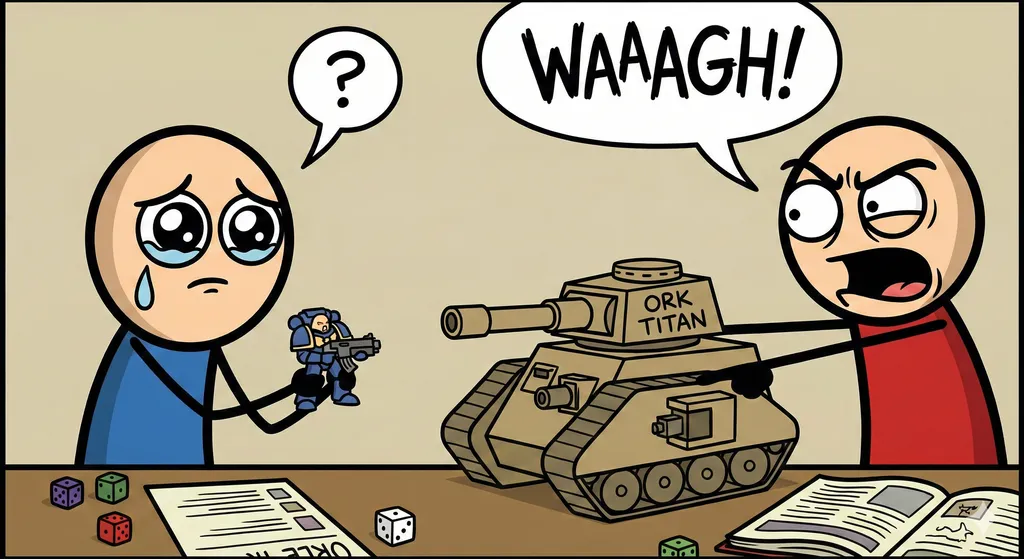
The Crit Sheet has been abuzz, and rightly so, with news of RPG innovator Grant Howitt's latest foray into fan content: "Space Marine Deathmatch," a free Warhammer 40,000 fan game that promises pure, unadulterated slapstick carnage. This isn't just another homebrew; it's a masterclass in subversion, taking the grimdark antiheroes of the Imperium and plunging them headfirst into a maelstrom of comedic misfortune. Howitt, a designer renowned for his ability to distil complex concepts into elegantly simple, narrative-first mechanics, has once again proven that sometimes, the most profound insights come from the most absurd premises.
At its core, Space Marine Deathmatch is a testament to minimalist design, echoing the streamlined brilliance of Howitt’s previous works like Honey Heist. Players embody a genetically engineered super-soldier, a Space Marine, whose inherent perfection is constantly at odds with the chaotic, often ridiculous, circumstances of the "deathmatch." Forget intricate stat blocks; your Marine is defined by two primary attributes: "Zeal" and "Discipline." Zeal drives heroic feats; Discipline maintains tactical composure. Actions are resolved with a single d6 roll, aiming for a 4+ after adding the relevant stat. The narrative twist is key: a critical success on Zeal might mean power-fisting an opponent through a wall, but a critical failure could mean declaring loyalty to a discarded cultist banner. A failed Discipline check won't just miss; it might result in discharging your bolter into scenery, or slipping on a greasy Ork squig. The game replaces traditional hit points with "Humiliation" tokens. Accumulate too many, and your Marine is not merely defeated but utterly disgraced, forced to perform some demeaning act before being "removed" from the field. It’s a brilliant inversion of grimdark lethality, trading fatal blows for ego-shattering pratfalls. A "Glitch" mechanic further cements the slapstick ethos, forcing temporary, hilarious personality quirks or impediments. This game is less about strategic positioning and more about describing the most gloriously inept way your Space Marine can stumble into victory or ignominious defeat. For those who appreciate Grant Howitt's other indie gems, this design philosophy will feel instantly familiar and wonderfully executed.
The lore subversions are where Space Marine Deathmatch truly shines. Warhammer 40,000 is defined by its unrelenting grimdark and brutal gravitas. Space Marines are the Emperor's Angels of Death. To place these iconic figures in a scenario where their greatest threat is their own clumsiness or an uncontrollable urge to emote inappropriately is genius. This isn't disrespectful mockery; it's a playful deconstruction, highlighting the inherent absurdity beneath hyper-serious settings. Imagine a stoic Ultramarine, mid-battle, overcome by giggles from a "Glitch" token, or a Blood Angel, in the Black Rage, attempting a Rubik's Cube with a power fist. The game thrives on this juxtaposition, using the established weight of the 40k universe as the perfect comedic anvil. It’s a delightful thought experiment: what happens when the most fearsome warriors are forced into situations demanding physical comedy over tactical genius? The deathmatch setting is often vague, allowing GMs to conjure absurd scenarios, from a 'friendly' training exercise gone awry to a bizarre Inquisitorial test.
So, is Space Marine Deathmatch good for the game? Absolutely, though not for traditional Warhammer 40,000 competitive play or serious campaigns. It is, however, an unparalleled experience for one-shots, convention games, or a refreshing palate cleanser. Its low barrier to entry, mechanically and financially (being free!), makes it incredibly accessible. It fosters highly collaborative, improvisational play, encouraging players to embrace absurdity and contribute to the comedic narrative. For veteran GMs seeking levity, or groups exploring the lighter side of the grimdark, this fan game is a revelation. It reminds us that even hallowed settings benefit from irreverent humor, proving the robustness of the Warhammer 40,000 universe. It's a game that doesn't just ask "What if?" but shouts "Why not?!" delivering a surprisingly satisfying answer. It’s a testament to community creativity, demonstrating how fan works can enrich an IP without diminishing its core appeal.
Related Stories
Infernal Descent: When Hell Becomes Alien
Umbral Codex Games unleashes 'Infernal Descent,' a TTRPG supplement that twists Dante's classic journey into a terrifying cosmic horror odyssey. This deep dive
Daggerheart's Sweet Resistance: Community Mechanics for a Grim World
Daggerheart, Darrington Press's burgeoning TTRPG, is seeing its community flourish with innovative homebrew. 'A Sweet Resistance' introduces mechanics for colle
Dark Conspiracy: When the Mundane Breaks Under Eldritch Dread
Dark Conspiracy promises a return to gritty urban horror, where extra-dimensional threats bleed into our reality. We dissect its mechanics and lore to see if it