
Hammanaroth: The Enduring Heart of Collaborative Homebrew
The 'Who's On First Watch' podcast showcases Hammanaroth, a homebrew world built by friends over decades. This deep dive explores how shared creation fuels the most enduring TTRPG experiences.
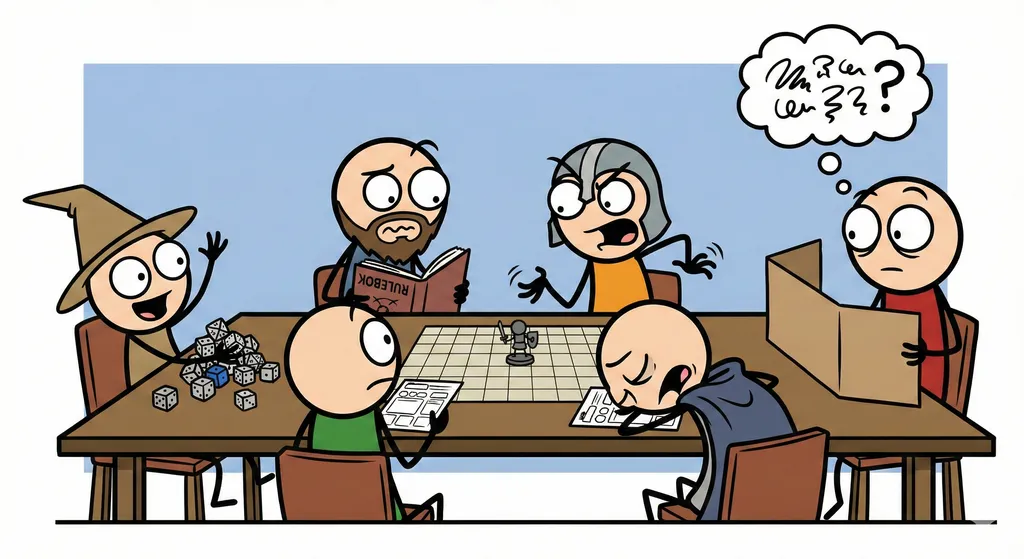
While many chase the latest official releases, the true spirit of tabletop roleplaying finds its most vibrant expression in community-driven creativity, a truth brilliantly underscored by the 'Who’s On First Watch' podcast and its sprawling homebrew world, Hammanaroth.
Born from the decades-long collaboration of Australian friends Richard and Shawn, Hammanaroth isn't just a setting; it's a testament to the power of shared imagination. This isn't some corporate-mandated IP; it's the raw, unadulterated joy of making things up together, a process that every veteran Game Master recognizes as the true crucible of unforgettable campaigns.
Forget rigid stat blocks or pre-defined encounter tables for a moment. The *mechanics* at play in the creation of Hammanaroth, and subsequently, the 'Who’s On First Watch' narrative, are far more fundamental: they are the very engine of collaborative storytelling. This isn't about a specific d20 roll or a clever Advantage/Disadvantage system; it's about the *social contract* of play and the iterative design loop inherent in truly bespoke settings. When Richard and Shawn built Hammanaroth, they weren't just sketching maps; they were codifying a shared reality, continually testing its boundaries through play. What rules govern this? It's the implicit rule of 'yes, and…' applied to world-design, the constant process of suggestion, integration, and refinement. A player's character concept might inspire a new faction, complete with internal politics and unique abilities. A throwaway line about a local deity blossoms into a pantheon with its own domain spells and sacred rites. The 'new game' mentioned as their catalyst likely wasn't a commercial product, but rather a refined *approach* to their homebrew, a set of agreed-upon principles for how ideas were introduced, vetted, and integrated into the Hammanaroth canon. This is the crunch of *creative consensus*, the most powerful engine in any TTRPG. It demands active listening, flexible interpretation, and a willingness to let go of individual ownership for the sake of a richer, shared tapestry. For GMs, this means developing a keen sense for when to adjudicate and when to cede narrative ground, fostering player investment not just in their character's journey, but in the very fabric of the world they inhabit. It's the meta-game of system design, played out in real-time, adapting and evolving with every session.
From a lore perspective, Hammanaroth is a masterclass in organic worldbuilding. It isn't a setting born from a committee or market research; it's a living document of two friends’ shared cultural touchstones and imaginative flights. The 'homages to favourite' pop-culture elements aren't mere Easter eggs; they are foundational pillars, recontextualized and re-envisioned within the Hammanaroth cosmology. This approach creates a world that feels both familiar and utterly unique. Players entering Hammanaroth aren't just engaging with a fictional history; they're stepping into a narrative space imbued with decades of personal investment. This deep, personal connection translates into tangible verisimilitude at the table. When the creators genuinely *love* the stories and characters, that passion bleeds into every description, every NPC interaction, every world-shaking event. It’s the difference between a meticulously constructed museum piece and a beloved, lived-in home. This intimate lore offers GMs a wealth of hooks, not just because it’s detailed, but because it’s *meaningful* to its originators, and by extension, to the audience of 'Who’s On First Watch' who now get to explore it.
What does the Hammanaroth phenomenon, and the 'Who’s On First Watch' podcast, mean for your own table? It’s a resounding affirmation of the power of collaborative creation. In an era often dominated by pre-packaged settings and meticulously balanced systems, this story reminds us that the most memorable, most *personal* campaigns are often those where the players and GM are co-authors. This isn't just about 'playing a game'; it's about co-creating a legend. The table feel here is one of deep ownership and emergent narrative. When players contribute to the world's lore, suggesting new cities, ancient ruins, or even entire cultures, the stakes become profoundly personal. Every victory feels more earned, every loss more poignant, because a piece of *them* is intrinsically woven into the fabric of the story. It cultivates a sense of shared discovery and collective pride that even the most brilliantly written pre-written modules struggle to replicate. For Game Masters, it’s an invitation to loosen the reins slightly, to trust in the collective creativity of their group, and to embrace the beautiful chaos of emergent gameplay. It’s about building a living, breathing world together, rather than merely uncovering one. The longevity of Hammanaroth – four decades of inspiration culminating in a vibrant podcast – speaks volumes about the enduring appeal of a world built from love, not just rules. This is the heart of the hobby, beating strong, and a potent reminder that the best adventures are often the ones we craft ourselves, together, at the table.
Top Pick: The Tome of Ultimate Mapping
For GMs looking to bring their homebrew worlds to life with clear, evocative maps.
Check Price on Amazon →Related Stories
Unions at the Table: Echoes of the Spire's Radical Design
Ardent Forge Games' Echoes of the Spire introduces groundbreaking 'Collective Action' mechanics, challenging traditional TTRPG power structures. We delve into h
Aetherium's Void Echoes: Skirmish Goes Narrative RPG
Vanguard Miniatures' Aetherium Skirmish Tactics gets a massive campaign expansion, "Echoes of the Void," adding persistent progression and GM-driven narrative.
Dungeon Cube: A Rubik's Labyrinth Reimagines Exploration
Nicolò Chioato's Dungeon Cube concept turns the Rubik's Cube into a dynamic dungeon. This innovative idea marries spatial puzzle-solving with narrative explorat