
Magic's 'Goodwill Collection': A Confounding Altruism?
Wizards of the Coast's latest reveal, the 'Most Confusing Goodwill Collection' for Magic: The Gathering, introduces mechanics that challenge traditional competitive play. We dissect how this counter-intuitive design might reshape the game's social contracts and strategic depth.
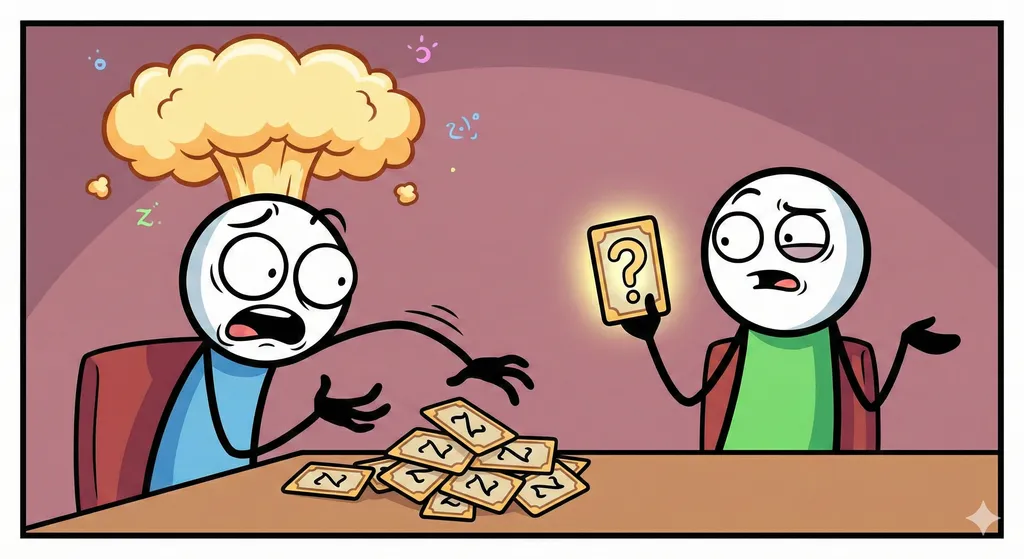
The recent announcement from Wizards of the Coast regarding Magic: The Gathering's 'Most Confusing Goodwill Collection' has certainly stirred the cauldron of community speculation, leaving many veteran Planeswalkers scratching their heads. As a publication dedicated to dissecting the very sinews of tabletop gaming, The Crit Sheet is here to cut through the corporate fog and examine what this peculiar product means for our tables.
At its core, this 'Goodwill Collection' appears to revolve around a new keyword ability, 'Benevolent Bargain.' On paper, the concept is simple, yet in practice, it’s a Gordian knot of player interaction. Cards featuring Benevolent Bargain often present a powerful effect coupled with a cost that, remarkably, *benefits an opponent*. For example, imagine a potent removal spell that reads: 'Benevolent Bargain (You may sacrifice a permanent. If you do, target opponent draws a card.) Destroy target nonland permanent.' Or a creature with 'Whenever ~ attacks, you may pay 2. If you do, target opponent gains 3 life, then you draw a card.' The design space here is deliberately adversarial altruism. Players are asked to weigh the immediate benefit to themselves against the often-unpredictable advantage granted to a rival. This isn't the simple politics of multiplayer Commander; this is a forced, often awkward, act of kindness that feels less like a strategic choice and more like a social experiment. How do you leverage a mechanic that actively empowers your opponents? Is the primary effect truly worth the cost of fueling another player's engine? It's a fascinating, if perplexing, departure from the usual zero-sum game theory Magic players are accustomed to, especially within the tight margins of competitive Modern or Pioneer. The nuance lies in discerning when a 'gift' is actually a poisoned chalice for your opponent, or when your own gain far outweighs their incremental advantage. The most powerful iterations seem to be those that allow you to choose *which* opponent benefits, enabling surgical kingmaking or targeted diplomacy that could swing entire games.
Lore-wise, the 'Goodwill Collection' seems to hail from a previously unexplored shard of Alara, perhaps a plane where acts of 'benevolence' are tied to powerful magical energies, or where a peculiar, parasitic form of reciprocity dictates social and arcane contracts. Imagine a society built on forced communal benefit, where every powerful spell requires a tithe to a rival house, or where personal strength is paradoxically linked to the empowerment of others. This narrative framework attempts to justify the mechanics, painting a picture of a world where 'goodwill' is not necessarily altruistic, but rather a complex, sometimes sinister, form of social control or magical obligation. Perhaps a new faction of 'Pact Weavers' or 'Symbiont Mages' emerges, their power derived from these strange, reciprocal enchantments. It’s a compelling, if slightly unsettling, flavor, echoing themes of mutualism and forced cooperation in a multiverse often defined by conflict and individual ambition.
So, what does this mean for the table? 'The Most Confusing Goodwill Collection' is, without a doubt, a high-risk, high-reward design venture. For casual players, particularly in the Commander format, it introduces a whole new layer of political maneuvering. Imagine the table talk: 'I'll give you a card if you don't attack me next turn!' or 'If I let you draw, will you help me deal with the player who just cast their new Commander precons?' It could lead to incredibly dynamic, memorable games filled with surprising alliances and betrayals. However, for competitive players, the mechanic presents a significant hurdle. Optimizing a deck around intentionally benefiting an opponent requires a level of meta-understanding and threat assessment that few mechanics demand. It risks feeling clunky, counter-intuitive, and potentially frustrating if the 'goodwill' costs consistently outweigh the benefits, or if it leads to un-fun kingmaking scenarios. The cards will require careful piloting and even more careful deck construction to ensure that the 'altruism' is always a net positive for the player casting the spell. Ultimately, while confusing, the collection pushes the boundaries of Magic's social contract and offers a fresh, albeit challenging, strategic paradigm.
Top Pick: Commander Legends: Battle for Baldur's Gate
Excellent for exploring multiplayer politics and intricate player interactions
Check Price on Amazon →Related Stories
Strixhaven's Final Scrolls: Unearthing Arcane Power
The final wave of Secrets of Strixhaven spoilers has dropped, revealing potent mythics and rares that promise to reshape spellcasting strategies across formats.
Strixhaven's Hidden Synergies: New Commander Decks Revealed
Wizards of the Coast has unveiled the 'Secrets of Strixhaven Commander Decklists,' promising fresh takes on the beloved magical academy. These new preconstructe
Jackpot Collection: A High-Stakes Wager on MTG's Future
Wizards of the Coast unveils the "We Hit the Jackpot Collection," a bold new venture into high-risk, high-reward gameplay. This release introduces a thrilling n