
Monopoly's True Strategy: Unmasking the Forgotten Rules
Monopoly often gets a bad rap, but is it the game or how we play it? This deep dive explores how forgotten rules fundamentally alter the experience, revealing a strategic core often obscured by common house rules.
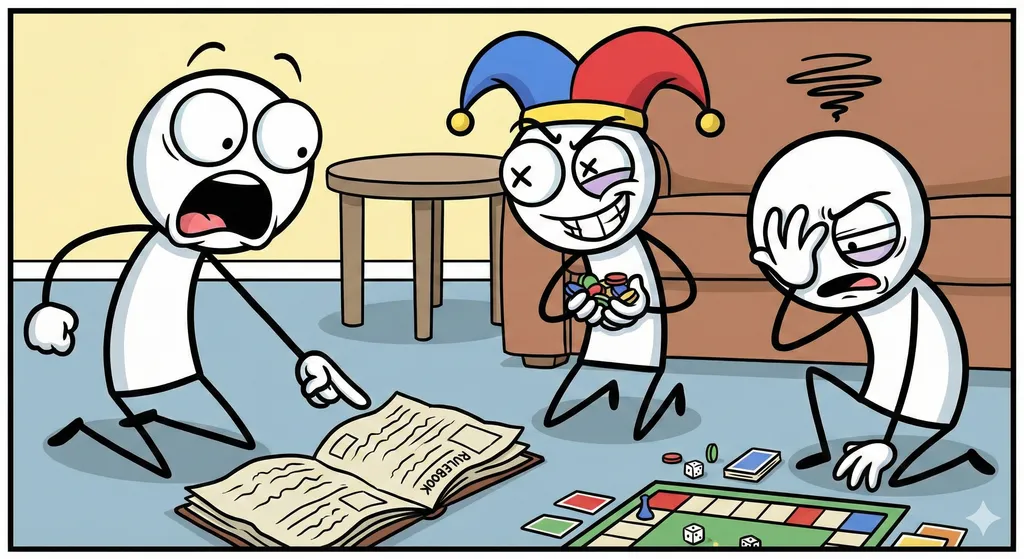
The perennial table-splitter, Monopoly, published by Parker Brothers (now under Hasbro), recently sparked a familiar debate in a Slate article, questioning if we've been playing it "wrong all along." As a seasoned Game Master, the notion of established house rules completely overshadowing a game's intended design is a fascinating, if sometimes frustrating, phenomenon. It’s a testament to the organic evolution of play, yet often a disservice to the meticulous (or, in this case, surprisingly robust) mechanics beneath the surface. For too long, Monopoly has languished in the purgatory of "games we only play at holidays," its true strategic depth buried under layers of well-meaning, yet game-breaking, tradition.
The core mechanical divergence, the one that fundamentally shifts Monopoly from a drawn-out slog to a cutthroat economic engine, lies in the auctioning of unpurchased properties. When a player lands on an unowned space and declines to buy it, the property isn't just skipped; it immediately goes up for auction to all players. This single rule injects a dynamic, aggressive layer of economic strategy, ensuring properties are snapped up quickly, draining player cash, and kickstarting the building phase far sooner than most players ever experience. The game's scarcity isn't artificial; it's a direct consequence of this rule, forcing players to make critical decisions about their finances and property portfolios from the very first circuit of the board. It transforms passive dice-rolling into active engagement, where every player is constantly assessing value and risk, even on another's turn.
Furthermore, the infamous "Free Parking Jackpot" is, in the official rules, just that: a free space. No accumulated taxes, no get-out-of-jail fees collected, just a moment of respite. This seemingly minor detail is crucial. It prevents an arbitrary influx of cash that can prolong the game indefinitely, distorting the carefully balanced economy and stretching playtime to excruciating lengths. Without this cash injection, players cannot simply weather the storm of high rents; they must engage in aggressive property development and strategic negotiation to survive. The true strategic depth of Monopoly emerges when players understand the power of monopolies (pun intended) and the rapid escalation of rent with houses and hotels. It's not just about collecting sets; it's about leveraging those sets to build rapidly and bankrupt opponents, a race against the bank and each other that's far more brutal and swift than the casual player ever realizes. This is where the game turns from a simple dice-roller into a negotiation and resource management challenge, where every dollar counts and every property is a potential weapon in an increasingly tight economy.
The lore of Monopoly is as rich and surprising as its hidden mechanics. Far from being a celebration of cutthroat capitalism, its original iteration, 'The Landlord's Game,' designed by Elizabeth Magie in 1903, was intended as a pedagogical tool to expose the inherent unfairness of land monopolies and single taxation. It had two sets of rules: a 'monopolist' set and an 'anti-monopolist' set, the latter rewarding wealth creation for all. The version we know today evolved, ironically, into the monopolist set, stripped of its original didactic counterpoint. This historical context highlights the game's inherent tension: is it a critique or an embrace of its namesake? The pervasive nature of house rules, particularly the 'Free Parking jackpot' and the 'no auctioning' rule, speaks volumes about how communities adapt and sometimes soften the edges of competitive games. Perhaps it’s a subconscious attempt to reintroduce some of the 'fairness' or communal sharing that Magie’s original anti-monopolist rules sought to emphasize, even if it ultimately breaks the game’s intended flow and strategic depth. It’s a fascinating case study in folk mechanics, passed down through generations, often without understanding their systemic impact, transforming a game that was meant to be a sharp lesson into a meandering pastime. For those interested in the foundational mechanics, exploring The Landlord's Game is a rewarding experience.
For the veteran player, the 'true' Monopoly experience is a revelation. It transforms a game often derided for its interminable length and reliance on luck into a brisk, strategic skirmish of economic leverage and calculated risk. The auction mechanic forces early engagement and tough choices, while the absence of the Free Parking handout maintains a tighter economy, accelerating bankruptcy and bringing the game to a decisive conclusion. It’s less about surviving an endless grind and more about dominating the board through shrewd property acquisition and aggressive development. The player agency is significantly increased. Instead of passively waiting for properties to land, players are actively bidding, negotiating, and strategizing from the first turn. This sharpens the competitive edge, making every turn, every dollar, every decision impactful. For those who dismiss Monopoly as a relic, a single session played by the *actual* rules is often enough to convert them. It becomes a legitimate economic engine, a game about calculated risk and ruthless efficiency, rather than a test of endurance against the dice. It reveals a surprisingly elegant design, often obscured by generations of well-intentioned, but ultimately detrimental, modifications. It’s time to dust off the rulebook, gather your fellow strategists, and rediscover the game as it was meant to be played.
Top Pick: Monopoly Deluxe Edition
For the crisp, clear ruleset and classic components
Check Price on Amazon →Related Stories
Taco Cat Swerves Left: Go! Go! Go Kart's Board Game Debut
Taco Cat Games, known for rapid-fire card games, makes a strategic pivot with their new board game, Go! Go! Go Kart. We dissect its mechanics and lore to see if
President Maker: Unpacking the Korean Election's Strategic Core
Bonghwan Ju's President Maker brings the intricate world of South Korean presidential elections to your tabletop. We analyze its mechanics and thematic depth to
Hell of a Deal: Smirk & Dagger's Gen Con Coup
Smirk & Dagger's Hell of a Deal wasn't just a hit at Gen Con; it was a phenomenon, selling out twice over the weekend. This deep dive examines how a 'poker game