
Out of Sorts: The Cooperative Conundrum of Categorization
Out of Sorts redefines the 'memory game' by shifting focus from recall to collaborative debate. Players organize an alien library, arguing over abstract symbols and their subjective meaning, fostering joyous social interaction.
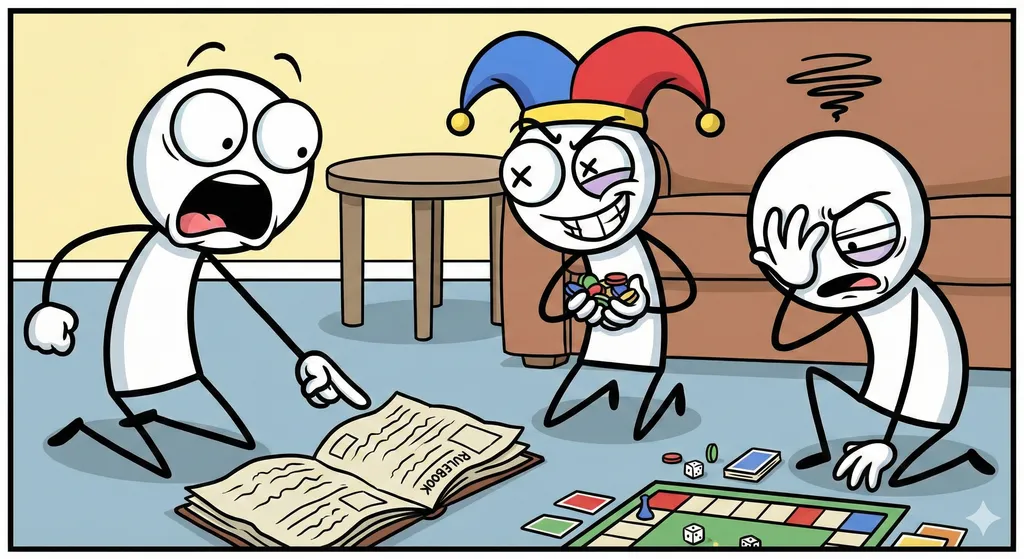
Out of Sorts, a cooperative title from the minds that understand social dynamics, stands as a fascinating counter-narrative to the very genre it purports to inhabit. Forget what you think you know about memory games; this isn't about rote recall. It's about the joyous, often frustrating, and ultimately profound act of collective interpretation.
At its core, Out of Sorts presents players with a deceptively simple task: organize an alien's chaotic archive of abstract symbols. The 'crunch' isn't in remembering where the 'squiggle-with-a-line' card was, but in collectively determining where it *belongs*. Each card features a unique, often bizarre, abstract illustration, devoid of explicit labels or context. The game then introduces a set of three fluid, often arbitrary criteria—perhaps 'Reptile,' 'Travel,' and 'Emotion'—which serve as the thematic pillars for your sorting efforts. These categories are not fixed, but rather chosen or revealed dynamically, adding another layer of interpretive challenge.
The real gameplay emerges in the passionate debate that ensues. A card depicting a swirling vortex might, to one player, unequivocally represent 'Travel,' its motion undeniable. To another, its chaotic energy screams 'Emotion,' a maelstrom of feeling. A third might even perceive a reptilian eye in its intricate pattern, forcing a re-evaluation. Players must, through discussion, persuasion, and shared understanding, come to a consensus on the placement of each symbol within the designated categories. There are no right or wrong answers dictated by the game itself, only the collective truth forged at your table. This isn't a game of perfect information; it's a game of shared, imperfect *perception* and collaborative meaning-making. The victory condition isn't about matching hidden pairs or achieving a pre-ordained order, but about successfully categorizing a set number of symbols to the group's satisfaction, often within a time limit or before a certain number of 'disagreements' or 'misplaced' items are logged, pushing the tension and the need for consensus.
The narrative framing of Out of Sorts is as delightfully peculiar as its mechanics. You and your fellow players are not intrepid space explorers or scholarly archivists; you are abductees. A 'seafoam green monstrosity' has plucked you from your mundane existence, not for probing or nefarious experiments, but to sort its library. This alien, whose motivations remain delightfully opaque, seemingly values human subjectivity above all else. Its own understanding of categorization might be so alien as to be incomprehensible to us, or perhaps it finds beauty in the chaos of our diverse interpretations.
This setup elevates the game beyond a mere puzzle. It transforms the act of sorting into a cross-cultural communication challenge, a desperate attempt to impose human order (or disorder) onto an alien system. Are you being tested? Are you merely tools for a grander, inscrutable purpose? The lack of explicit answers only deepens the lore, pushing players to invent their own context for the bizarre task at hand, naturally weaving a collaborative story around the abstract symbols and the peculiar abductor.
The genius of Out of Sorts lies in its ability to leverage the façade of a memory game to deliver a truly exceptional cooperative experience. This isn't a game you play silently, diligently flipping cards. This is a game of vibrant, often uproarious, discussion. It's about the nuances of language, the power of persuasion, and the fascinating ways different minds interpret the same stimuli. It's a deep dive into semiotics, cloaked in a lighthearted, alien abduction scenario.
For Game Masters, this design offers a masterclass in emergent narrative and player engagement. The 'story' isn't pre-written; it's the passionate argument over whether a jagged line is more 'Danger' than 'Art.' It's the moment a player, through sheer rhetorical prowess, convinces the entire table that a series of seemingly random dots is clearly 'Music,' despite initial skepticism. This kind of interaction fosters genuine bonds and unforgettable 'table moments' far more effectively than any rote memorization ever could. It's a game that respects player agency and creativity, turning a potential chore into a joyful, collaborative storytelling engine. It’s a refreshing palate cleanser for tables burnt out on competitive conflict or overly complex rule sets, inviting everyone to simply *talk* and *create* together. If you enjoy games that spark conversation, reveal insights into how your friends' minds work, and celebrate the beauty of subjective interpretation, Out of Sorts is an essential addition to your shelf. It’s a compelling reminder that the most profound tabletop experiences often come from the most unexpected places, challenging our preconceptions of what a 'game' can be. For another cooperative experience that thrives on player interaction and shared problem-solving, consider The Crew: Mission Deep Sea.
Top Pick: Codenames
For its brilliant use of abstract concepts and social deduction in a cooperative/team setting.
Check Price on Amazon →Related Stories
Not Alone: Remastered – A Masterclass in Asymmetrical Tension
Geek Attitude Games' Not Alone: Remastered Edition sharpens the claws of its asymmetrical survival horror. Players navigate a treacherous alien world, desperate
Alliances: Night of the Goblin Unmasks Co-op Potential for MCP
Atomic Mass Games takes its beloved skirmish system cooperative with Night of the Goblin, a new Alliances standalone. This deep dive examines if the spin-off ca
The Mists of Barovia: Horrified's D&D Tabletop Take
Ravensburger's Horrified series ventures into Dungeons & Dragons' iconic Ravenloft, bringing Barovia's horrors to your tabletop. Designed by Peter Lee and Nick