System's Whispers: Unpacking Design Intent for Better Tables
Gnome Stew's Gnomecast 248 dissects how game mechanics shape our stories. Understanding a system's core purpose transforms both GMing and player experience.
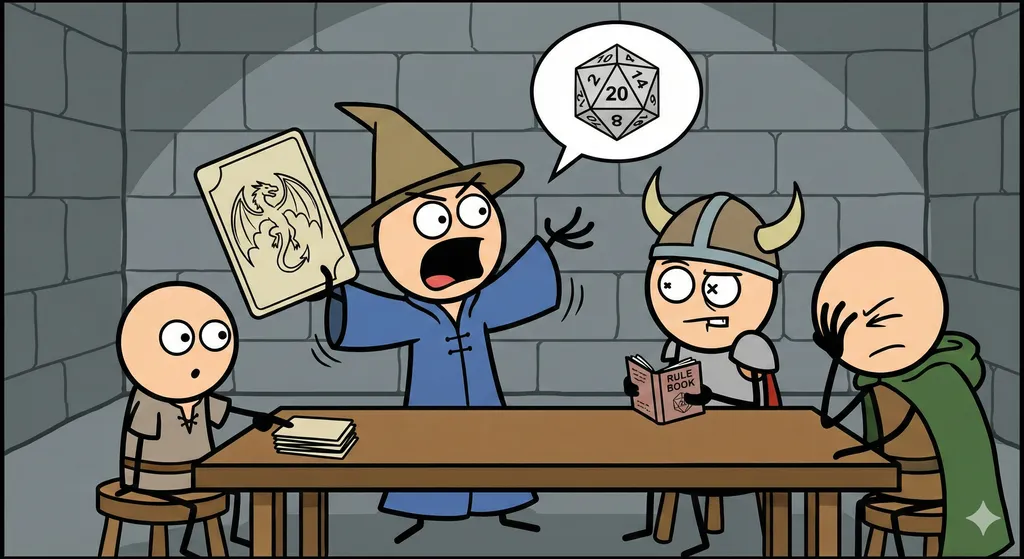
The recent discourse sparked by Gnome Stew's Gnomecast 248, "What the System Wants," cuts to the very heart of tabletop design: the inherent narrative biases embedded within a game's core mechanics. As veteran GMs, we often intuitively grasp what a system is *trying* to do, but rarely do we articulate it with such clarity. This isn't just academic navel-gazing; it's a critical lens for understanding why some campaigns soar and others falter, why certain hacks sing while others simply break. It’s about aligning our play with the game’s intrinsic design philosophy, unlocking a deeper, more satisfying experience for everyone at the table.
Let’s crack open the hood and talk crunch. Every rule, every dice roll, every character option in a TTRPG isn't just an arbitrary number; it’s a design choice that nudges play in a particular direction. Consider Dungeons & Dragons 5th Edition. Its bounded accuracy, advantage/disadvantage mechanic, and structured action economy inherently push for heroic fantasy, tactical combat, and resource management. The system *wants* you to feel competent, to overcome challenges through coordinated effort, and to manage your spells and hit points over an adventuring day. Contrast this with a game like a Powered by the Apocalypse (PbtA) title, where 'Moves' are triggered by fictional positioning and success often comes with a hard choice or a new complication. Here, the system *wants* you to lean into drama, to make hard choices, and to collaboratively build the narrative through shared authority. Or look to the Old School Revival (OSR) movement, epitomized by games like Shadowdark RPG. High lethality, minimal healing, and an emphasis on player skill over character stats mean the system *wants* you to explore dangerous locales cautiously, to use your wits to avoid combat, and to value every scrap of gold for its survival utility. The very DNA of these games informs the kind of problems they present and the solutions they reward.
This mechanical intent has profound implications for the fluff – the lore and worldbuilding we construct around our games. If D&D 5th Edition is built for heroic fantasy, a setting rich with epic prophecies, clear-cut villains, and ancient artifacts resonates perfectly. The lore provides the canvas for the mechanics to shine. Conversely, attempting to run a gritty, morally ambiguous political intrigue game using a system designed for high-fantasy dungeon delving can feel dissonant. The mechanics of D&D 5e, which favor clear combat resolution and heroic triumph, might actively resist a nuanced narrative where success is ambiguous and violence is often a last, desperate resort. Similarly, a PbtA game thrives on open-ended lore and questions that invite player input, because its mechanics are designed to 'play to find out what happens' and empower collaborative world-building. Understanding the system's underlying narrative assumptions allows GMs to craft lore that provides fertile ground for the game's mechanics to bloom, creating a cohesive and immersive experience where story and rules are in harmony.
The verdict for the table feel is unequivocal: understanding what the system wants is not just good, it’s transformative. For GMs, it’s a superpower. It allows us to lean into the game’s strengths, to design encounters and plot hooks that play directly to the system’s incentives. We stop fighting the rules and start using them as a guide. For players, it means a more satisfying experience. When their actions align with the game's intrinsic rewards, they feel more impactful, their choices feel more meaningful, and the narrative flows more naturally. It fosters a shared understanding at the table, reducing frustration and enhancing immersion. This deep dive into design intent underscores that a TTRPG isn't just a collection of rules; it's a carefully constructed engine designed to generate a specific kind of story. Our job, as GMs and players, is to learn how to drive it.
Top Pick: The Monster of the Week RPG
For being a sterling example of a system where crunch and fluff are perfectly aligned to create a specific, compelling narrative experience.
Check Price on Amazon →Related Stories
The Klein Wand: A Deep Dive into Non-Euclidean Magic
Campaign Mastery's October 2026 Blog Carnival introduced The Klein Wand, an artifact challenging traditional magic item design. We dissect its unique mechanics,
Lazy DM Prep: The Core of Engaging TTRPG Storytelling
Mike Shea's Return of the Lazy Dungeon Master introduced eight steps for efficient game prep that have revolutionized how many GMs approach their sessions. We d
Chronoscape Drifters: Aetherium Forge Twists Time at the Table
Aetherium Forge Games introduces Chronoscape Drifters: Echoes of the Sundered Ages via crowdfunding, promising a TTRPG experience where time itself is a player.