
The Crit Sheet's Deep Dive: The Annual Kid Game Clearout System
Justin Bell's 'Annual Kid Game Clearout' isn't just a chore; it's a meta-game system. We break down the mechanics, lore, and table feel of this essential parental ritual.
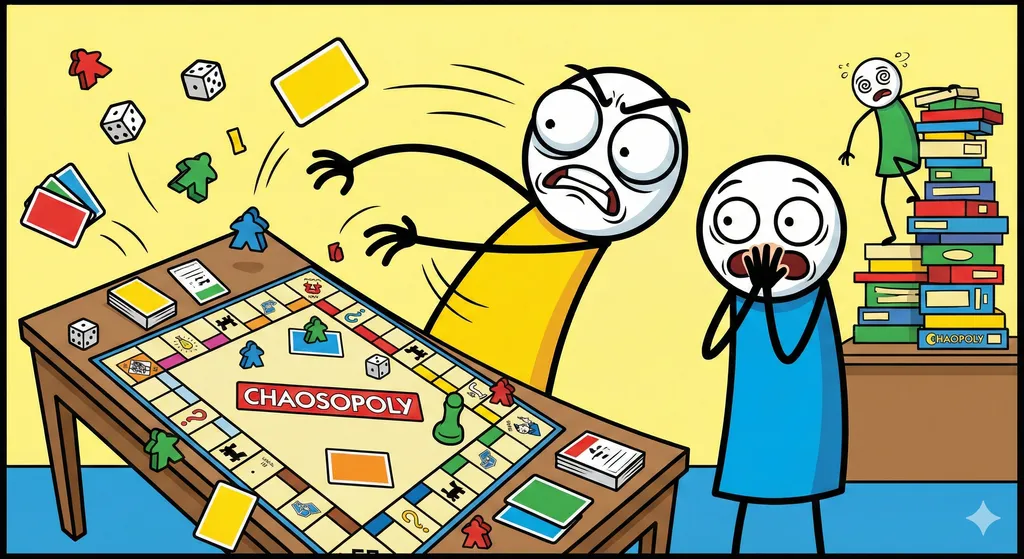
Every year, as the seasons turn and the relentless tide of new acquisitions threatens to overwhelm our carefully curated play spaces, a familiar ritual begins. Justin Bell, writing for BoardGameGeek, has eloquently documented this phenomenon, which we at The Crit Sheet recognize not merely as a household task, but as 'The Annual Kid Game Clearout': a complex, cooperative, and often chaotic meta-game system played out in countless homes worldwide.
At its core, The Annual Kid Game Clearout operates on principles familiar to any veteran designer of resource management games. The primary resource under contention is *space* – that most precious commodity in any family dwelling. Players (typically parents, often in a GM-like role) must navigate a landscape of existing components (children's games, toys, books) and incoming elements (birthday gifts, holiday hauls). The objective is multi-faceted: reclaim physical space, ensure continued engagement with high-value assets, and manage the emotional economy of childhood possessions.
The mechanics are surprisingly robust. Bell outlines key requirements: the presence of children (or regular child entertainment duties) and a dedicated 'kid game area.' This 'area' is the game board, often a contested zone like the fabled 'corner of the basement.' The 'action phase' involves an inventory audit: evaluating each game for its 'play value' (is it still enjoyed?), 'component integrity' (are all pieces present?), and 'shelf presence' (does it fit the aesthetic, or more practically, *fit* at all?). Decisions are made under pressure, often with direct input from junior players whose 'veto power' can derail even the most meticulously planned purge. 'Legacy mechanics' come into play as games are either archived (stored for future generations, a kind of deep deck-building), traded (passed to friends or charity, a form of player-to-player interaction), or culled (disposed of, a hard reset on a game's lifecycle).
The lore of the Clearout is deeply interwoven with the universal narrative of parenthood. This isn't just about tidying; it's about the passage of time, the evolution of interests, and the bittersweet joy of watching children outgrow phases. The 'kid game area' itself becomes a historical archive, a physical manifestation of years of play, laughter, and occasional sibling squabbles. Each game tells a story: the cooperative triumph of a family game night, the solo quest of a quiet afternoon, the epic battle over missing dice. The Clearout, then, is a form of narrative closure, preparing the 'setting' for new adventures and new games to fill the void. It’s a cyclical saga, as predictable and essential as the changing seasons, a testament to the enduring human need for order amidst delightful chaos.
So, is The Annual Kid Game Clearout 'good for the game'? Absolutely. As a meta-system, it fosters critical decision-making, resource allocation, and, crucially, negotiation skills – not just with children, but often between co-parent players. It encourages a healthy relationship with material possessions, teaching both parents and children about value, utility, and the joy of giving. The 'table feel' can range from a tense Eurogame optimization puzzle to a free-form TTRPG session where unexpected character choices (e.g., a child’s sudden, fierce attachment to a forgotten toy) dictate the narrative. While it can be exhausting, the ultimate 'victory condition' – a tidy, functional play space and renewed enthusiasm for the *remaining* games – is immensely satisfying. It’s a vital rebalancing act that prevents collection bloat and ensures that the games that truly matter continue to see play.
Top Pick: Kallax Shelving Units
Essential for modular, scalable game storage that adapts as your collection (and children) grow.
Check Price on Amazon →Related Stories
Star Wars D&D: WotC's Chance to Reclaim Its D20 Legacy
Wizards of the Coast is poised to release a new Star Wars D&D RPG, a move that could redefine their design philosophy. This isn't just another reskin; it's an o
The One Ring's New Edition & Bestiary: Deeper Shadows for Middle-earth
Free League's acclaimed The One Ring RPG is receiving an updated core experience and a much-anticipated hardcover bestiary. This deep dive explores how these ad
Blades in the Dark's Brilliance: Three Mechanics Every TTRPG Needs
Delve into the genius of Blades in the Dark and its Forged in the Dark engine. We dissect three core mechanics that elevate narrative play and empower both GMs