
The Edition Equation: What Makes a New Ruleset Truly Great?
Goonhammer recently pondered the success of new editions. We dive into the crunch, fluff, and table feel of evolving rulesets, using Warhammer 40,000 as a prime example.
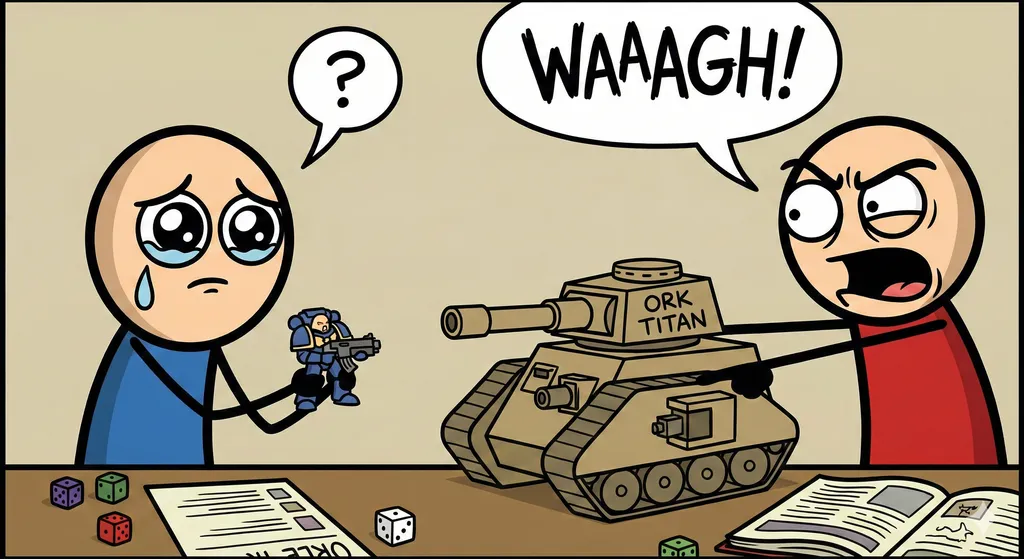
The perpetual cycle of new editions is a familiar rhythm for any veteran of the tabletop, a topic recently dissected with typical insight by Goonhammer's "That 6+++ Show" Episode 182. But what truly separates a triumphant evolution from a misstep, particularly when a titan like Games Workshop unveils a fresh iteration of Warhammer 40,000? It's more than just a new rulebook; it's a profound shift in the very fabric of our shared hobby.
**The Mechanics: Parsing the Crunch of the New Edition**
When a new edition of Warhammer 40,000 drops, the first thing we, the tactical architects, scrutinize is the crunch. How does it *play*? Is it an elegant refinement of previous systems, or a wholesale demolition and rebuild? Consider the seismic shift from 7th to 8th Edition 40k. Gone were the complex Universal Special Rules, replaced by keyword-driven abilities directly on datasheets. This was a deliberate move towards streamlining, aimed at reducing cognitive load and making the game more accessible. While some veterans lamented the loss of granular detail, the immediate benefit was a faster, more fluid game.
However, "streamlining" isn't always synonymous with "better." A truly successful mechanical overhaul doesn't just simplify; it deepens. It addresses systemic issues without introducing new ones. Think of the Command Point economy: a brilliant addition in theory, allowing for tactical gambits and player agency. Yet, its implementation across various editions has seen it swing from omnipresent to precious, sometimes feeling like a tax on core abilities rather than a strategic resource. The best mechanics are intuitive, consistently applied, and foster engaging decisions. They should reward skillful play, not just list-building prowess. A new edition should clarify ambiguities, not create new ones, and ideally, provide a robust framework that can be expanded upon for years without collapsing under its own weight. This is where the long-term health of a ruleset truly manifests.
**The Lore: The Narrative Engine of Change**
Beyond the dice rolls and stratagems, a new edition must advance the narrative. Warhammer 40,000's grimdark universe thrives on its ongoing saga. From the Great Rift tearing the galaxy asunder to the return of the Primarchs, the lore provides the essential context for our battles. A successful edition weaves its mechanical changes into the fabric of its setting. The Indomitus Crusade wasn't just a marketing ploy for new models; it was a narrative justification for a new starter set and a shift in the galaxy's geopolitical landscape.
Where editions falter is when the lore feels tacked on, or worse, when beloved narratives are casually retconned without sufficient care or explanation. The strength of 40k’s lore lies in its vastness and its capacity for individual stories within a cosmic conflict. A new edition should open doors for new narrative campaigns and inspire players to tell their own tales, not just provide window dressing for competitive play. It’s about making the galaxy feel alive, dynamic, and worth fighting for. The best editions enrich the setting, providing fertile ground for Black Library novels and fan-made content alike, ensuring the universe feels like a living entity, not just a backdrop.
**The Verdict: The Table Feel and Long-Term Impact**
So, is a new edition good for the game? Ultimately, it comes down to the table feel. Does it make players excited to roll dice? Does it foster balanced, engaging games across different playstyles – from narrative crusades to hyper-competitive tournaments? A truly successful new edition strikes a delicate balance: it must be accessible enough to welcome new players without alienating the veterans who are the lifeblood of the community. It needs to provide depth for mastery, while being straightforward enough to teach.
The biggest challenge for any publisher, especially Games Workshop, is managing expectations and balancing innovation with legacy. Too much change, and you risk fracturing the player base; too little, and the edition feels stagnant, failing to address core issues. The best editions invigorate the meta, encourage diverse army compositions, and most importantly, make the *game* fun. They are supported by clear errata, thoughtful FAQs, and a consistent release schedule that builds upon the core rules rather than constantly rewriting them. When an edition nails this, it doesn't just sell rulebooks; it builds a stronger, more vibrant community. It ensures that the next generation of players will also wonder, with anticipation, what the *next* edition might bring.
Top Pick: Warhammer 40,000 Core Rulebook
Essential foundation for understanding the game's current mechanics and lore.
Check Price on Amazon →Related Stories
11th Edition 40K: Unpacking the Grimdark's Next Evolution
The next iteration of Warhammer 40,000 from Games Workshop is on the horizon, promising significant shifts. Our deep dive analyzes the revealed mechanical and l
11th Edition 40K: Tactical Depth Returns to the Grimdark
Games Workshop's initial reveals for Warhammer 40,000's 11th Edition hint at a return to tactical depth. We analyze the proposed changes to CP, Doctrines, and u
11th Edition 40k: GW's Grimdark Vision for 2026 Unveiled
Games Workshop's 11th Edition 40k Q&A hints at significant shifts for 2026. We dissect the implications of free rules, terrain objectives, and refined detachmen