
The Narrative Power of Non-Mechanical Outcomes
Sly Flourish challenges GMs to embrace fictional outcomes over strict mechanics for every roll. This approach enriches TTRPGs, fostering deeper immersion and more dynamic storytelling at the table.
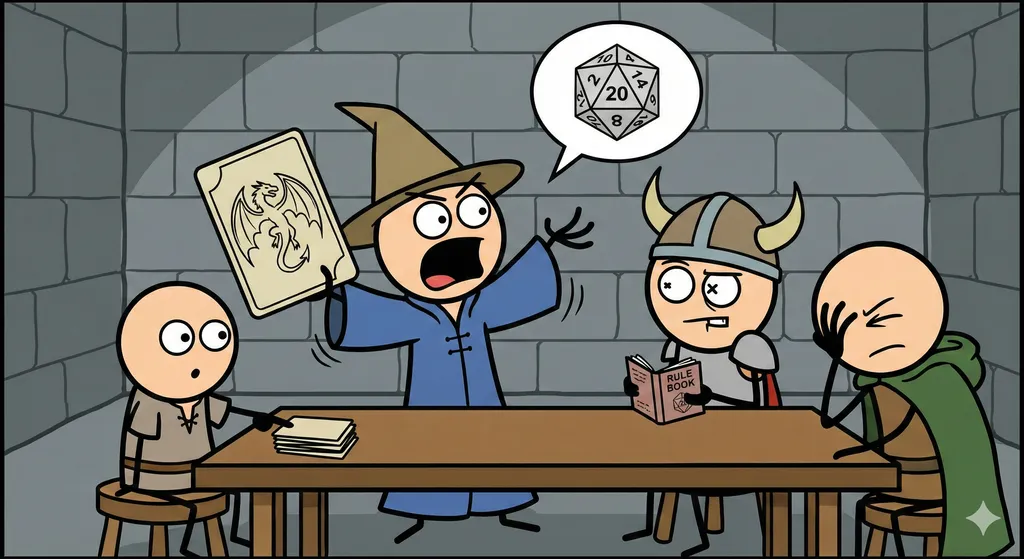
“Every Roll Doesn’t Need a Mechanical Outcome.” It’s a deceptively simple statement from Sly Flourish, yet it strikes at the very heart of how many Game Masters approach the table, particularly those steeped in the traditions of Dungeons & Dragons 5th Edition. For years, we've been conditioned to seek a numerical modifier, a hit point deduction, or a status effect for every die roll. But what if the most impactful results aren't found on a character sheet, but in the unfolding narrative itself? This isn't about abandoning the robust mechanics of your chosen system; it's about understanding when to let the story breathe, unburdened by an unnecessary numerical tether.
The core concept here is elegantly straightforward: a successful or unsuccessful roll can yield a fictional outcome without a direct mechanical component. Consider a rogue attempting a Stealth check to eavesdrop on a conversation. A high roll doesn't necessarily mean they gain a +2 bonus to their next attack against the target; it means they overhear critical information about a hidden cache, or they learn the guard's patrol route shifts at midnight, granting a narrative advantage. Conversely, a failed check doesn't always lead to immediate combat. Perhaps the rogue bumps a loose barrel, drawing a guard's attention not to their exact location, but to the general area, forcing them to scramble for a new hiding spot or improvise a distraction. The consequence is real, impactful, but doesn't require consulting a table of conditions or applying a penalty to a future roll. This approach, often championed by indie TTRPGs designers, empowers the GM to interpret results through the lens of dramatic tension and world logic, rather than purely statistical arbitration. It’s about leveraging the "failing forward" principle, where even failure pushes the story into new, interesting territory, rather than simply stalling progress.
From a worldbuilding perspective, embracing fictional outcomes adds immense depth and verisimilitude to any campaign, be it a sprawling D&D epic or a gritty Cyberpunk RED street run. When a character's actions resonate purely within the narrative, the world feels more responsive and less like a series of interconnected mini-games. A successful Persuasion check might not grant a discount at the market, but it could earn the respect of a notoriously stubborn guild master, opening doors to future opportunities that cannot be quantified in gold pieces. A botched Investigation roll doesn't just mean "you find nothing"; it might mean the character overlooks a crucial detail, leading them down a red herring path, only to discover the true clue much later through a chance encounter or a different approach. This allows the lore to breathe, to develop organically through character choices and consequences, rather than being dictated by a spreadsheet of modifiers. It fosters a sense of discovery and genuine consequence, making the players feel their characters are truly part of a living, reacting world, rather than simply navigating a challenge course.
So, is this approach good for the game? Unequivocally, yes. For the veteran Game Master, it's an invitation to shed the shackles of purely mechanical thinking and embrace the improvisational spirit that defines the best TTRPG experiences. It reduces "roll fatigue," where players and GMs alike feel compelled to find a mechanical effect for every d20 toss. Instead, every roll becomes an opportunity to advance the narrative, deepen character arcs, or complicate the situation in engaging ways. It shifts the focus from optimizing numbers to exploring story, from calculating probabilities to crafting compelling moments. While some tables undeniably thrive on the crunch and precision of strict rules interpretation, a healthy dose of narrative-driven outcomes can elevate any game, making the world feel richer, the stakes more personal, and the players' choices more meaningful. It's a powerful tool in the GM's arsenal, allowing the narrative to flow more smoothly and making every session feel less like a series of discrete challenges and more like a cohesive, unfolding story.
Top Pick: The Lazy Dungeon Master by Sly Flourish
Excellent guide for GMs seeking to streamline preparation and focus on narrative impact.
Check Price on Amazon →Related Stories
Farnassia's Verdant Embrace: A Modular Jungle for Your Table
Ed Chaurero's Jungles of Farnassia delivers a compelling, setting-agnostic adventure for D&D 5th Edition. This module breathes life into tropical exploration, c
Cocks' Crossover Push: D&D's Identity Crisis or New Horizon?
Chris Cocks confirms an intensified focus on Dungeons & Dragons crossover products, sparking debate among veteran players. We dissect the mechanical and lore im
Cthulhu Dark Providence: Despair, Eldritch Horrors, and the American Dream
Cthulhu Dark Providence plunges players into a collapsing post-Depression America, where human corruption entwines with cosmic terror. This deep dive explores h