
The Polyhedral Pantheon: Deconstructing 'Dream Dice Day'
Justin Bell's 'Dream Dice Day' concept from BoardGameGeek challenges us to re-evaluate the humble dice. We dive deep into how a dedicated celebration of dice mechanics elevates gameplay and player agency.
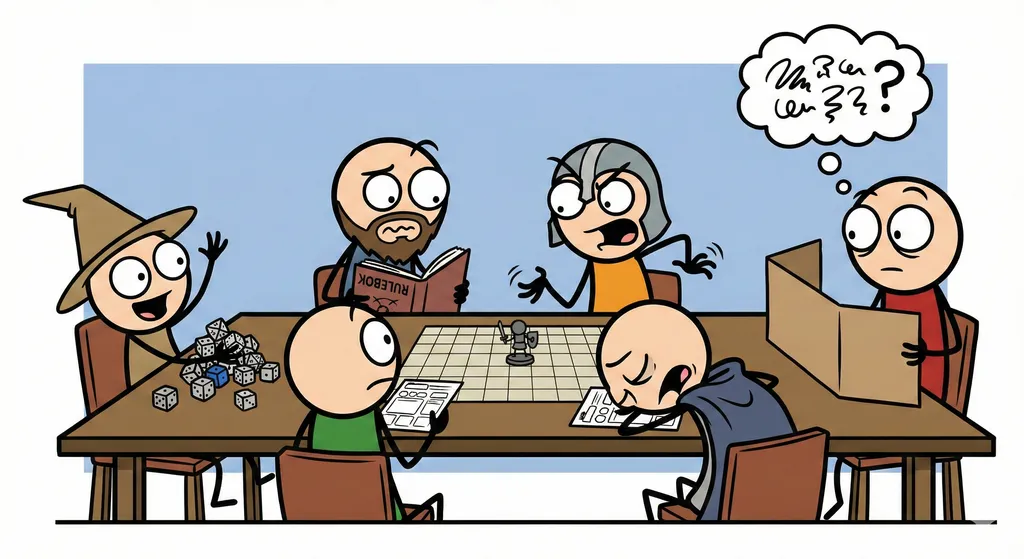
A recent thought experiment circulating on BoardGameGeek, dubbed 'Dream Dice Day' by contributor Justin Bell, has us at The Crit Sheet rolling critical hits on a deeply satisfying concept. This isn't just about throwing plastic; it's a call to curate an entire gaming session—or even a design philosophy—around the glorious, unpredictable, and surprisingly diverse world of dice mechanics. Far from corporate fluff, this idea champions the tactile, the strategic, and the sheer joy of the polyhedral. Let's deconstruct why embracing a day dedicated to the dice is a profound boon for our tables.
The beauty of 'Dream Dice Day' lies in its broad church. Bell's initial musings stretched from dice drafting to dice chuckers, roll-and-writes, and worker placement with dice. This isn't just a list; it’s a spectrum of player engagement. Dice drafting, as seen in modern classics like Sagrada, transforms pure chance into tactical decision-making. Players aren't just hoping for a good roll; they're choosing *which* roll to leverage, often sacrificing immediate gain for long-term strategic advantage. This mechanic elevates the humble d6 from a randomizer to a resource, a currency of opportunity.
Then there's the visceral thrill of the 'dice chucker'—the pure, unadulterated chaos of a handful of d10s determining the fate of a squad in Warhammer 40,000. Here, the mechanic is less about choice and more about managing probability, understanding statistical spreads, and the exhilarating risk/reward of an 'all-in' assault. It's the moment where the narrative hinges entirely on the tumble, a shared breath held around the table.
Roll-and-writes, like Ganz Schön Clever, introduce a fascinating puzzle element. A single roll generates a shared pool of results, and players individually optimize their choices, often chaining effects and creating intricate score paths. Here, dice are prompts, catalysts for individual strategic puzzles that unfold simultaneously. Worker placement with dice workers, exemplified by games like Alien Frontiers or Viticulture Essential Edition, blends the deterministic strategy of placement with the uncertainty of the die's face. The value of your 'worker' changes with each roll, forcing dynamic adaptation and clever allocation of limited resources. Each of these approaches uses dice not merely as random number generators, but as fundamental components of player agency, strategic depth, and emergent gameplay.
While 'Dream Dice Day' isn't tied to a specific fictional setting, its 'lore' manifests in the shared narrative created at the table. The lore of a dice-centric session isn't found in a rulebook's background section; it's forged in the moments of collective anticipation, the gasps at a critical failure, and the cheers for a clutch success. It's the story of the player who gambled on a low-value die in the draft and made it sing, or the general who defied the odds with a terrible volley of 'chucked' dice, only to pull off a miraculous victory.
This kind of gaming day fosters a unique kind of social contract: a mutual appreciation for the inherent drama of chance. It's about embracing the 'dice gods' as capricious deities, sometimes benevolent, sometimes cruel, but always central to the unfolding story. The tactile experience of rolling, placing, or marking is a ritual, a tangible connection to the game's mechanics that deepens immersion in a way that purely digital counterparts struggle to replicate. The 'setting' becomes the table itself, vibrant with the clatter of dice, the scribbling of pens, and the animated discussions of probability and strategy. It cultivates a meta-narrative of gaming itself – a celebration of the tools we use to tell our stories.
So, is a 'Dream Dice Day' good for the game? Unequivocally, yes. This concept is more than just a fun theme for a game night; it's a powerful statement about game design philosophy and player engagement. For Game Masters, it’s a blueprint for curating an incredibly satisfying session, perhaps exploring a new indie TTRPG that leans heavily into a specific dice mechanic, or even designing a one-shot where dice manipulation is key. For designers, it's an affirmation that innovative uses of dice are still fertile ground for profound gameplay.
The emphasis on diverse dice mechanics challenges the often-simplistic 'roll to succeed' paradigm. It encourages a deeper appreciation for the nuanced ways randomness can be integrated to enhance, rather than detract from, player agency. By focusing on dice, we're forced to consider how to mitigate pure luck through tactical choices, how to create engaging puzzles from random inputs, and how to build systems where even a 'bad' roll can open up interesting strategic pathways. This isn't about promoting chaos; it's about mastering the beautiful interplay between chance and choice. A 'Dream Dice Day' fosters a deeper understanding and appreciation for the very core of what makes many tabletop games so compelling: the thrilling, unpredictable dance with the polyhedrals.
Top Pick: Q-Workshop Elven Dice Set
Exquisite craftsmanship for your most crucial rolls
Check Price on Amazon →Related Stories
The Queen's Dilemma: Royal Legacy Refined, Not Just Rehashed
Horrible Guild announces The Queen's Dilemma, a sequel to their acclaimed legacy game, arriving this May. Players will navigate a new story in the Kingdom of An
Diplomacy's Betrayal, Now in Your Hand: The Golden Blade
Rosco Schock reimagines the classic 'friendship killer' into a card game. We dissect how 'The Golden Blade Card Game' maintains the strategic backstabbing of or
Choconnect: A Sweet Symphony of Strategy and Supply Chains
Sandro Blasich's Choconnect, published by Sweet Victory Games, redefines tile-laying with its innovative chocolate network-building. We delve into its delectabl