
The Scene-Centric Die Roll: A Master GM's Secret Weapon
Discover how a single target number per scene, popularized by Index Card RPG and Pirate Borg, can revolutionize your TTRPG sessions. This elegant mechanic streamlines gameplay, heightens tension, and empowers GMs to focus on narrative flow.
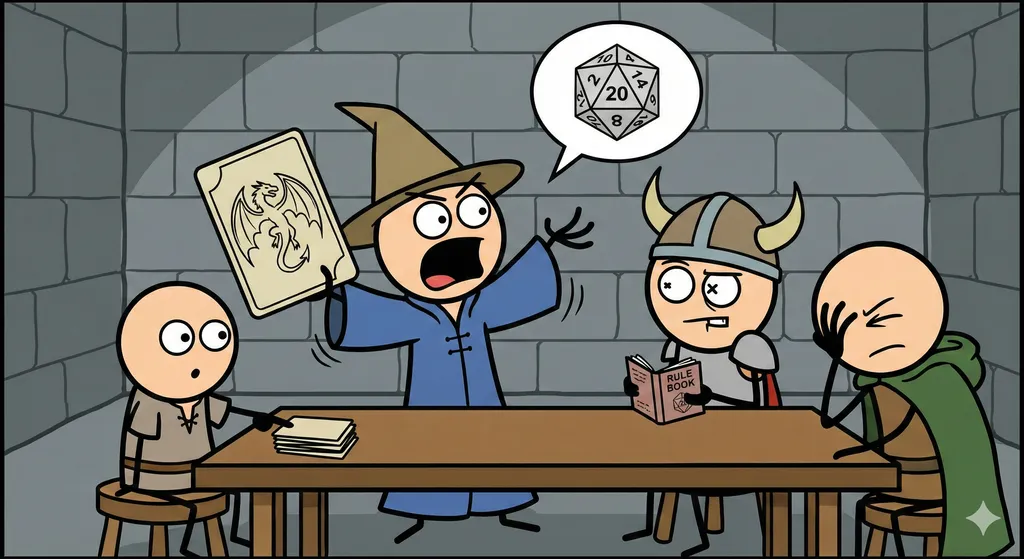
As veteran Game Masters, we've all been there: juggling a dozen different Difficulty Classes, trying to recall the exact DC for a specific action amidst the chaos of a tense scene. It's a mental tax that can pull even the most seasoned GM out of the narrative flow. This is precisely why the design philosophy shared by Index Card RPG from RUNEHAMMER GAMES and Pirate Borg, published by Limithal Games in partnership with Free League Publishing, demands our attention. They champion a deceptively simple yet profoundly impactful concept: using a single target number for an entire scene.
At its core, the mechanic is elegantly straightforward. Instead of assigning granular DCs to every single action a player might attempt within a combat, a social encounter, or an exploration phase, the GM declares one overarching Difficulty (or Target Number) at the scene's outset. Imagine a high-stakes chase through a crumbling wizard's tower. The GM might announce, "The collapsing tower presents a unified challenge: a DC of 14." Now, every relevant action—leaping a gap, bracing a falling beam, picking a locked door mid-flight, even an attack against a pursuing construct—targets this single number. Success means the action is performed, failure means complications or partial success. For a game like Dungeons & Dragons 5th Edition, where GMs often assign bespoke DCs for every check, this represents a significant shift in cognitive load. The number itself might be categorized as EASY (10), MEDIUM (12), HARD (14), or DEADLY (16), as seen in ICRPG, making it instantly digestible. The crucial nuance lies in how varying difficulties within that scene are handled: not by changing the target number, but by applying Advantage or Disadvantage. A particularly precarious jump might require a roll with Disadvantage, while a well-prepared character might attempt a task with Advantage. The target remains constant; the *odds* shift, keeping the GM's mental focus squarely on narration and adjudication.
Narratively, this isn't just a mechanical shortcut; it's a powerful framing device. It imbues a scene with a palpable, unified sense of danger or opportunity. In the grim, chaotic world of Pirate Borg, a single target number for a ship-to-ship battle or a desperate escape from a kraken isn't just about speeding up play; it reinforces the brutal, overwhelming nature of survival on a cursed sea. Every action, from patching a hull breach to firing a cannon, is a struggle against the same unforgiving environment. For ICRPG, this unified difficulty, often paired with a 'Room Target' and a 'Timer,' creates a frantic, pulp-action feel where the entire environment pushes back with a singular, unified force. It shifts the narrative emphasis from individual task complexity to the overarching challenge presented by the environment or situation itself, fostering a cohesive thematic experience.
So, is this good for the table? For GMs, the benefits are immediate and profound. It drastically reduces mental overhead, allowing for greater improvisation and a focus on descriptive narration rather than rules lookup. This translates to faster, smoother play, keeping the energy high and preventing the dreaded 'analysis paralysis' at the table. Players, too, benefit from the clarity; they're constantly aware of the prevailing challenge and can focus on creative problem-solving within those parameters. This system shines brightest in high-stakes combat, tense chases, or any scene where urgency and a unified threat are paramount. However, it's not a universal panacea. For games or scenes that thrive on granular detail, intricate puzzles, or complex social negotiations where specific skill applications and varied DCs are central to the challenge, this approach might feel too broad. It requires a GM comfortable with adjudicating Advantage/Disadvantage on the fly to maintain task differentiation, otherwise, everything can risk feeling a little too 'samey.' Ultimately, for those seeking to inject more dynamism, narrative flow, and streamlined action into their TTRPGs, the scene-centric target number is a potent tool in the GM's arsenal.
Top Pick: Index Card RPG Master Edition
For GMs seeking elegant simplicity and dynamic play
Check Price on Amazon →Related Stories
The Faceless Howl: Grimstone Press's Masterclass in Dread
Grimstone Press unveils The Faceless Howl, a horror crawl demanding keen intellect and nerves of steel. This module promises a chilling blend of investigation a
Ancestry Reforged: Grimstone Chronicles' Bold New System
Black Iron Games' Grimstone Chronicles introduces a revolutionary Heritage & Calling system, decoupling biology from culture for deeper character generation. Th
Echoes of Aethelgard: Sundered Isles' Grit & Glory
Stoneheart Games' latest for Echoes of Aethelgard introduces Heroic Momentum and a Gritty Wound System. We dissect how these mechanics transform table dynamics,