
The Whispered Truth: Why Vecna's Obelisks Almost Didn't Happen
Ray Winninger reveals that the multiversal obelisk plot in Vecna: Eve of Ruin was a late addition. We analyze what this pivot means for D&D's high-level play.
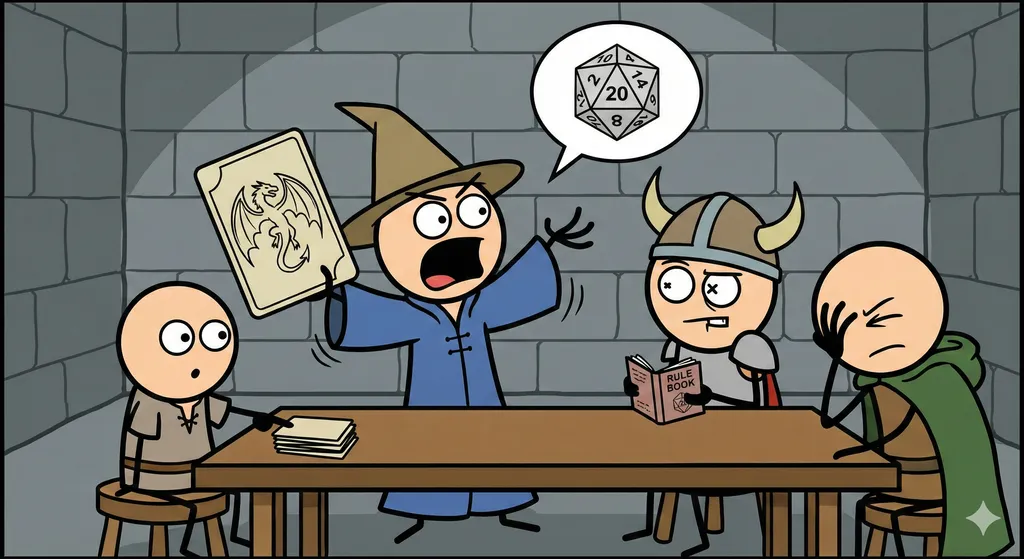
Ray Winninger’s recent admission regarding Vecna: Eve of Ruin from Wizards of the Coast confirms what many veteran Dungeon Masters suspected: the connective tissue of the 5th Edition multiverse was far from a predetermined master plan. In a recent interview, the former Head of D&D clarified that the mysterious black obelisks scattered across decade-old adventures like Tomb of Annihilation and Rime of the Frostmaiden were not originally intended to culminate in the Vecna-led apocalypse we received. This revelation pulls back the curtain on the design philosophy at Hasbro, suggesting that narrative synergy is often retrofitted rather than foundational.
Mechanically, Vecna: Eve of Ruin operates as a high-stakes scavenger hunt across the planes, utilizing the Rod of Seven Parts as its primary MacGuffin. For those of us running Tier 4 play, the challenge has always been the sheer power of Level 20 characters. The adventure attempts to solve this by forcing players into specific planar nodes where the action economy is strictly managed through environmental hazards and legendary resistances. However, the mechanical integration of the obelisks feels vestigial. Winninger noted that the original pitch focused more heavily on the Rod itself—a legacy item dating back to the 1976 TSR era—rather than the Netherese monoliths. When you look at the stat blocks for Vecna the Archlich, you see a design intended for high-mobility combat, yet the narrative weight of the obelisks provides little more than a backdrop for the cosmic stakes.
From a lore perspective, the obelisks represent a fascinating missed opportunity for deep world-building. These structures were teased as remnants of the Weaver, an ancient power capable of rewriting reality. In the final version of the 5th Edition campaign, they serve as the fuel for Vecna’s Ritual of Remaking. But knowing this was a late-stage pivot explains the dissonance many GMs felt. In Rime of the Frostmaiden, the obelisk was a terrifying localized anomaly; in Eve of Ruin, it becomes a generic battery. This shift from weird fiction mystery to superhero crossover event is emblematic of the current direction of the Commander Format influence on D&D—where every character and artifact must be part of a recognizable, marketable pantheon.
The table feel of this adventure suffers from this late-stage redirection. While the individual set pieces are evocative, the overarching campaign structure lacks the organic growth found in tighter modules like Curse of Strahd. Players today are savvy; they can tell when a plot point is a load-bearing wall and when it is merely wallpaper. The obelisk plot, while grand in scope, feels like the latter. It is a Vecna: Eve of Ruin experience that prioritizes the spectacle of the multiverse over the mechanical depth of its components. For a veteran GM, the task becomes one of re-weaving these threads to make the obelisks feel earned rather than inserted.
Ultimately, Winninger’s transparency is refreshing. It confirms that even at the highest levels of professional TTRPG design, the process is iterative and often chaotic. The pivot toward the obelisks was likely a corporate desire for a Cinematic Universe moment to celebrate D&D's 50th anniversary. While the result is a functional, high-octane romp through the Outer Planes, it serves as a reminder that the best stories at your table are rarely the ones mandated by a brand manager. They are the ones that emerge naturally from the dice and the history of your own world.
Top Pick: Quests from the Infinite Staircase
It provides the modularity that Eve of Ruin lacks, allowing for a more organic multiversal experience.
Check Price on Amazon →Related Stories
Vecna: Eve of Ruin and the Truth Behind the Metaplot
Former D&D lead Ray Winninger clarifies the original vision for Vecna: Eve of Ruin, putting to rest rumors of a grand, abandoned metaplot for the 5th Edition mu
Toy-to-Table: How D&D Questers Aims to Secure the Next Generation
Hasbro and Basic Fun! announce D&D Questers, a collectible figure line designed to bridge the gap between action-figure play and the 5th Edition tabletop experi
Neon Odyssey: Can Legends of Avantris Launch 5E to the Stars?
Legends of Avantris unveils 'Neon Odyssey,' a bold 5E space opera project. This editorial dives deep into how 5th Edition's mechanics and lore could adapt to th