
Warhammer 40K 11th Ed: Tactical Evolution or Grimdark Stagnation?
Games Workshop's rapid iteration continues with the 11th Edition of Warhammer 40,000, promising significant shifts in tabletop battles. We analyze how these changes could redefine strategic depth and the player experience.
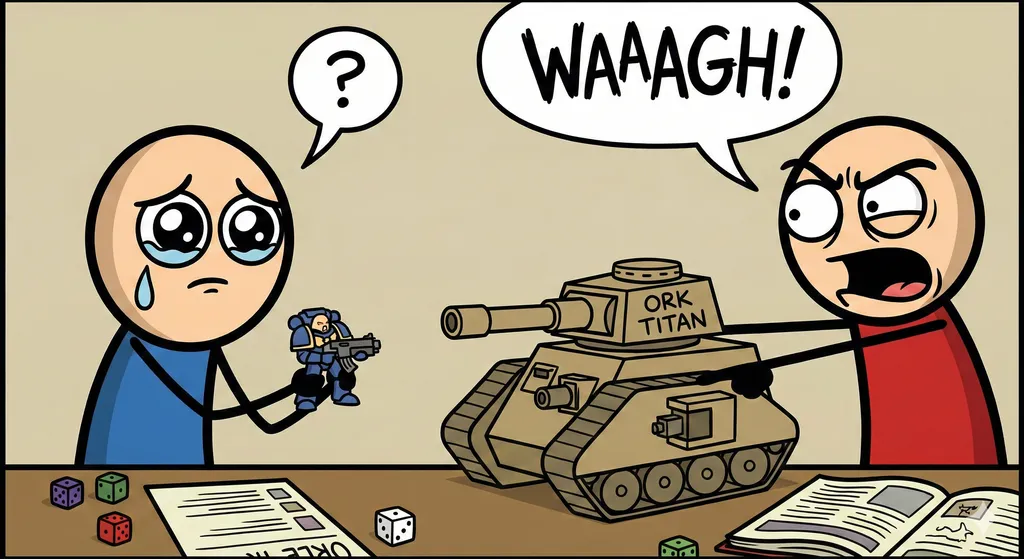
The Crit Sheet has been poring over the '11th Edition 40k Tabletop Battles Roundup' from Goonhammer, and the sheer volume of news coming from Games Workshop regarding the next iteration of Warhammer 40,000 is, frankly, dizzying. It feels like only yesterday we were unpacking the nuances of 10th Edition, and here we are, already dissecting what promises to be a fundamental re-evaluation of the game's core loop. This rapid pace isn't just about new model releases; it's about a continuous evolution of the game's strategic landscape, demanding that veteran players and newcomers alike adapt or be left behind in the warp-storms of competitive play.
At the heart of the rumored changes for 11th Edition lies a philosophy of dynamic engagement, moving away from prescriptive stratagems and towards reactive, on-the-fly decision-making. The most significant mechanical shift appears to be the introduction of 'Adaptive Doctrine Points' (ADP). Gone are the days of a fixed pool of Command Points to be hoarded or spent pre-emptively. Instead, players will generate ADP throughout each battle round, contingent on achieving specific, often secondary, objectives during their turn – holding an exposed flank, eliminating a key enemy unit, or successfully completing a risky maneuver. These ADP can then be spent on 'Tactical Directives,' which are powerful, short-duration buffs, debuffs, or even mid-phase unit adjustments. Imagine using ADP to grant a unit 'Overcharged Las-Cells' for a turn, boosting their AP, or initiating a 'Rapid Redeployment' to shift a single unit's position by a crucial few inches after both sides have moved. This system fundamentally alters the flow of play, turning every action into a potential resource generator and every decision into a tactical gamble. It's a bold move, pushing players to engage with the entire battle space rather than focusing solely on primary objectives.
Complementing the ADP system is an overhaul of objective play. Static, fixed objectives are reportedly being replaced by 'Fluid Objectives' that evolve or escalate throughout the game. A seemingly innocuous 'Hold the Line' objective might, after Turn 2, transform into 'Seize the Promethium Cache,' shifting its scoring criteria or even its physical location on the board. This forces constant tactical re-evaluation. No longer can a player simply secure an objective and forget it; they must constantly adapt their forces to the changing demands of the battlefield. This promises to make every game a unique narrative, a desperate struggle against an ever-shifting tide of war. Furthermore, rumors suggest a revised 'Morale' system, tying unit cohesion more closely to their proximity to HQ units or specific terrain features, making line breaks and flanking maneuvers far more punishing than before. This could significantly impact how players screen their vital assets and utilize their character models, turning them into true force multipliers rather than just stat-sticks.
From a lore perspective, these mechanical shifts resonate profoundly with the increasingly desperate and chaotic nature of the 41st Millennium. The concept of 'Adaptive Doctrine Points' could represent the frantic, improvised command decisions made in the heat of battle within the Imperium Nihilus, where established protocols often fail and commanders must constantly innovate to survive. The 'Fluid Objectives' mirror the ever-shifting battlefronts and unpredictable nature of galactic warfare, where strategic priorities can change on a dime due to warp incursions, xenos ambushes, or the machinations of Chaos. This isn't just a game; it's a simulation of a universe on the brink, where every victory is hard-won and every tactical decision carries immense weight. The increased emphasis on unit cohesion and morale could reflect the psychological toll of fighting an endless war against incomprehensible horrors, where even the most hardened Space Marine can break under relentless pressure if their command structure falters. It deepens the grimdark narrative, grounding the crunch in the fluff in a way that feels organic and compelling, making the battlefield feel more alive and less like a static chessboard. The Crit Sheet's Guide to 40K Lore
So, what does this mean for the table? For veteran players, 11th Edition Warhammer 40,000 promises a deeper, more engaging tactical puzzle. The emphasis on dynamic resource generation and evolving objectives rewards adaptability, foresight, and a willingness to deviate from pre-planned strategies. List building will likely shift from pure efficiency to versatility, as players prepare for a wider array of in-game challenges. Casual players might find the initial learning curve steeper, as the game demands more active participation in the command phase, but the payoff is a far more interactive and less predictable experience. For the competitive scene, this could be a breath of fresh air, shaking up established metas and fostering a more diverse range of viable strategies. The potential for 'gotcha' moments and dramatic turnarounds feels significantly increased, making for thrilling games that are decided not just by dice rolls, but by superior tactical acumen and resource management. While the constant evolution can feel like a treadmill, 11th Edition appears to be pushing Warhammer 40K towards a more sophisticated, reactive, and ultimately, more rewarding wargaming experience.
Top Pick: Warhammer 40,000 Core Rulebook (11th Edition)
Essential for understanding the new tactical landscape and ADP system.
Check Price on Amazon →Related Stories
11th Edition Event Companion: A Glimpse at 40k's Competitive Future
Goonhammer's deep dive into the 11th Edition Warhammer Event Companion reveals Games Workshop's strategic vision for competitive play. This document could resha
Tabletop Battles App: 11th Edition 40K Data Tracking Unpacked
Goonhammer reports the Tabletop Battles App now supports "11th Edition 40K" game recording. This pre-emptive data collection signals a significant shift for com
WAAAGH! Erupts: 11th Edition Orks Unleash New Brutality
The 11th Edition Ork Faction Pack introduces three potent new Detachments, dramatically reshaping how players field the Green Tide. This deep dive dissects the