
Wing It! Extreme Storytelling: A GM's Unexpected Ally
Wing It: The Game of Extreme Storytelling! offers a vibrant take on party games, transforming simple prompts into collaborative narrative adventures. It's a surprising tool for GMs and a perfect gateway to tabletop creativity.
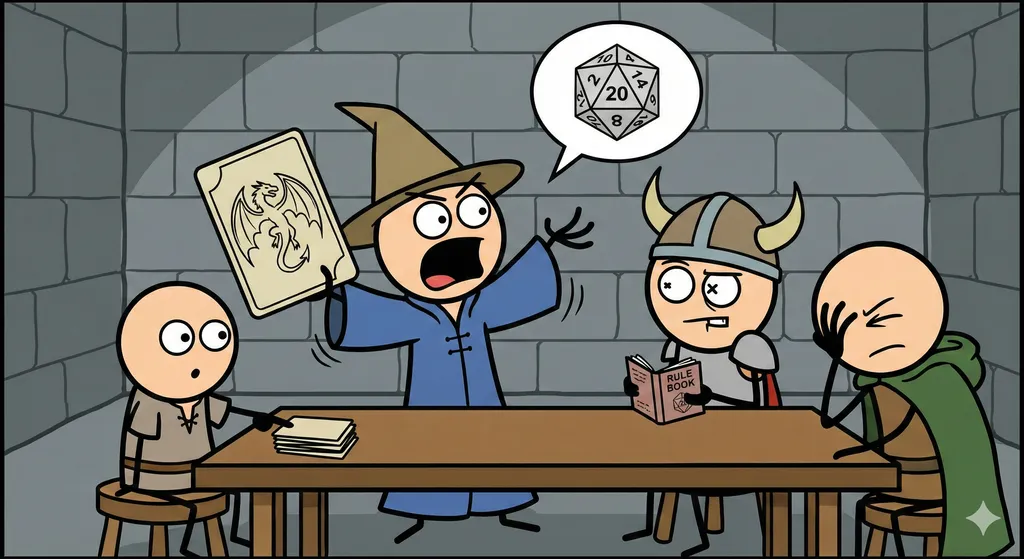
Wing It: The Game of Extreme Storytelling! isn't merely another entry in the crowded field of prompt-and-judge party games; it’s a surprisingly potent engine for emergent narrative, a delightful sandbox for the improvisational mind. For us at The Crit Sheet, who spend our lives dissecting the DNA of interactive fiction, a game that promises "extreme storytelling" immediately piques our interest. Can a few cards genuinely unlock the chaotic brilliance of group improvisation, or is it just another superficial laugh factory? Let’s crack open this box and see what kind of tales it truly spins.
At its core, Wing It! operates on a familiar chassis: a "Narrator" (or judge) presents a prompt, and players craft a response using a hand of cards. Where Wing It! distinguishes itself, however, is in the granularity and evocative nature of its card types. Rather than simple adjectives or nouns, players are typically dealt a hand comprising "Character Archetype" cards (e.g., "The Reluctant Hero," "The Scheming Vizier"), "Setting Modifier" cards (e.g., "In a Crumbling Necropolis," "Aboard a Galactic Freightliner"), and crucial "Plot Twist" cards (e.g., "A Betrayal from Within," "An Unexpected Ally Appears").
The Narrator draws a "Core Conflict" card – perhaps "The Ancient Artifact Must Be Recovered" or "The City Faces Imminent Destruction." Each player then selects a combination of cards from their hand to construct a short, compelling narrative, typically a paragraph or two, that resolves or profoundly impacts the core conflict. The "extreme" aspect often arises from the juxtaposition of disparate elements – imagine "The Reluctant Hero" (a sentient toaster) in "A Crumbling Necropolis" facing "An Unexpected Ally" (a flock of ravenous pigeons) to recover "The Ancient Artifact" (a spork). Players are encouraged to weave these elements together with flair, originality, and a dash of the absurd. The Narrator, after hearing all submissions, awards points based on criteria like "Most Creative Resolution," "Funniest Twist," or "Most Cohesive Chaos." It’s a simple system, yet one that demands genuine on-the-spot creativity, far beyond mere word association.
In a game like Wing It!, "lore" isn't a pre-packaged setting or an intricate pantheon of gods; it's the ephemeral, often hilarious, shared fiction that erupts at the table. Each round is a micro-campaign, a flash-fiction one-shot where the players are co-authors, directors, and sometimes even the unwitting protagonists. The game's strength lies in its ability to generate unexpected narrative connections, forging a unique, if fleeting, "lore" with every story told. A recurring character archetype might take on an entirely new personality based on the player's interpretation, or a seemingly mundane setting could become the crucible for an epic saga. This dynamic, emergent lore is the very soul of collaborative storytelling, mirroring the organic world-building that happens naturally around a good GM's table. It primes players to think beyond static descriptions, encouraging them to imbue characters and places with agency and consequence, even if only for a few minutes. This kind of creative storytelling is vital for any aspiring roleplayer.
So, is Wing It! good for the game? Absolutely, and in more ways than one. For the veteran Game Master, it's a fantastic warm-up exercise, a way to flex those improvisational muscles before diving into a complex dungeon crawl. It encourages lateral thinking and the ability to connect disparate narrative threads – skills indispensable for running a dynamic TTRPG session. For groups that include non-gamers, Wing It! is a revelation. It strips away the intimidating rulebooks and stat blocks, presenting the purest essence of tabletop roleplaying: collaborative storytelling. It teaches players that their ideas have weight, that creativity is rewarded, and that the most memorable moments often arise from the unexpected.
Furthermore, Wing It! fosters a vital sense of "yes, and" at the table. Players are building upon prompts, not just reacting, and the judge's role is less about strict adjudication and more about celebrating the most inventive narrative. The replayability is virtually infinite, constrained only by the imagination of the players and the ever-shifting combinations of cards. While it won't replace a dedicated TTRPG session, it certainly serves as an excellent gateway, a low-stakes introduction to the joy of shared narrative creation. It's a game that celebrates the spark of invention, proving that extreme stories don't always need extreme rules.
Top Pick: Rory's Story Cubes
Excellent for creative prompts and solo play, perfect for GMs needing quick inspiration.
Check Price on Amazon →Related Stories
Skullcrusher: Grimdark Delves - Perilous Paths to OSR Mastery
Ironclad Games' Skullcrusher: Grimdark Delves promises a brutal, tactical return to old-school dungeon crawling. Its unique Peril System forces players to weigh
Aetherial Conduits: Echoes & The Resonance Engine
Obsidian Gate Studios' 'Aetherial Conduits: Echoes of the Sundered Realm' introduces the innovative Resonance mechanic. We break down how this system shifts mag
Dragon Kings: A Harsh New Dawn for 5th Edition
The original architects of Dark Sun bring their brutal vision to 5th Edition with Dragon Kings. This deep dive examines how a world of psionics and scarcity res