
Xenos Unleashed: A 10th Edition Warhammer 40,000 Retrospective
The Crit Sheet dives deep into Warhammer 40,000's 10th Edition Xenos factions. We dissect the mechanical shifts and their impact on lore and table dynamics.
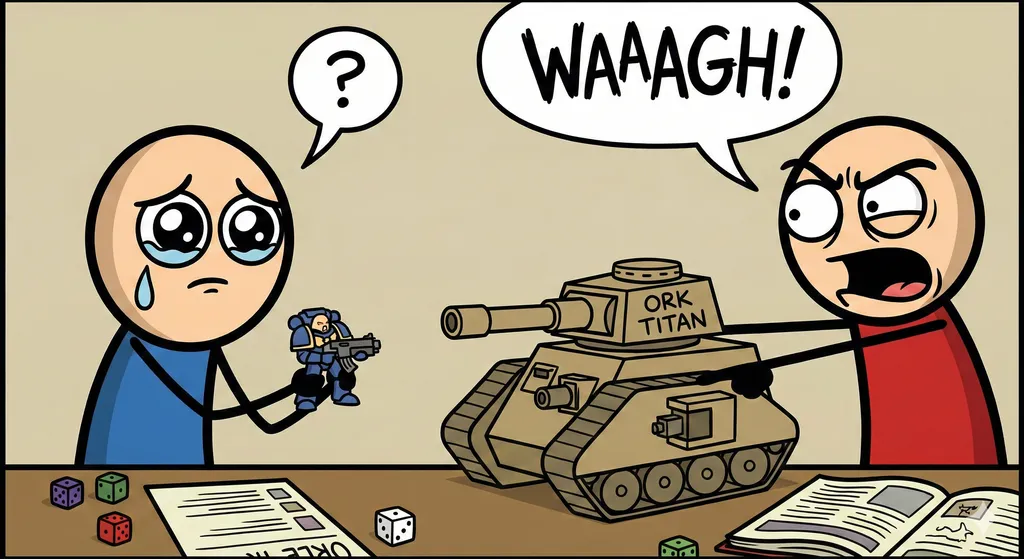
Goonhammer’s recent “Tabletop Battles Autopsy: The Big 10th Edition Retrospective – Xenos” offers a crucial vantage point from which to examine the state of alien life in Warhammer 40,000 10th Edition by Games Workshop. As veteran commanders, we’ve weathered many editions, and 10th promised a significant streamlining. For the myriad Xenos factions, this meant a radical re-evaluation of identity, mechanics, and tabletop presence.
From a purely mechanical standpoint, 10th Edition Warhammer 40,000 launched with an audacious design philosophy: simplify, streamline, and re-center the game on the individual datasheet. For Xenos, this translated into a dramatic shift from the complex sub-faction rules of 9th Edition to the more constrained Detachment system. Gone were the bespoke stratagems and Warlord Traits that defined specific Space Marine Chapters or Craftworld Aeldari; in their place, each faction received a limited set of Detachments, each offering a specific flavor of play.
Consider the Tyranids, a launch faction for 10th Edition. Their Synapse and Shadow in the Warp abilities were re-envisioned, becoming omnipresent but less granular. While the core concept of a psychic, swarming horde remained, the nuances of different Hive Fleets were largely subsumed into generic Detachments like the Invasion Fleet or the Crusher Stampede. Necrons, similarly, saw their Reanimation Protocols refined, becoming more consistent and reliable across the board, rather than relying on specific character synergies. This consistency was a double-edged sword: it made the game easier to learn and reduced cognitive load, but it often came at the cost of the intricate, faction-specific combos that defined high-level play in previous editions. Factions like the Orks, while retaining their Waaagh! mechanic, often felt like they lost some of their chaotic, ramshackle distinctiveness, with many units feeling similar across different Detachments. The initial dominance of Aeldari, driven by powerful Strands of Fate manipulation and highly efficient datasheets, highlighted the precarious balance of this new design paradigm.
Lore, the very soul of these armies, was always going to face a challenge with such a mechanical overhaul. For the most part, 10th Edition succeeded in preserving the *essence* of the Xenos. Tyranids still feel like an unstoppable biological tide, their rules for sustained attacks and relentless advance perfectly mirroring their ravenous nature. Necrons, with their reanimating hordes, embody the relentless, ancient threat they represent. The T’au Empire’s focus on coordinated fire and markerlight mechanics, though initially somewhat underpowered, still speaks to their technological prowess and tactical acumen. However, the simplification of sub-factions occasionally felt like a narrative flattening. Where once a specific Ork Kulturs or Drukhari Obsessions offered unique storytelling hooks and tactical pathways, these were often generalized into broader Detachment themes. This can make it harder for players to deeply connect their specific army composition to the rich background that Games Workshop has cultivated over decades. The Leagues of Votann, a newer addition, suffered from a less distinct mechanical identity, struggling to fully convey their stoic, technologically advanced lore through their initial ruleset.
So, is 10th Edition good for the Xenos? The verdict is, as Goonhammer alluded to, a mixed bag. On one hand, the accessibility of 10th Edition is undeniable. Getting new players into the game, especially with streamlined Combat Patrol boxes and simpler Detachment rules, is a massive win. For new Xenos players, the barrier to entry has never been lower. The core gameplay loop is fast, brutal, and undeniably Warhammer 40,000. On the other hand, for the veteran player, the initial iteration of 10th Edition often felt like a step back in mechanical depth and faction nuance. While subsequent Codex releases have begun to reintroduce some of that lost complexity and character, the initial “Indexhammer” phase left many Xenos players yearning for the intricate tactical decisions and unique flavor that defined their chosen armies in prior editions. The power pendulum swung wildly, with some Xenos factions feeling dominant, others utterly lost in the meta. The design team has clearly prioritized a robust core ruleset, which is a solid foundation, but the journey to fully flesh out each Xenos faction’s identity within this new framework is ongoing. It’s a testament to the community’s creativity that players continue to find ways to express their faction’s lore through list building, despite some of the mechanical limitations.
Related Stories
40k's 11th Edition Combat Patrol: A New Era for Skirmishes
Games Workshop unveils the 11th Edition Combat Patrol Companion, a refined format promising streamlined, balanced skirmishes for Warhammer 40,000. This strategi
11th Edition 40k: The Quiet Drop That Shakes the Galaxy
Games Workshop's sudden reveal of Warhammer 40k 11th Edition's release date has ignited player speculation. This move signals a significant shift, demanding a c
11th Edition Leaks: Space Marines Adapt, Paints Perfect Tone
Whispers of Warhammer 40,000's 11th Edition reveal a tactical overhaul for Space Marines, promising dynamic gameplay. Concurrently, new Tone Pro Paints aim to r