
40k 11th Ed: Save Groups Redefine Battlefield Survival
Warhammer 40,000 11th Edition introduces Save Groups, a fundamental shift in how damage is absorbed. This system, coupled with revised Precision and Feel No Pain rules, promises a more tactical and granular approach to unit preservation.
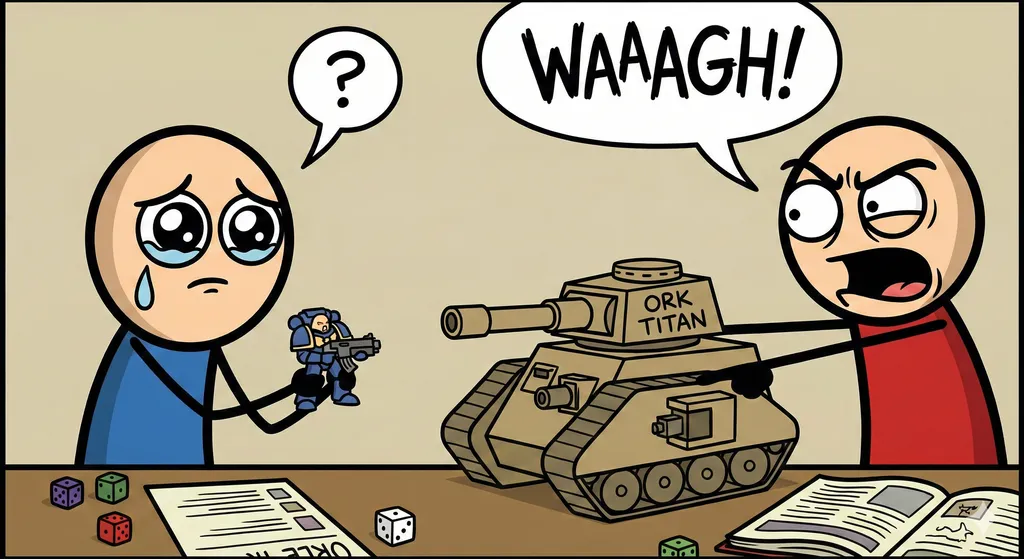
The galaxy trembles once more as Games Workshop unveils the first concrete details of Warhammer 40,000 11th Edition, and for veteran commanders, the most impactful revelation isn't a new faction or a flashy model, but a deep-seated philosophical shift in how units endure the brutal realities of the battlefield: the Save Group system.
For generations, damage allocation in Warhammer 40,000 has been a relatively straightforward affair: wounds were assigned to a unit, and the owning player decided which models would fall. While this offered some tactical flexibility, it often led to scenarios where valuable specialists or characters could be safely shielded behind a wall of expendable troops, or conversely, entire units vaporized by overkill. 11th Edition’s Save Groups, as hinted at by the latest Ruleshammer insights, fundamentally alter this paradigm, demanding a much more nuanced understanding of unit composition and target priority.
At its core, the Save Group system breaks down a unit into distinct sub-components, each potentially possessing different defensive profiles or wound characteristics. Imagine a unit of Space Marine Intercessors. Instead of simply ten identical bodies, you might now have a ‘Standard Intercessor Group,’ a ‘Sergeant Group’ with enhanced resilience, and perhaps a ‘Grenade Launcher Specialist Group.’ When damage is allocated to the unit, it must first be assigned to a specific Save Group. This isn’t a free choice for the player anymore; the nature of the attack and the unit’s internal structure dictate where the blows land. This is where the interaction with ‘Precision’ attacks becomes utterly critical.
Precision, in 11th Edition, appears to be less about singling out an independent character hiding in a unit, and more about forcing damage onto a *specific Save Group* within a unit. No longer can your Primaris Ancient be entirely insulated by a wall of Bolter fodder if your opponent fields a unit with Precision. They can now actively target that critical banner-bearer, forcing you to allocate wounds to his specific, likely more durable, Save Group. This creates a fascinating dance of priority, where the attacker seeks to dismantle key capabilities by targeting their constituent parts, and the defender must learn to mitigate damage to their most vital components. Furthermore, ‘Feel No Pain’ (FNP) rules now apply *after* these Save Group allocations, serving as a final layer of resilience. This means that while a unit might have a broad FNP, the specific wounds and saves of the targeted Save Group are still paramount. It’s a cascading system of defense, demanding foresight and strategic depth.
From a lore perspective, this change is brilliant. It reflects the grim reality of a battlefield where not all lives are equal, and not all armor is identical. A veteran sergeant, hardened by a hundred campaigns, *should* be tougher to bring down than a newly inducted recruit, even within the same squad. A heavy weapon specialist, laden with cumbersome but powerful gear, presents a different tactical challenge than a standard line trooper. This system allows the mechanics to better reflect the narrative, adding a visceral realism to the tactical choices on the table. It’s less about abstract health pools and more about the specific, brutal attrition of war, where commanders prioritize targets and aim for the weak link or the vital specialist. This level of granularity truly immerses players in the desperate struggles of the 41st Millennium.
For the table, this is a significant evolution, not a mere iteration. The introduction of Save Groups, coupled with the refined Precision and FNP rules, promises to elevate the tactical ceiling of Warhammer 40,000 11th Edition considerably. List building will require a fresh perspective; the internal structure of units, and how their Save Groups interact with potential enemy Precision attacks, will become a crucial consideration. No longer will players simply stack units with good saves and high wound counts; they’ll need to consider the *distribution* of those wounds and saves across their sub-components. This shift rewards diverse unit builds and intelligent target prioritization, making every shot and every wound allocation a more meaningful decision. While it might introduce a slight increase in rules complexity initially, the payoff in strategic depth and narrative immersion is immense. This isn't just a new edition; it's a re-evaluation of what makes a unit resilient, forcing veteran players to rethink their fundamental approaches to battlefield survival. Commanders looking to stay ahead of the curve should be poring over every detail of the new Codex supplements as they drop.
Top Pick: Warhammer 40,000 Core Rulebook (11th Edition)
Essential for understanding these foundational changes and the new tactical landscape.
Check Price on Amazon →Related Stories
Orks Unleashed: 11th Edition's Green Tide of Improvements
The 11th Edition of Warhammer 40,000 brings significant, much-needed mechanical refinements to the Ork faction, promising a more robust and tactically engaging
Warhammer 40,000 11th Ed: Meta Shake-Up or Fluff?
Goonhammer's 'That 6+++ Show' has sparked debate on Warhammer 40,000's hypothetical 11th Edition. We dive deep into potential mechanical shifts and narrative im
40K 11th Edition Points: The Meta Shifts Again
Games Workshop's latest balance update, dubbed '11th Edition Points,' is reshaping Warhammer 40,000. Veteran players must re-evaluate strategies as unit costs s