
11th Edition 40K: Unpacking the New Strategic Calculus
The first whispers of Warhammer 40,000's 11th Edition are upon us, sparking fervent discussion among the competitive elite. We dissect the early insights from battle-hardened players navigating its intricate new systems.
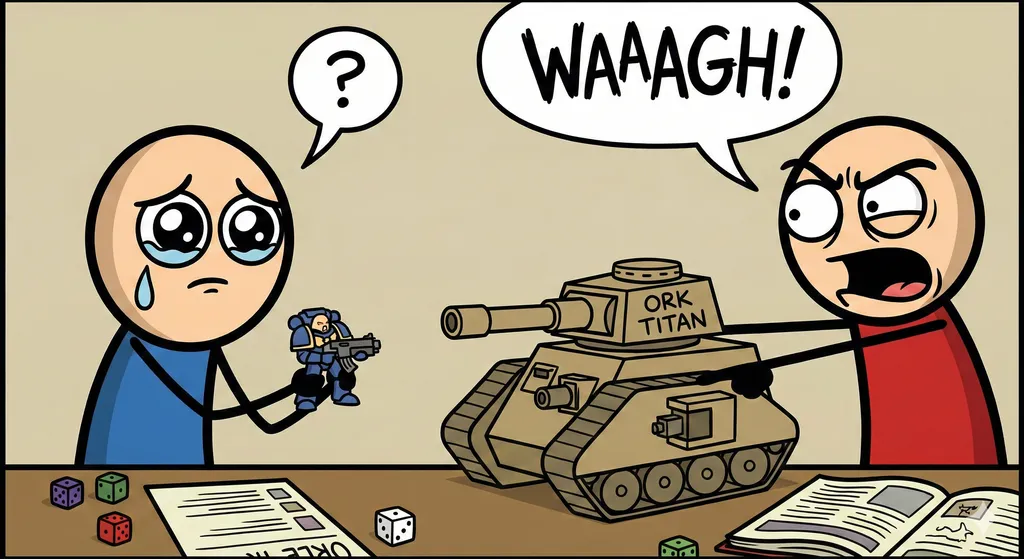
The hallowed halls of tabletop wargaming are abuzz with the impending strategic shift heralded by Games Workshop’s nascent 11th Edition of Warhammer 40,000. While official pronouncements remain guarded, competitive intel, such as the recent deep-dive from Goonhammer, offers a tantalizing glimpse into the rigorous learning process required to master this evolution. Our veteran colleague, Ben, has already plunged headfirst into the new ruleset, and his initial findings paint a picture of a game leaning heavily into dynamic, reactive play over static list optimization.
At the heart of 11th Edition's competitive paradigm appears to be the introduction of 'Strategic Flux Points' (SFP). These aren't simply another resource; they're a quantifiable representation of battlefield momentum, earned through achieving specific mission objectives, eliminating key enemy units, or even successfully weathering a sustained assault. Players begin each battle with a baseline SFP pool, which then fluctuates throughout the game. Crucially, SFP can be spent during the Command Phase to activate powerful, transient effects: boosting a unit’s Toughness for a critical turn, granting a re-roll on a crucial charge, or even temporarily denying an opponent their own objective control. This mechanic forces players to constantly assess the ebb and flow of battle, prioritizing tactical gains that feed their SFP economy. The early reports suggest that understanding the optimal SFP expenditure for various army archetypes will be the ultimate competitive differentiator. It’s a far cry from the more static CP systems of previous editions, demanding a constant, almost improvisational, strategic calculus.
Complementing the SFP system is what seems to be a more nuanced 'Adaptive Doctrine' mechanic. Instead of pre-game declarations, units now gain specific keywords and abilities based on their proximity to controlled objectives or the current SFP state of the battlefield. For instance, an Imperial Guard infantry squad holding a critical objective might gain 'Stubborn Resolve,' improving their leadership and allowing them to ignore certain morale tests. Conversely, a Tyranid swarm overwhelming an enemy position might activate 'Predatory Instincts,' granting bonus attacks. This isn't just about 'holding the line' anymore; it's about *what kind* of line you're holding, and how that line adapts to the shifting tides of war. The lore implications are rich: the unpredictable nature of the 41st Millennium's conflicts, where every battle is a desperate, evolving struggle for survival, is now directly mirrored in the core mechanics. The Imperium’s reliance on doctrine and training, the Aeldari’s swift tactical shifts, or the Orks' brutal adaptability are no longer just fluff; they are embedded in the strategic choices players make turn by turn. Mastering these reactive unit profiles will be key to unlocking the full potential of your chosen faction, making list building less about raw stats and more about versatile unit composition.
So, what does this mean for the table? For veteran players, 11th Edition promises a challenging, deeply engaging experience. The sheer depth introduced by Strategic Flux Points and Adaptive Doctrine moves Warhammer 40,000 away from prescriptive play patterns and towards a more fluid, interactive battlefield. Initial games will undoubtedly be slower as players grapple with the new decision trees, but the long-term payoff is a game that rewards tactical acumen, foresight, and the ability to pivot under pressure. It mitigates the 'solved meta' problem that can plague competitive scenes, as optimal strategies will likely be highly contextual and reactive rather than universally applicable. This emphasis on in-game decision-making over pre-game theory-crafting feels incredibly fresh and revitalizing. While the learning curve will be steep, especially when grappling with the new Strategic Flux Points, the potential for truly epic, back-and-forth narratives on the tabletop is immense. This isn't just a new edition; it's a recalibration of what competitive 40K can be, pushing players to be better generals, not just better list builders.
Top Pick: Warhammer 40,000 Core Rulebook (11th Edition)
Essential for understanding Strategic Flux and Adaptive Doctrine
Check Price on Amazon →Related Stories
Warhammer 40,000: Contemplating the '11th Edition' Quake
The mere whisper of a new Warhammer 40,000 edition, even satirically, provokes deep thought on the game's future. We dissect what an 11th Edition would truly me
Necrontyr Awakening: Kill Team's Strategic Overhaul Revealed
Games Workshop's 2026 Big Summer Preview unveiled a tectonic shift for skirmish players with Kill Team: Necrontyr Awakening. This expansion promises to redefine
40k 11th Ed: Save Groups Redefine Battlefield Survival
Warhammer 40,000 11th Edition introduces Save Groups, a fundamental shift in how damage is absorbed. This system, coupled with revised Precision and Feel No Pai