
Warhammer 40,000: Contemplating the '11th Edition' Quake
The mere whisper of a new Warhammer 40,000 edition, even satirically, provokes deep thought on the game's future. We dissect what an 11th Edition would truly mean for mechanics, lore, and the player experience.
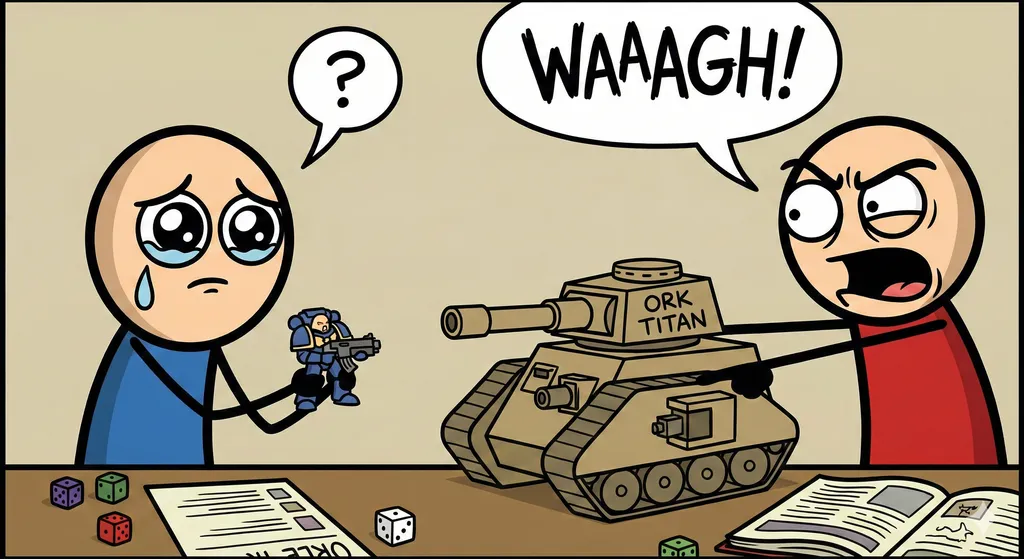
The rumour mill, perpetually churning through the warp, has once again delivered a potent dose of speculative energy. Goonhammer's recent 'Badcast' episode 185, 'The Badcast Enters Chapter 11,' playfully – or perhaps presciently – mentions the 'arrival of 11th edition' Warhammer 40,000. While the context is undoubtedly satirical, the mere utterance of '11th Edition' so soon after 10th's celebrated launch forces us, as veteran players and dedicated analysts, to confront a critical question: What would such a rapid evolution mean for the galaxy's darkest setting, and more importantly, for the health of our beloved game?
Let's first dissect the crunch. 10th Edition, for all its initial streamlining, was a deliberate pivot. It stripped away layers of complexity, consolidated rules into faction indexes, and introduced the Combat Patrol format as a true entry point. The design ethos was clear: accessibility. If an 11th Edition were to materialize within a year or two of 10th, it would signal one of two things: either 10th was a catastrophic misstep requiring immediate course correction, or Games Workshop is shifting to an unprecedentedly aggressive update cycle. The former seems unlikely given the generally positive reception to 10th's foundational changes. The latter, however, brings its own host of mechanical anxieties. Would it be a refinement, tweaking points and keywords, or a fundamental rewrite? Would we see the reintroduction of the Psychic Phase, or the return of granular wargear options that 10th largely abstracted? Each edition, from 3rd to 7th, then 8th, 9th, and 10th, has incrementally redefined core mechanics. A rapid 11th edition would either cement 10th's principles with fine-tuning or, more controversially, introduce a new paradigm before players have fully mastered the current one. The meta, currently in a state of dynamic flux with codex releases, would be thrown into immediate disarray, forcing players to adapt yet again to new universal special rules, detachment abilities, or even a revised Command Point economy.
From a lore perspective, such an accelerated edition cycle would necessitate equally dramatic narrative shifts. 10th Edition kicked off with the monumental Tyranid invasion of the Leviathan Fleet, a galaxy-spanning threat that fundamentally reshaped the Imperium's strategic focus. This was a narrative hook worthy of an edition launch. What cataclysmic event could possibly warrant an 11th Edition so soon? Would the Tyranid threat be resolved, or perhaps eclipsed by an even greater horror? The lore of Warhammer 40,000 thrives on slow-burn narratives and the persistent, grinding attrition of its many wars. A new edition typically marks a significant turning point in the galaxy's grimdark saga. To justify an 11th Edition, we would need to see a narrative event on par with the Great Rift or the return of a Primarch – perhaps the awakening of a C'tan shard, or the definitive emergence of a new Xenos empire. Without such a profound shift, a new edition risks feeling like a mechanical update disconnected from the rich tapestry of the setting, a mere reshuffling of the cards rather than a new chapter in the galactic history.
So, what's the verdict for the table? The prospect of an 11th Edition, even a hypothetical one, immediately raises concerns about player fatigue and investment. Warhammer 40,000 is not a cheap hobby. Players invest significant time and money into their armies, painting them, converting them, and learning their rules. A frequent edition churn can make players feel as though their investment, particularly in learning a ruleset, is constantly devalued. While updates and balance patches are welcome, a full edition change is a commitment. It demands learning a new ruleset, potentially purchasing new rulebooks, and adjusting to a new meta. For new players, the thought of the game constantly changing could be a barrier to entry, rather than an invitation. For veterans, it can lead to a sense of exhaustion, a feeling of perpetually chasing a moving target. The sweet spot for an edition's lifespan often lies in allowing the meta to mature, for players to explore the depth of the ruleset, and for the community to develop its own strategies and innovations before a fresh reset. Rapid editions risk superficial engagement, preventing the kind of deep, tactical play that defines the best tabletop experiences.
While the 'Badcast's' mention of an 11th Edition is almost certainly a playful jab, it serves as a valuable thought experiment. It forces us to consider the delicate balance between refreshing a game and respecting player investment. For now, let's savor 10th Edition and its unfolding narrative. The true strength of Warhammer 40,000 lies not just in its rules, but in the enduring community that embraces its grimdark future. Ensure you're equipped for any edition with a solid foundation. Grab the Warhammer 40,000 Core Book.
Top Pick: Warhammer 40,000 Leviathan Box Set
Excellent value for starting or expanding a 10th Edition force and narrative experience
Check Price on Amazon →Related Stories
11th Edition's Early Meta & The Pre-Painted Terrain Divide
Warhammer 40,000 11th Edition's launch stirs the pot with early 'unbeatable' lists dominating discussion, alongside a heated debate over Games Workshop's push f
Thousand Sons' 11th Ed. Ritual: Regeneration Deep Dive
Goonhammer's preview of the Thousand Sons' Ritual of Regeneration Detachment for 11th Edition Warhammer 40,000 offers a glimpse into their arcane resilience. Th
Orks Unleashed: 11th Edition's Green Tide of Improvements
The 11th Edition of Warhammer 40,000 brings significant, much-needed mechanical refinements to the Ork faction, promising a more robust and tactically engaging