
40k's Shifting Sands: Meta Rankings and the Tabletop Truth
Spikey Bits’ latest Warhammer 40k meta analysis reveals the top-tier and struggling factions. We dissect these competitive shifts to understand their true impact on the casual player and the game's health.
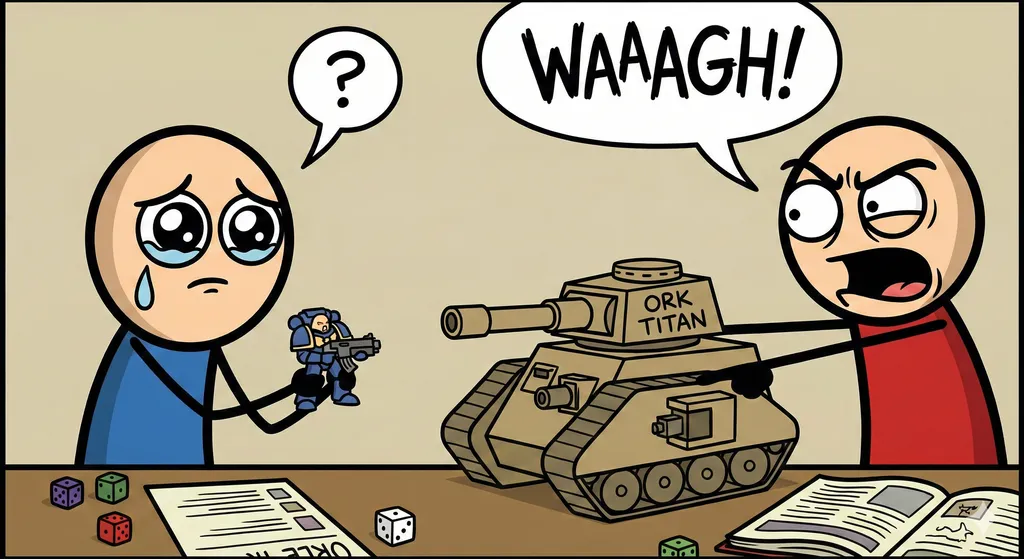
The recent meta analysis from Spikey Bits, dissecting the current state of Warhammer 40,000 under Games Workshop's ever-watchful eye, has once again stirred the crucible of competitive play. While such rankings — highlighting which armies are ascendant and which are struggling — are invaluable for tournament players, "The Crit Sheet" believes their true utility lies in understanding the tectonic shifts beneath the tabletop, and what they mean for every player, from the Grand Tournament circuit to the casual garage brawl.
Mechanically, the ebb and flow of the Warhammer 40k meta is a complex beast, rarely reducible to a single overpowered unit or a glaringly weak datasheet. Instead, it's a symphony of points adjustments, stratagem interactions, core rule interpretations, and the meta-game's reaction to itself. When a faction like, say, the Aeldari, consistently tops the charts, it's often due to an elegant confluence of high-impact abilities, efficient unit profiles, and robust objective play. Their speed and lethality, coupled with potent psychic support and defensive tricks, create a list-building puzzle that is difficult for many opponents to solve. Conversely, a faction "flopping hard" might suffer from an inability to compete on primary objectives, a lack of defensive resilience against prevalent threats, or simply being too points-inefficient for their battlefield role. We've seen iterations where dedicated melee armies struggle against overwhelming shooting, or horde armies crumple under high-strength, high-AP attacks. The critical aspect is not just *what* is strong, but *why* it is strong: Does it bypass core defensive mechanics? Does it generate disproportionate resources? Does it break the action economy? Games Workshop's ongoing efforts with the a robust toolkit for balancing and quarterly balance dataslates are crucial here, aiming to gently nudge the scales back towards equilibrium without completely reinventing every faction's identity.
From a lore perspective, the competitive meta often presents a fascinating, if sometimes jarring, reflection of the grimdark universe. When the Imperium’s elite Custodes or the ancient Aeldari consistently dominate, it resonates with their in-universe status as peerless warriors and master strategists. These are factions whose narrative strength is intrinsically tied to their martial prowess. However, when a faction like the Imperial Guard, the countless brave souls holding the line against unimaginable horrors, consistently finds itself at the bottom of the rankings, it can feel narratively dissonant. It challenges the image of the Imperium's indomitable will and sheer weight of numbers. Similarly, if a faction known for its resilience, such as the Death Guard, struggles to survive on the tabletop, it can undermine the very essence of their thematic identity. The best meta states, from a narrative standpoint, are those where a diverse array of factions can contend, each bringing their unique tactical flavor to the fore, allowing for a more dynamic and lore-appropriate clash of empires.
Ultimately, what does this constant churn of "best" and "worst" mean for the table experience? For the hyper-competitive player, it’s a constant challenge, a puzzle to be solved, and a reason to optimize lists and tactics. For the casual player, however, it can be a double-edged sword. On one hand, a dynamic meta keeps the game fresh, preventing stagnation. On the other, it can inadvertently pressure players into "net-listing" – copying successful tournament lists – rather than fostering creative list building around their favored models or narrative concepts. This can lead to homogeneous play experiences at local game stores, where every opponent seems to field a variation of the same dominant archetype. The beauty of Warhammer 40k, for many, lies in its vast model range and the freedom to craft a unique force. When the meta dictates that only a narrow band of units is "viable," it stifles this creativity and can lead to player frustration or even burnout. Games Workshop's challenge, and our hope, is for a meta where faction diversity is celebrated, where skilled generals can win with a variety of lists, and where the "worst" factions are still capable of punching above their weight with clever play. A healthy meta isn't about absolute parity, but about meaningful choices and rewarding skill over raw power.
Top Pick: Warhammer 40,000 Core Book
Essential for understanding the game's foundational rules and context
Check Price on Amazon →Related Stories
Warhammer 40k 11th Ed: Starter Set Rumors, A New Era Looms
Whispers of Warhammer 40,000 11th Edition's starter set are circulating, signaling potential shifts for Games Workshop's flagship. We dissect what these early m
Chaos Rises: 40k's Next Grand Legionary Refresh Looms Large
Whispers of a massive 2026 Chaos refresh for Warhammer 40,000 are circulating, promising new models and rules. We break down what these rumors could mean for th
Dawn of War 4: The Imperium's Digital Advance Returns in 2026
Warhammer 40k Dawn of War 4 is confirmed for 2026, promising a new era for the iconic RTS series. We dissect what this means for tabletop players and the future