
Beyond Genres: Tagging TTRPGs for Clarity and Discovery
Sly Flourish's discussion on 'Defining RPGs with Tags' offers a vital framework for categorizing TTRPGs. This deep dive explores how a precise tagging system can revolutionize game discovery and table expectations.
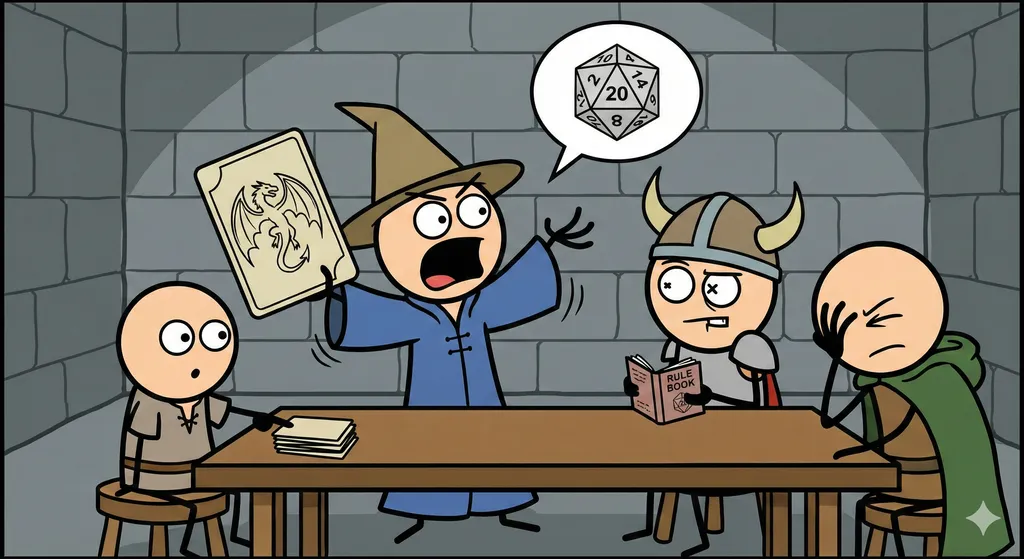
The perennial quest to categorize the sprawling landscape of TTRPGs often feels like wrangling a hydra: chop off one head of vague terminology, and two more sprout. It’s a challenge Sly Flourish, known for his pragmatic insights, recently tackled on his Lazy RPG Talk Show with the concept of "Defining RPGs with Tags." This isn't just academic navel-gazing; it's a critical discussion for GMs and players alike, offering a potential paradigm shift in how we understand, communicate, and ultimately play our games.
At its core, the mechanics of this proposed tagging system are elegantly simple yet profoundly impactful. Rather than relying on broad, often nebulous genre labels like "fantasy" or "OSR," this approach advocates for granular, descriptive keywords that articulate a game's fundamental design principles and play experience. Imagine a game not just being "OSR," but carrying tags such as "High Lethality," "Sandbox Exploration," "Player-Skill Focus," "Rules-Lite Combat," "Resource Management," and "Dungeon Crawl." This moves beyond a marketing blurb to a functional descriptor, a lexicon that allows GMs to precisely articulate the experience they're offering and players to identify exactly what kind of adventure they're seeking.
Consider the practical application: a GM searching for a system that emphasizes narrative control over tactical positioning could filter by "Player-Driven Story" and "Loose Combat Rules," rather than sifting through countless "story games" with wildly divergent actual play. This isn't about creating rigid boxes, but about providing a shared vocabulary for the nuanced mechanics that truly differentiate one TTRPG from another. It’s a meta-system for expectation management, ensuring that when a player sits down, they have a clear understanding of the game's core loop, its GM philosophy, and its player agency. For those looking to refine their GMing craft, I highly recommend GMs check out his other resources for practical advice on streamlining prep.
Historically, the 'lore' of TTRPG categorization has been a muddled affair. Early D&D clones often defined themselves by their proximity or divergence from the progenitor. The OSR movement, while striving for a return to specific principles, still grapples with internal definitions, leading to terms like "NSR" or "Nu-OSR" that only add layers of abstraction. Indie TTRPGs, with their boundless creativity, further complicate matters, often defying traditional genre classifications entirely. This lack of a standardized, descriptive language has led to countless mismatched tables, where a player expecting a heroic power fantasy finds themselves in a gritty, resource-starved survival horror, simply because both were broadly labeled "fantasy RPGs."
Sly Flourish's initiative acknowledges this historical quagmire and offers a pragmatic path forward. It’s about building a common ground, a universal set of descriptors that cuts through marketing fluff and subjective interpretations. This isn't about gatekeeping or limiting creativity; it's about empowering discovery and fostering more informed conversations within our vibrant community. It brings clarity to the often-opaque world of TTRPG design philosophy, making it easier for new players to find their footing and for veterans to explore new horizons.
For the table, the verdict is unequivocally positive. A robust tagging system enhances the "table feel" by reducing friction and elevating player satisfaction. GMs can confidently select systems that align with their preferred style and their group's desires, minimizing the dreaded "session zero surprise" where expectations clash. Players gain agency in articulating their preferences, moving beyond vague statements to precise requests like, "I prefer a game with 'Player-Driven Lore' and 'Rules-Medium' combat." It transforms the sometimes-frustrating search for the 'right' game into an efficient, enjoyable process, leading to more cohesive and fulfilling play experiences. This approach fosters a more transparent, communicative, and ultimately healthier TTRPG ecosystem.
Top Pick: Worlds Without Number
For its modular design and extensive GM tools that benefit from clear categorical thinking
Check Price on Amazon →Related Stories
Elric's Rebirth: Two New RPGs Challenge the Throne
The Young Kingdoms beckon anew as Free League's Dragonbane and Goodman Games' Dungeon Crawl Classics both announce adaptations of Michael Moorcock's iconic anti
Chthonic Echoes: A New Depth for OSR Dungeon Crawls
Iron Crown Studios' Chthonic Echoes promises a return to high-stakes adventuring with its innovative 'Echo Die' mechanic. This deep dive explores how this OSR-i
Perilous Paths: Arcane Scrollworks’ New Die in 'Echoes of the Serpent King'
Arcane Scrollworks has dropped a free preview module for 'Echoes of the Serpent King' in a recent charity bundle, unveiling the intriguing Peril Die mechanic. T