
Crafting Narrative: Beyond the Dice Roll
Gnome Stew's latest, Gnomecast 243, tackles the perennial GM challenge: sparking genuine player roleplay. We dissect their insights into practical techniques for deeper immersion.
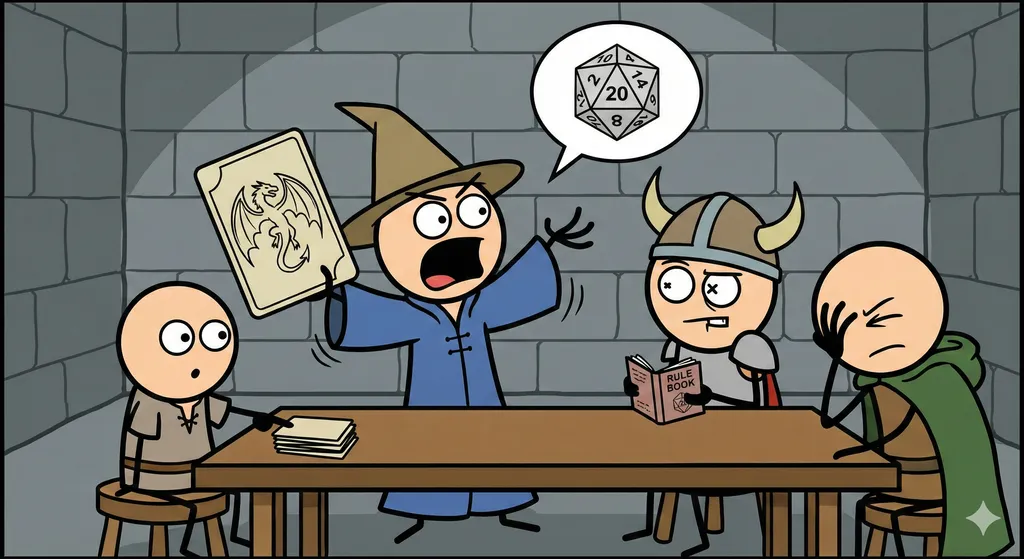
The eternal quest for every Game Master isn't just about crafting intricate plots or balancing encounters; it's about igniting the spark of genuine player immersion. "Gnomecast 243 – Getting Them to Roleplay" from Gnome Stew, a recent deep dive into player engagement, zeroes in on this very challenge: moving players from simply declaring actions to truly inhabiting their characters. This isn't about forcing voices or elaborate backstories, but about cultivating an environment where players *want* to embody their adventurers, where the character's internal world becomes as vital as their stat block.
The podcast’s discussion, while conversational, points towards several concrete mechanical and procedural levers GMs can pull. Firstly, the emphasis on *prompts* is paramount. Instead of asking "What do you do?", a GM can pivot to "How does [Character Name] *feel* about this betrayal?" or "What memory does this dusty inn conjure for [Character Name]?" These aren't rhetorical questions; they demand an in-character response, shifting the player's perspective from external observer to internal participant.
Consider the explicit integration of character traits. Many systems, from D&D 5th Edition's "Bonds, Flaws, Ideals" to FATE's Aspects, provide hooks. A GM should actively weave these into scenarios. A character with a flaw of "cowardice" shouldn't just be *told* they're scared; they should face a situation where their fear presents a tangible choice, perhaps gaining a temporary "Disadvantage" on a bravery check or being offered a clear path to retreat at a narrative cost. Similarly, rewarding roleplaying isn't just a pat on the back. D&D's "Inspiration" mechanic, often underutilized, is a perfect tool. Granting Inspiration for a moment of excellent in-character decision-making or a compelling monologue validates the effort and encourages repetition.
Another powerful technique involves structured downtime. Instead of simply stating "a week passes," GMs can prompt players to describe what their characters *do* during that time, encouraging them to pursue personal goals, engage in hobbies, or interact with NPCs on a deeper level. This provides low-stakes opportunities for roleplaying practice. Furthermore, establishing social mechanics that go beyond a single Persuasion roll is crucial. Systems like *Burning Wheel* excel here, but even in simpler games, breaking down social encounters into stages, with specific goals and consequences for each interaction, forces players to think about *how* their character would approach a conversation, not just *what* skill to roll. For GMs seeking practical advice on integrating these elements seamlessly, I often recommend The Lazy Dungeon Master for its actionable, low-prep approach to engaging narrative.
Beyond the crunch, the "why" of roleplaying lies in the very essence of shared storytelling. When players inhabit their characters, the world ceases to be a mere backdrop for combat and treasure; it becomes a living, breathing entity that reacts to their personalities, their histories, and their choices. The lore, the intricate history of a kingdom, the nuanced motivations of an antagonist, or the cultural quirks of a goblin tribe, all gain resonance when filtered through the lens of a distinct character. A fighter whose family was wiped out by orcs will perceive a new orc threat differently than a scholarly wizard. This personal connection transforms exposition into experience.
Roleplaying breathes life into the narrative by fostering emotional investment. It’s not just about *what* happens, but *how* it affects the characters, and by extension, the players. When a character faces a moral dilemma, a heartbreaking loss, or a triumphant victory, the emotional weight is amplified tenfold if the player is truly invested. This depth creates memorable moments far more enduring than any critical hit or clever trap. It’s the difference between describing a hero's journey and *being* the hero, grappling with their fears and celebrating their triumphs.
The insights from Gnomecast 243 underscore a fundamental truth: fostering roleplay is a collaborative art, not a GM's dictatorial decree. The techniques discussed – thoughtful prompts, mechanical integration of character traits, structured downtime, and nuanced social challenges – are not about forcing players into uncomfortable performances. Instead, they are about creating irresistible invitations. They lower the barrier to entry for hesitant roleplayers while providing rich opportunities for seasoned veterans.
The "table feel" when these techniques are successfully employed is palpable. The game transcends a series of encounters and dice rolls, evolving into a dynamic, character-driven saga. Players lean forward, genuinely curious about what their character would say or do, rather than what the optimal tactical choice might be. This doesn't mean sacrificing strategy or mechanics; rather, it means weaving them into a richer narrative tapestry where character motivation drives action. The ultimate goal is a table where players aren't just moving pieces on a board, but breathing life into heroes and villains, making choices that resonate, and creating stories that belong uniquely to *their* group. It's an essential skill for any GM aspiring to elevate their game beyond the ordinary.
Top Pick: Return of the Lazy Dungeon Master
A masterclass in practical GMing that encourages narrative depth by focusing on player agency and character engagement.
Check Price on Amazon →Related Stories
The GM's First Steps: Cutting Through the Noise for New Masters
Navigating the initial hurdles of Game Mastering can feel like a labyrinth. We dissect essential advice, separating practical mechanics from overwhelming lore f
Blades in the Dark's Brilliance: Three Mechanics Every TTRPG Needs
Delve into the genius of Blades in the Dark and its Forged in the Dark engine. We dissect three core mechanics that elevate narrative play and empower both GMs
The Crit Sheet: Renegade's DCC RPG Crawls to the Tabletop
Gen Con 2026 was abuzz with the Dungeon Crawler Carl RPG from Renegade Games. We break down how this LitRPG phenomenon translates to the tabletop, from its uniq