
D&D's Lore Legacy: An Official Compendium Looms
Penguin Random House is creating an official Dungeons & Dragons encyclopedia. This ambitious project promises to catalog decades of lore, creatures, and settings, offering a definitive reference for GMs and players alike.
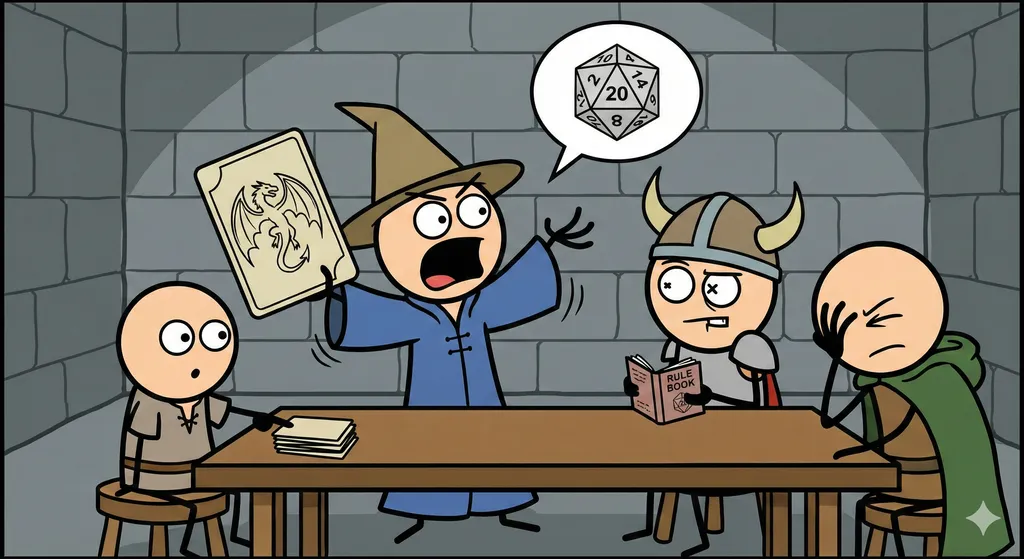
The announcement that Penguin Random House is compiling an official Dungeons & Dragons Encyclopedia has sent ripples through the collective consciousness of the tabletop community, promising a definitive compendium of the game's sprawling history and lore. As veteran GMs and players, our first instinct isn't just excitement, but a critical assessment: what does this mean for the practical application at our tables?
An encyclopedia, in the context of a TTRPG, isn't just a book; it's a tool. Its “mechanics” are in its utility, its navigability, and its authority. How will this D&D Encyclopedia function for the active Game Master or the lore-hungry player? We're talking about the systematic organization of decades of material across numerous editions—from the nascent Chainmail days through Advanced Dungeons & Dragons, the 3rd, 4th, and current 5th Edition. Will it be a single, imposing tome, or a series? The true mechanical test will be its cross-referencing capabilities. Imagine needing to confirm the precise nature of an Astral Dreadnought or the historical context of the Spellplague; a well-designed encyclopedia would offer clear, concise entries, perhaps with edition-specific nuances highlighted, or even better, a reconciliation of conflicting information. This isn't just about listing facts; it's about providing a robust, authoritative framework that GMs can confidently lean on to resolve disputes or fill in gaps without resorting to exhaustive internet searches or pulling out a dozen different sourcebooks. We need to know if the entry for, say, a Beholder, will detail its physiological variations across editions, its societal structure in different settings, and its historical appearances in modules. This kind of structural rigor is the 'crunch' of a reference text, allowing GMs to quickly access and apply definitive information, ensuring consistency and reducing table-time spent on lore disputes. The value here is in the *standardization* and *accessibility* of information, streamlining the process of worldbuilding and adjudication for D&D's vast universe. For GMs running long-form campaigns, having a single, canonical source for the nuances of the Planes or the historical conflicts of the Forgotten Realms would be invaluable, allowing for richer, more cohesive storytelling.
The lore of Dungeons & Dragons is a colossal beast, a magnificent, often contradictory tapestry woven over nearly fifty years. From the foundational mythos of Greyhawk and Mystara to the intricate political machinations of Eberron, the cosmic horrors of Planescape, and the high fantasy of Dragonlance, the sheer volume is staggering. The challenge for this D&D Encyclopedia will be immense: how to distill, clarify, and, where necessary, reconcile the countless established facts, forgotten deities, and retconned histories. Will it prioritize the prevailing narratives of 5th Edition, or will it give due reverence to the deep cuts and obscure corners of earlier editions? A true veteran’s encyclopedia would acknowledge and perhaps even celebrate these historical shifts, providing context rather than simply overriding past canon. It’s an opportunity to solidify the core principles of the D&D multiverse, offering definitive descriptions of creatures, spells, artifacts, and geographical locations. Consider the impact of a comprehensive listing of the major deities and their portfolios across settings, or a detailed timeline of significant events in the Forgotten Realms. This isn't just about cataloging; it's about preserving and presenting the intellectual heritage of the hobby in a cohesive, accessible manner.
So, is this a good development for the game? Unequivocally, yes, with a few caveats. The potential for a centralized, authoritative D&D Encyclopedia is a boon for Game Masters and players alike. It provides a common ground for understanding the expansive settings, resolves ambiguities, and serves as an endless wellspring of inspiration for homebrew content. New players will have an accessible entry point to grasp the foundational lore, while veteran GMs can confirm esoteric facts without arduous research. The caveat, as always, lies in execution. Will it be comprehensive enough? Will it acknowledge the diverse and sometimes contradictory interpretations that have flourished in the community? If Penguin Random House and Wizards of the Coast deliver a truly robust, well-indexed, and thoughtfully curated encyclopedia, it will become an indispensable tool at every D&D table, a permanent fixture alongside the core rulebooks. It has the potential to elevate the quality of play by empowering GMs with definitive knowledge, fostering more consistent and immersive worlds. The Crit Sheet eagerly anticipates the opportunity to pore over its pages, ready to integrate its wisdom into our next epic campaign.
Top Pick: Monster Manual
Essential for any GM to populate their world with iconic D&D creatures.
Check Price on Amazon →Related Stories
D&D's Gen Con Keynote: Decoding the Future of Your Table
Wizards of the Coast is livestreaming their D&D Gen Con keynote, signaling a direct line to the future of the game. We break down what this transparency means f
Between Earth and Sky: Monte Cook Games' Next Narrative Horizon
Monte Cook Games is adapting the Between Earth and Sky novels into a new TTRPG, bringing a rich literary world to the tabletop. This move promises deep lore and
Arcana Unleashed: Deadfall – The Epic Tier Finally Gets Its Due
Emberlight Games' Arcana Unleashed: Deadfall pledges a full Level 11-20 adventure, tackling the often-neglected high-tier of 5th Edition play. The Crit Sheet br