
Hasbro's AI Studio: A Glimmer or a Glitch for D&D?
Hasbro, owner of Dungeons & Dragons, has launched an AI studio to license its characters. This move ignites a critical discussion on the future of TTRPG content generation and creative integrity.
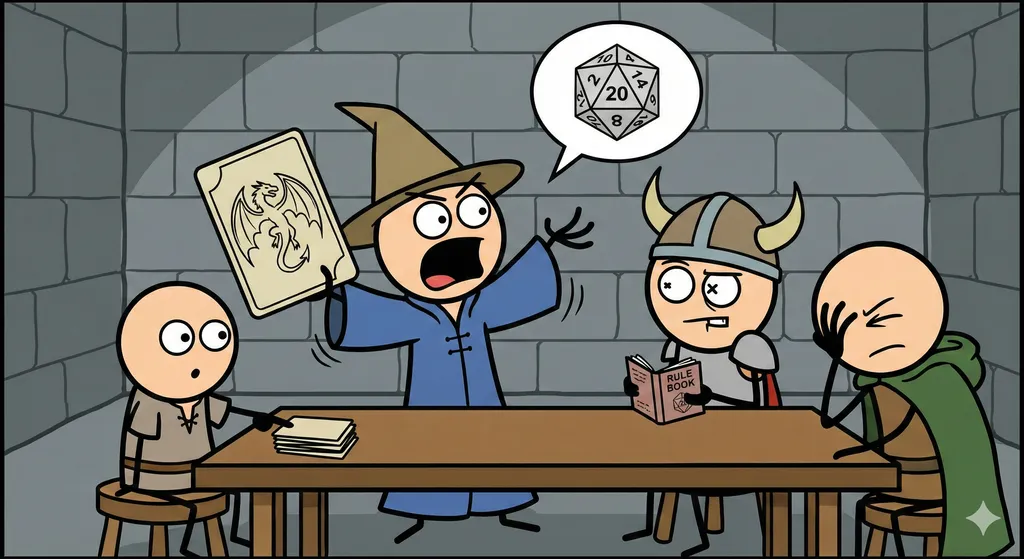
The news from Hasbro, owner of Dungeons & Dragons, regarding their new AI studio for character licensing has sent a ripple through the tabletop community. While the initial report from Wargamer leaves open the question of whether D&D IP will be mined, the implications for our beloved TTRPGs are profound, demanding a closer look at the potential impact on our tables, our lore, and our very process of play.
Let’s address the crunch first: how might an AI studio actually manifest at the gaming table? If applied to Dungeons & Dragons, such technology would likely offer toolsets for content generation. Imagine a Dungeon Master's assistant capable of rapidly generating NPC backstories, adjusting monster stat blocks for specific challenge ratings, or even drafting adventure hooks based on a few keywords. The 'mechanics' here aren't dice rolls or combat rules, but the *mechanics of creation*. An AI could theoretically parse vast datasets of existing D&D content, learning patterns in narrative structure, character archetypes, and encounter balancing. A DM might input 'forest encounter, fey creatures, level 5 party' and receive not just a list of monsters, but a fully fleshed-out scenario with descriptive text, potential traps, and even a few lines of dialogue for a capricious sprite. The efficiency could be staggering, freeing up precious prep time. However, the critical question becomes one of *quality control* and *adaptability*. Can an algorithm truly grasp the nuanced balance of a 5th Edition encounter, or the subtle psychological motivations that make an NPC memorable? The risk lies in generic, bland output that lacks the spark of human ingenuity, reducing the 'crunch' of game design to a predictable formula rather than an art. The true test will be if these tools empower DMs to build *better* campaigns, or merely *faster* ones, potentially at the cost of distinctiveness.
Now, for the fluff: the context within the setting. Dungeons & Dragons thrives on its rich, evolving lore—from the Forgotten Realms' epic sagas to Eberron's pulpy noir. The collaborative storytelling inherent in TTRPGs means that lore isn't just a static background; it's a living narrative shaped by every player's choices and every DM's improvisation. If AI begins generating 'official' or officially sanctioned lore elements, what does that mean for consistency and creative vision? Will a generated character's motivations always align with the established political landscape of Waterdeep? Can an AI craft a compelling mystery that respects the intricate pantheon of gods without accidentally introducing contradictions? The 'feel' of D&D lore is deeply rooted in the passion of its creators and the community's engagement. A dragon's hoard isn't just a list of items; it's a reflection of its personality, its history, and its place in the world. An AI might populate a hoard with statistically appropriate items, but can it imbue it with the unique flavor that makes it memorable? The concern is not just about factual accuracy, but about the *soul* of the setting. Lore is the foundation upon which adventures are built, and if that foundation becomes algorithmically generated, it risks losing the very human touch that makes it resonate.
So, what's the verdict for the table? Is this a boon or a bane for the D&D experience? The answer, as with many technological advancements, is likely nuanced. On one hand, AI tools could be incredibly beneficial for new DMs, reducing the barrier to entry by automating some of the more daunting aspects of preparation. For veteran DMs, it could serve as a powerful ideation engine, providing endless prompts and variations to combat creative blocks. The potential to quickly mock up battle maps, generate unique monster variants, or even translate complex rules into simpler language for players is undeniably appealing. However, the shadow cast by this initiative is the potential for homogenization and the erosion of the unique, often quirky, creativity that defines our hobby. The beauty of a homebrew world, a character with an unexpected flaw, or an adventure path that defies convention often comes from the messy, inefficient, and utterly human process of creation. Will AI-generated content dilute the vibrant ecosystem of third-party publishers and community creators who push the boundaries of D&D? Will it lead to a future where every adventure feels eerily similar because it's drawn from the same algorithmic well? The ultimate arbiter remains the Game Master. AI should be viewed as a sophisticated set of brushes and paints, not the artist itself. It can augment, inspire, and accelerate, but it cannot replace the human element of improvisation, empathy, and the shared narrative experience that defines Dungeons & Dragons. Our tables demand authenticity, and while AI can offer efficiency, the true magic of our games will always reside in the minds and hearts of the players and the DM, building worlds together, one story at a time. For those seeking to deepen their understanding of the craft, exploring official D&D sourcebooks remains paramount.
Top Pick: D&D Beyond Master Tier
For integrated digital tools and resources that enhance, rather than replace, human creativity.
Check Price on Amazon →Related Stories
D&D's Lore Legacy: An Official Compendium Looms
Penguin Random House is creating an official Dungeons & Dragons encyclopedia. This ambitious project promises to catalog decades of lore, creatures, and setting
UA Villain Subclasses: A GM's New Arsenal
Wizards of the Coast's latest Unearthed Arcana introduces revised villainous subclasses. This deep dive explores how these new tools empower GMs to craft more c
Fanatical's Menagerie: A GM's Strategic Haul for 5E
Fanatical's 'Menagerie of Adventures RPG bundle' offers 28 D&D 5E-compatible books at 94% off. This deep dive explores how this diverse collection empowers Game