Guilded Paths: A Cinematic TTRPG Vision Beyond the Screen
The Guild's crowdfunded film unveils 'Guilded Paths,' a TTRPG designed to extend its narrative universe. We dissect its innovative mechanics and lore, evaluating its potential to redefine cinematic tabletop experiences.
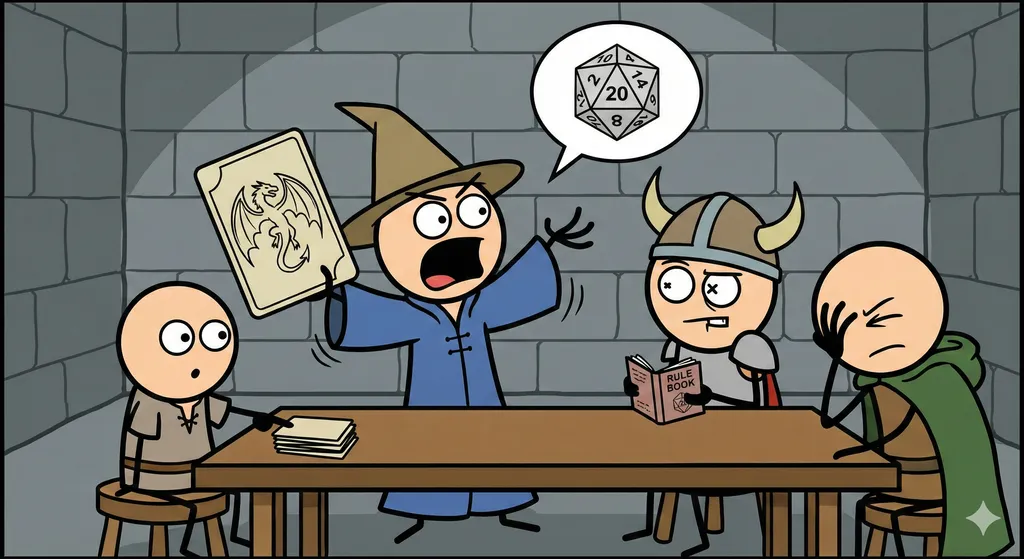
The announcement that 'The Guild,' a highly anticipated crowdfunded film project, will include a dedicated tabletop role-playing game, 'Guilded Paths,' has sent ripples through both the cinema and TTRPG communities. Published by the film’s own newly formed imprint, Felt & Fury Games, this isn't merely a licensed tie-in; it’s an ambitious foray into transmedia storytelling that demands a closer look from us at The Crit Sheet.
At its core, 'Guilded Paths' is a narrative-first system, eschewing traditional stat blocks for a more fluid, character-driven approach. The core mechanic revolves around 'Narrative Momentum' dice pools. Each player character has a set of core Desires (e.g., 'To Prove Worth,' 'To Find Belonging,' 'To Master a Craft') and Flaws (e.g., 'Overconfidence,' 'A Secret Burden'). When attempting a significant action, players roll a pool of d6s equal to their relevant Desire rating, plus any situational bonuses. Successes (typically 4+) generate 'Momentum Tokens.' These tokens aren't just for success; they're a currency. Players can spend Momentum to narrate specific outcomes, add detail to the scene, or even activate 'Cinematic Flourishes' – powerful, once-per-scene abilities tied to their character's arc. Crucially, failing a roll isn't a dead end; it generates 'Complication Tokens' for the Game Master, who can then introduce new obstacles or twists, ensuring the story always progresses, albeit perhaps not as the players initially intended. This elegant feedback loop ensures every roll, successful or not, fuels the unfolding drama, making it genuinely feel like playing out a movie scene.
Lore-wise, 'Guilded Paths' positions players as fledgling members of the titular Guild, an ancient, interdimensional organization dedicated to safeguarding and shaping the foundational 'Narratives' that underpin reality itself. These Narratives manifest as distinct worlds, historical epochs, or even fictional genres. The film itself is presented as one such 'Grand Narrative' that players might explore or even subtly influence. Characters aren't just adventurers; they are 'Chroniclers' or 'Architects' of story, tasked with intervening when a Narrative risks unraveling, or when a 'Void Weaver' — an antagonist seeking to corrupt or erase stories — threatens existence. This meta-narrative framework is brilliant. It not only justifies the TTRPG's existence alongside the film but also provides an infinitely scalable setting. One session could see your Guild member fixing a temporal paradox in a steampunk metropolis, the next could involve protecting a nascent hero in a high fantasy realm. The implied connection to the film's events provides a compelling launchpad, but the system is clearly designed to stand on its own, offering vast creative freedom for GMs and players to craft their own 'Guild Missions' across the multiverse. The initial campaign module, 'Echoes of the First Narrative,' is rumored to directly tie into the events leading up to the film, offering a unique prequel experience. Guild Master's Sourcebook
So, is 'Guilded Paths' good for the game? Absolutely. While the cynical among us might initially dismiss a crowdfunded movie tie-in as a secondary thought, Felt & Fury Games appears to have put significant thought into creating a system that is not only thematically resonant but mechanically engaging. The Narrative Momentum system provides tangible player agency in shaping the story, moving beyond simple pass/fail outcomes to a more nuanced 'how does this failure make the story more interesting?' dynamic. The lore, far from being restrictive, opens up a boundless multiverse of storytelling opportunities, making it a fantastic tool for Game Masters who thrive on worldbuilding and improvisation. My primary concern would be the initial learning curve for players accustomed to more traditional, crunchy systems, but the payoff for those willing to embrace its narrative focus promises rich, cinematic sessions. This is a bold move that, if executed well, could set a new standard for how creative projects bridge different media, proving that a TTRPG can be more than just marketing collateral; it can be an integral, living extension of a story.
Top Pick: Shadowdark RPG
For GMs seeking another elegant, streamlined system that encourages creative problem-solving and emergent narrative.
Check Price on Amazon →Related Stories
Aetherbound Expeditions: Charting the Sundered Isles
Arcane Foundry Games' latest crowdfunding effort for Aetherbound Expeditions promises sky-high adventure and deep tactical play. We dissect how its new 'Zephyr
Echoes of the Sundered Star: A Deep Dive into Astral Forge's Sci-Fantasy Gem
Astral Forge Games launches 'Echoes of the Sundered Star,' a promising sci-fantasy TTRPG on crowdfunding. We dissect its innovative Echo Pool mechanics and rich
Chronos Engine: Echoes & Agency in TTRPG Storytelling
Aetherforge Games' Chronos Engine introduces a revolutionary Dynamic Causality System. This mechanic empowers players to collaboratively shape game lore and his