
Magic's Paradox: Can Cards Still Explain Themselves?
Magic: The Gathering faces a growing tension between increasing card complexity, rapid release cycles, and the influx of new players. The age-old wisdom 'reading the card explains the card' is under unprecedented strain.
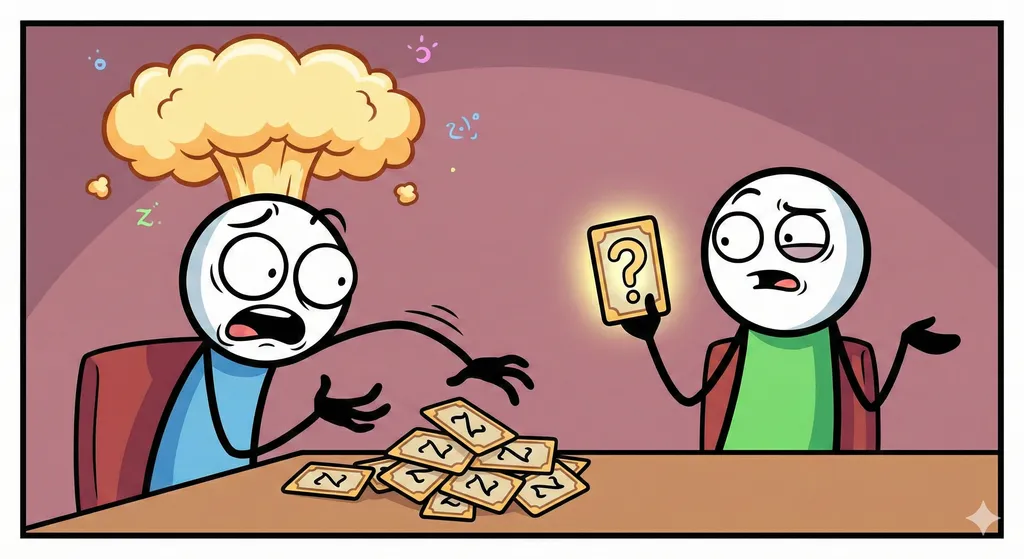
The hallowed halls of tabletop gaming echo with a persistent, if polite, debate regarding the current state of Magic: The Gathering. Wizards of the Coast, under the Hasbro banner, has undeniably ushered in an era of unprecedented growth and innovation. Yet, this very expansion presents a profound paradox: as the game strives for broader appeal, its core mechanics and lore are simultaneously growing more intricate, challenging the foundational tenet that a card's text should be its own clear arbiter.
The casual wisdom, “reading the card explains the card,” has served generations of players, a simple mantra for navigating the game’s ever-expanding rules. In 2026, however, this adage feels less like a guiding principle and more like a cruel joke for newcomers, and a weary sigh for veterans. The sheer volume of new cards — multiple Standard-legal sets, Commander precons, supplementary products, and Universes Beyond drops annually — means that even dedicated players cannot hope to parse every new interaction. This isn't just about the quantity; it's about the density of rules text. Modern common cards often feature more lines of complex, conditional abilities than rare cards from a decade ago. Keywords are no longer just shorthand; they often carry hidden layers of rules baggage that demand external knowledge, or at least a quick search on Scryfall, to truly comprehend. The game’s design philosophy seems to be pushing the boundaries of what a single cardboard rectangle can convey, leading to a constant state of rules ambiguity at the table, where the actual play experience grinds to a halt while players consult Oracle text or argue interpretations. The elegant simplicity of early Magic has given way to a baroque tapestry of triggers, replacements, and state-based actions that can make even a simple combat phase feel like a legal deposition.
The lore, once a pillar of Magic's identity, also finds itself at a crossroads. While Universes Beyond has undeniably injected fresh narratives and beloved characters, from Warhammer 40,000 Commander Decks to Fallout, into the game's ecosystem, it has also fragmented the core IP. The rich, internally consistent planes of Dominaria, Ravnica, or Innistrad now share the stage with properties that carry their own established mythologies. For new players drawn in by these familiar franchises, the learning curve is steep enough just grasping Magic's rules; connecting to the deeper, original lore of the Multiverse often becomes an afterthought, secondary to understanding the complex interactions of their favorite pop culture characters. For veterans, this can feel like a dilution, a trade-off where the unique, resonant fantasy of Magic sometimes takes a backseat to cross-promotional synergy. The increasingly verbose mechanics on cards often leave less room for evocative flavor text, further reducing the immediate textual connection to the game's intrinsic narrative.
So, is this good for the game? The verdict from the table is, predictably, mixed. For a segment of the player base, particularly those deeply invested in competitive Modern or Standard, the constant influx of new, powerful, and intricate cards offers an endless puzzle to solve, a meta-game to dissect and conquer. However, for the vast majority, especially those who gather around a kitchen table for a casual Commander format game, the escalating complexity can be a significant barrier. New players, overwhelmed by the sheer volume of unique effects and the implied knowledge of a quarter-century of rules interactions, often find themselves frustrated. Even veteran Game Masters, accustomed to parsing complex systems, find themselves struggling to keep up with the nuanced interactions that define the current Magic landscape. The spirit of spontaneous, intuitive play is diminished when every other card requires a deep dive into its comprehensive rules. The community's creativity, once fueled by elegant design, now often leans into finding broken synergies within an increasingly complex web of rules, rather than appreciating the individual elegance of a card.
While Magic: The Gathering remains a titan, its current trajectory demands a re-evaluation of design principles. The game needs to find a way to welcome new players with clarity, while still providing depth for veterans, without sacrificing the intuitive understanding that once made it so approachable. The best cards should *still* explain themselves.
Top Pick: Commander Legends: Battle for Baldur's Gate
Excellent set for accessible, lore-rich Commander gameplay.
Check Price on Amazon →Related Stories
Flash Photography: Unpacking a 500% Price Surge in Final Fantasy MTG
The Magic: The Gathering x Final Fantasy card, Flash Photography, has seen an unprecedented 500% price increase, leaving many players wondering why. This deep d
"Skate into the Fray": Legacy's New Skateboard Dominates the Meta
"Skate into the Fray," a TMNT crossover artifact from Magic: The Gathering, is making waves in Legacy. This unassuming equipment offers trample, a combat damage
Landfall Triumphs in TMNT Magic Spotlight: A Deep Dive
Puglisi Clark's Mono-Green Landfall deck secured a significant victory in the Magic Spotlight: Teenage Mutant Ninja Turtles event. This win underscores the endu