
Maro's Secret Project: Mood Swings & The Art of Simplicity
Mark Rosewater, Magic: The Gathering's head designer, unveils Mood Swings, a TCG honed for 28 years. This deep dive explores its mechanics, lore, and potential impact on tabletop gaming.
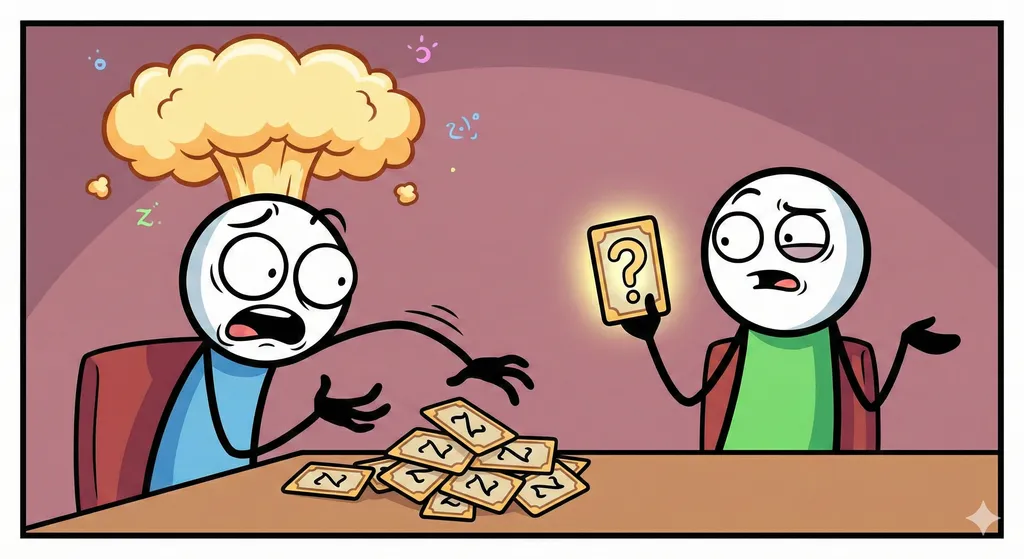
The whispers are true: Mark Rosewater, the venerable architect of Magic: The Gathering, is finally pulling back the curtain on Mood Swings, a fast-paced, simple TCG he's been secretly honing for nearly three decades. This isn't just another card game; it's a window into the mind of a master designer, stripped bare of corporate mandates and decades of accumulated complexity. For those of us who appreciate elegant design and the raw power of a well-crafted mechanic, this announcement from the Wargamer source is nothing short of fascinating.
At its core, Mood Swings, as described, eschews the escalating power creep and keyword soup that often characterizes modern collectible card games. Instead, it leans into fundamental psychological states. Imagine a game where your primary resource isn't mana or energy, but *emotions*. Players begin with a 'Core Mood' card, perhaps 'Serenity' or 'Ambition,' which subtly dictates their starting strategy and provides a passive bonus. Each turn, players draw 'Impulse' cards – these are the game's actions, representing thoughts, events, or reactions. Impulse cards have a 'Mood Cost' – for instance, an 'Aggressive Outburst' might require two 'Anger' points, while a 'Moment of Clarity' might demand one 'Calm' point. Mood points themselves are generated by playing other Impulse cards or by the effects of your Core Mood.
The genius in this simplicity lies in its inherent tension. Moods are often antagonistic; accumulating 'Joy' might diminish 'Sadness' on your board, but perhaps a powerful 'Insight' card requires both. The victory condition isn't about reducing an opponent's life total directly, but rather their 'Emotional Resilience.' This could manifest as a track, where accumulating too many negative moods or failing to manage your emotional state pushes you closer to an 'Overwhelmed' or 'Burnout' state, signifying defeat. The interplay between building your own emotional state and disrupting your opponent's, all through a streamlined resource system, promises a strategic depth that belies its initial simplicity. It's a system that rewards careful planning, reactive play, and a keen understanding of your opponent's psychological landscape, much like a good poker game or a classic abstract strategy board game.
The lore of Mood Swings, though likely minimalistic given its 'simple TCG' designation, is ripe with potential. Envision a world where players are 'Mind-Weavers' or 'Emotive Architects,' battling not with swords and sorcery, but with the raw, untamed forces of the psyche. The 'Core Moods' aren't just starting points; they're the very essence of your avatar, shaping your perceptions and capabilities. Impulse cards become manifestations of internal struggles or external influences, each with a tangible impact on the shared mental arena. This setting allows for incredibly evocative card art and flavor text, turning each play into a narrative beat in a psychological duel. It’s a compelling departure from the typical high fantasy or sci-fi settings, grounding the conflict in something universally understood yet deeply personal.
So, is Mood Swings good for the game? Absolutely. Mark Rosewater's design philosophy has consistently championed elegance, clarity, and the player experience. A game he has personally refined for 28 years, without the pressures of a massive corporate machine, is likely to be a masterclass in focused design. It offers a refreshing alternative to the ever-increasing complexity of many TCGs, potentially serving as an accessible entry point for new players while providing profound strategic depth for veterans. Its focus on psychological states could foster unique player interactions, bluffing, and mind games, providing a 'table feel' that is both intimate and intensely competitive. This isn't just a new TCG; it's a testament to sustained passion and iterative design, reminding us all that sometimes, the most profound experiences come from the simplest rules. It’s an exciting prospect for the broader landscape of TCGs, and a valuable lesson in game design for anyone looking to create something truly resonant.
Top Pick: Gloomhaven: Jaws of the Lion
Its streamlined approach to a complex system proves that less can be more for player accessibility and depth.
Check Price on Amazon →Related Stories
Sedgemoor Witch: Arcavios's Spell-Slinging Engine Awakens
The unassuming Sedgemoor Witch has seen a dramatic price surge, fueled by a renewed focus on Strixhaven's spellcasting prowess. This 2-mana warlock is proving t
Strategic Drops: Unpacking MTG Arena's Digital Resource Stream
The persistent presence of MTG Arena codes isn't merely a perk; it's a sophisticated lever in Wizards of the Coast's digital economy, shaping player engagement
Standard Gets Stormy: Prismari Resurfaces a Classic Threat
The recent surge of Prismari Storm in Standard has players scrambling to understand this surprising return of a traditionally non-Standard archetype. This deep