
Overturn: Abstract Strategy, Deep Lore, and the GM's Toolkit
The obscure Pressman title, Overturn, a thrift store enigma, presents a fascinating case study in abstract strategy and how minimalist design can inspire expansive lore at the tabletop. We dissect its potential as a TTRPG mini-game and worldbuilding catalyst.
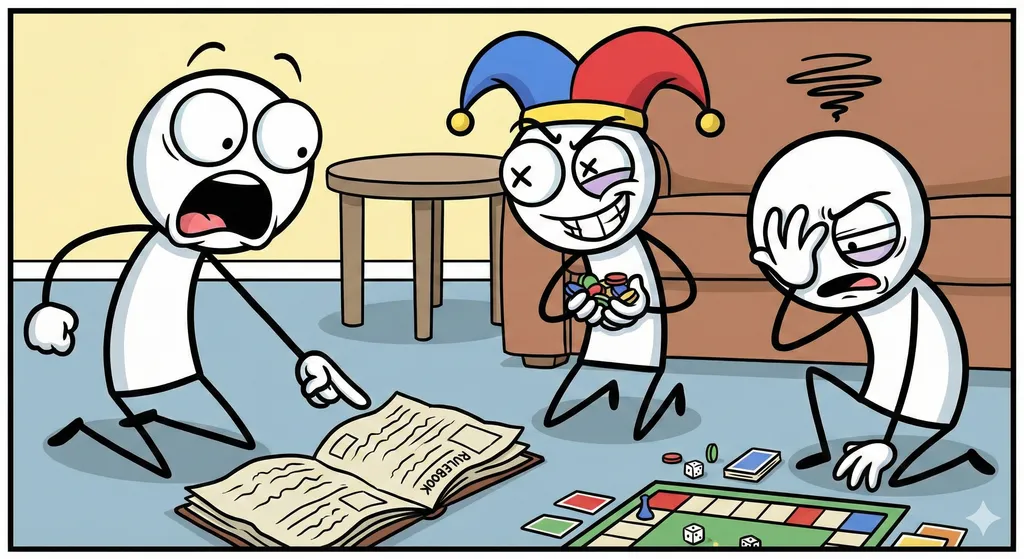
The obscure Pressman title, Overturn, a thrift store enigma, presents a fascinating case study in abstract strategy and how minimalist design can inspire expansive lore at the tabletop. Discovered amidst the forgotten relics of family game nights, this unassuming board game, much like its spiritual cousin Othello, beckons us to consider how elegant mechanics, even those from a decades-old abstract, can enrich our roleplaying campaigns.
At its core, Overturn is a game of territorial control and strategic conversion, played on a striking black frame housing eighteen white square tiles. Each tile, a nexus of nine distinct 'Power Glyphs,' represents a micro-arena for influence. The genius lies in its simplicity: two players, vying for dominion over these glyphs. A player's turn involves placing a marker on an unoccupied Power Glyph within any tile, initiating a cascading chain of potential 'overturns.' The critical mechanic is the 'Glyph Cascade.' When a player places a marker, they create a vector of influence. If this vector, extending from the newly claimed glyph, successfully 'flanks' an opponent's marker on an *adjacent* tile, all intervening Power Glyphs on that flanked tile — and potentially further tiles in a chain reaction – are 'overturned,' flipping to the current player’s control. The '9 letters p' on each tile aren't just decorative; they are the individual segments of power, each representing a minor node of control. The game concludes when all Power Glyphs are claimed, or no legal moves remain, with victory going to the player controlling the majority.
Now, let's talk fluff. For the veteran Game Master, Overturn isn't just a dusty board game; it's a blueprint for an in-world political struggle, a magical ritual, or even a tactical combat simulation. Imagine the 'Power Glyphs' not as mere game pieces, but as runic symbols of elemental alignment, ancestral spirits, or the very ley lines of a forgotten continent. The act of 'overturning' becomes a magical contest between rival mages, a political coup in a shadowy court, or the shifting tides of battle between two ancient factions. A single game of Overturn could represent a season of skirmishes in a larger war, where the outcome dictates the availability of resources or the morale of an army. Furthermore, the 'raised black frame' and 'white square tiles' suggest an ancient, almost sacred artifact—perhaps a divination tool or a relic of a bygone empire used to predict the ebb and flow of cosmic energies. The Tome of Abstract Mechanics The lore writes itself when the mechanics are this clean: who invented this game? What prophecies are hidden within its patterns? What cosmic struggle does it mirror?
So, is Overturn good for the game? Absolutely. For the TTRPG table, it's a potent tool. As a mini-game, it offers a refreshing break from combat or social encounters, providing a tangible, strategic challenge for players. Imagine your party needing to 'play' Overturn against an NPC to secure a critical alliance, decipher an ancient riddle, or even settle a dispute in a high-stakes gambling den. The abstract nature means it can be reskinned for virtually any setting—from sci-fi starship maneuvers to fantasy spell duels. Beyond direct play, its elegant 'Glyph Cascade' mechanic offers inspiration for designing unique spell systems, political intrigue frameworks, or even environmental hazards that players must 'overturn' to overcome. It trains players in strategic thinking and pattern recognition, skills invaluable in any complex TTRPG. Overturn proves that sometimes, the simplest systems yield the deepest tactical and narrative wells.
Top Pick: The Art of Game Design: A Book of Lenses by Jesse Schell
Essential reading for GMs seeking to understand and apply fundamental game design principles to their campaigns.
Check Price on Amazon →Related Stories
Somnus Domina's Soul of Trickery: A Vulpine Deep Dive
Nat 19's upcoming D&D expansion, The Soul of Trickery, promises vulpine deception and assassination for 2026. This article explores its potential mechanics, lor
Shadowdark's Crimson Veil: Gritty Stamina & Stress Deep Dive
Arcane Scrollworks unveils "Crimson Veil" for Shadowdark RPG, introducing a new Stamina & Stress system. We dissect how these mechanics amplify the OSR experien
Aetherium's Luminous Gambit: Unpacking 'Tripping the Light Fantastic'
ChronoForge Games' latest Aetherium Chronicles supplement, 'Tripping the Light Fantastic,' promises to revolutionize movement and illusion within the vibrant se