
The Player Aid Imperative: Clarity at the Table's Core
Unclear rules can shatter game night. This deep dive explores how robust player aids are critical for smooth gameplay and deeper immersion. We analyze the 'breaking point' phenomenon and its impact on the gaming experience.
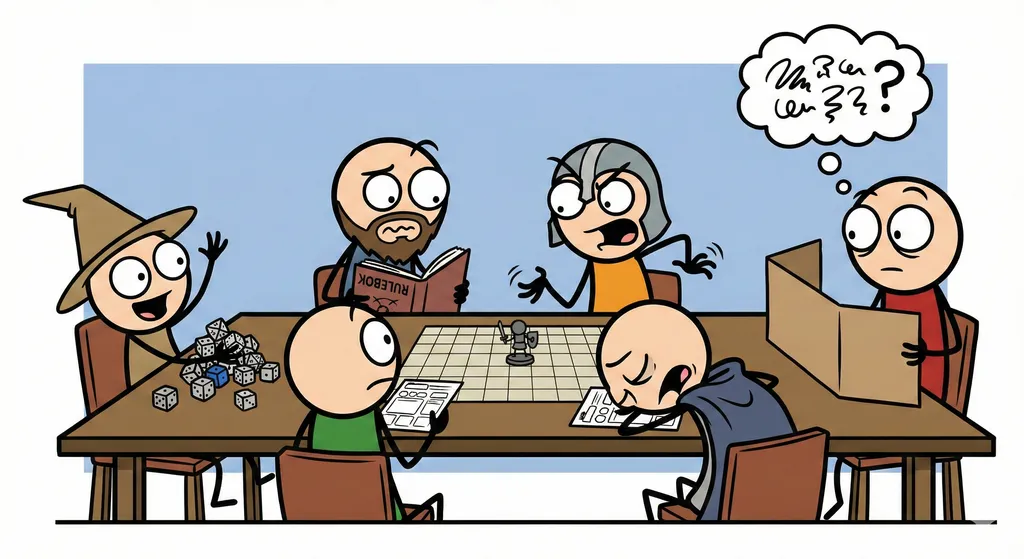
“Read the Player Aid!” from any competent game designer, publisher, or even the community itself, isn't just a suggestion; it's a foundational pillar of enjoyable tabletop gaming. This principle, often overlooked until frustration boils over, recently hit home for me, not in the pages of a brand-new rulebook, but through a series of frustrating gaming sessions that mirrored a deeply personal 'breaking point.'
Like many, I’ve had those moments of existential dread staring at a number on a scale, prompting a desperate scramble for clarity and better habits. Similarly, after three consecutive nights of rules disputes, fumbled turns, and the collective groan of players trying to decipher an obscure interaction, I felt a familiar anger. It wasn’t the players' fault, nor entirely the game's, but rather a systemic failure in how information was presented and accessed. The crucial lesson here, for designers and GMs alike, is that the elegance of a system's mechanics is only as good as its accessibility.
Let's talk crunch. The mechanics of a good player aid aren't about adding complexity; they're about *removing* it. We're not discussing a new ability or a combat maneuver; we're analyzing the meta-mechanics of information delivery. A well-crafted player aid functions as a rapid-access database, a cognitive shortcut that allows players to spend less time parsing text and more time making meaningful decisions. This could be a concise two-page spread summarizing all core actions and conditions, or a cleverly designed personal dashboard with iconography for common effects. The best aids don't just list rules; they illustrate them, often with flowcharts for complex sequences or clear examples of edge cases. Consider a system like Warhammer 40,000's Kill Team, where the core rules are dense, but the individual datacards and quick reference sheets for each faction are paramount. They distill the necessary information into an immediately actionable format, allowing players to focus on tactical positioning rather than rulebook spelunking. Without this kind of clarity, even the most elegant core engine grinds to a halt, leaving players feeling like they're fighting the rules, not the enemy.
From a lore perspective, clear mechanics and player aids are the bedrock upon which shared stories are built. When players are constantly pulling their heads out of the game world to consult a dense tome, the immersive spell breaks. The grand narrative, the intricate worldbuilding, the compelling character arcs—all these 'fluff' elements suffer when the 'crunch' is inaccessible. Imagine a tense moment in a Shadowdark RPG dungeon crawl: the rogue needs to pick a lock, the fighter is holding a door, and the wizard is preparing a spell. If the GM and players are fumbling for the exact rules on lockpicking difficulty, spellcasting components, or grappling, the tension dissipates. Instead of a gripping narrative, you have a rules seminar. When the rules are intuitive and readily available, the focus shifts entirely to the *story* unfolding at the table. Players embody their characters more fully, make decisions driven by lore rather than procedural uncertainty, and collectively weave a richer, more cohesive narrative tapestry. The game's world feels more real, more tangible, because its internal logic is consistently applied and understood by all.
The verdict on the table feel is unequivocal: well-designed player aids are not just a luxury; they are a necessity for a truly satisfying gaming experience. For GMs, they reduce the burden of being the sole arbiter of every rule, empowering players to take ownership of their character's capabilities and the game's systems. For players, they foster confidence, encourage strategic thinking, and minimize frustration. The 'breaking point' I experienced, and that which the source material so eloquently describes in a different context, stems from a fundamental lack of clarity leading to repeated, unsatisfactory outcomes. In gaming, this translates to slower play, arguments, and ultimately, a diminished desire to return to the table. Investing in clear, concise, and comprehensive player aids – whether as a designer, a publisher, or even as a GM creating your own house-rule summaries – is an investment in the longevity and enjoyment of your game. It ensures that the only 'critical failure' at your table is one rolled on the dice, not one born of confusion.
Top Pick: The Crit Sheet's GM Screen with Integrated Reference Cards
Essential for streamlined rules access and quick rulings during play.
Check Price on Amazon →Related Stories
Ancestry Reforged: Grimstone Chronicles' Bold New System
Black Iron Games' Grimstone Chronicles introduces a revolutionary Heritage & Calling system, decoupling biology from culture for deeper character generation. Th
Huckleberry: A Wyrd West RPG’s Gritty Frontier Appeal
Huckleberry: A Wyrd West RPG carves out a niche in the dark fantasy landscape, blending frontier grit with cosmic horror. This deep dive explores its innovative
Draw Steel's Summoner: More Than Just Minions, It's War! (On a Budget)
Forge Studios' Draw Steel introduces the Summoner class, shattering combat norms with tactical depth. This deep dive unpacks how it redefines battlefield contro