
Playthings: The Organic Evolution of Tabletop Play
Curio Games' Playthings transcends mere intuitiveness, offering an experience that cultivates emergent rules and narrative. It's a game that doesn't just make sense; it grows.
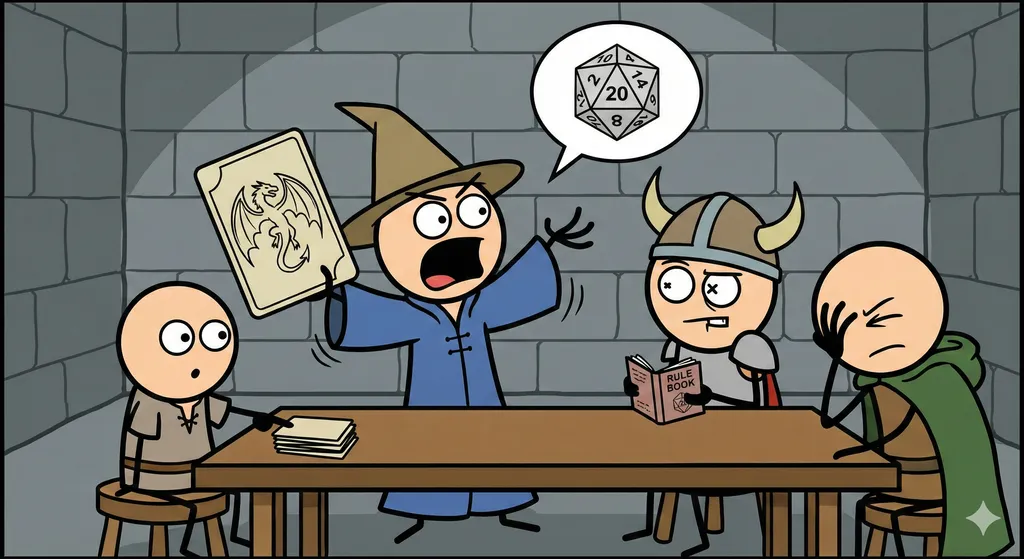
Playthings by Curio Games challenges our fundamental understanding of what a tabletop experience can be, moving beyond mere intuitiveness to something truly organic. In an industry often defined by meticulously crafted rulesets and pre-ordained narratives, Playthings emerges from the primordial ooze of imagination, demanding a re-evaluation of our most basic gaming tenets. This isn't just a game; it's a seed, planted at the table, whose growth is entirely up to the players.
At its core, Playthings operates less like a traditional board game and more like a collective dream made manifest. The 'mechanics' are, in fact, an absence of rigid mechanics. Players begin with a handful of abstract components – a collection of polished stones, perhaps, or a deck of evocative, wordless cards – which serve as the titular 'Playthings.' The initial ruleset is astonishingly sparse: a simple framework for introducing elements, describing actions, and asking questions. Crucially, the *answers* to these questions, and the *consequences* of those actions, are not found in a rulebook. Instead, they are collaboratively woven into existence by the players themselves. A player might declare, “My Plaything, the Clockwork Nightingale, attempts to sing a lullaby to the Shadow-Beast.” The game then prompts the group: “What must happen for the lullaby to succeed? What does success look like? What if it fails?” Through this iterative, consensual process, abilities emerge, challenges are defined, and the very physics of the shared imaginative space are established. Success is often determined by narrative consensus or by the communal expenditure of 'Imagination Tokens,' abstract resources that represent the collective creative energy. It's a game where the rules are not learned, but *discovered* and *negotiated* in real-time, making every session a unique, unrepeatable system design exercise.
The lore of Playthings is intrinsically tied to its organic mechanics. The setting is a liminal space – a forgotten nursery, a dusty attic, or the quiet corners of a dreaming mind – where the power of childhood imagination holds sway. The 'Playthings' themselves are not inert objects, but dormant entities, awaiting the stories and beliefs of players to grant them form and function. Players embody 'Dream Weavers' or 'Imaginauts,' children (or the echoes of children) whose very thoughts shape the reality around them. The latent conflict isn't against a villain with a stat block, but against the encroaching forces of 'Grown-Up Logic' or 'The Grey,' abstract concepts that threaten to solidify and sterilize the vibrant, ever-changing world. It’s a melancholic whimsy, evoking the bittersweet transience of childhood fantasy, where magnificent castles can be built from blankets and fearsome dragons vanquished with a whispered word. The game doesn't just tell a story; it embodies the *act* of storytelling as a world-shaping force, a concept beautifully explored in the `Collaborative Storytelling Guide` which offers further insights into emergent narrative.
Is this good for the game? For *Playthings*, absolutely. This design philosophy is not for every table, nor is it attempting to be. Players accustomed to the rigid structures of 5th Edition D&D or the tactical precision of Kill Team 2024 might find the lack of concrete resolution frustrating. However, for groups who revel in improvisation, collaborative world-building, and deep, unscripted role-playing, Playthings is a revelation. It fosters a unique sense of ownership over the narrative and the world itself, blurring the lines between player, GM, and game system. It's a potent reminder that the most compelling experiences often arise not from intricate engines, but from the raw, unfettered power of shared imagination. This is a game that truly lives up to its name, inviting players to return to the fundamental joy of unconstrained play, building worlds with the ephemeral stuff of dreams.
Top Pick: The Quiet Year
For groups who appreciate emergent narrative and collaborative world-building.
Check Price on Amazon →Related Stories
Personal Demons: Cowan's Return to the Tabletop Psyche
Judson Cowan, known for Deep Regrets, unveils Personal Demons, a cooperative narrative card game. It promises to rekindle that initial spark of discovery with p
The Unseen Campaign: Mastering Tabletop Logistics
Beyond the dice rolls and character sheets lies a meta-game of logistics. Discover how veteran groups tackle the epic challenge of getting their grandest campai
Not Alone: Remastered – A Masterclass in Asymmetrical Tension
Geek Attitude Games' Not Alone: Remastered Edition sharpens the claws of its asymmetrical survival horror. Players navigate a treacherous alien world, desperate