
Quickdraw: The TCG Experience, Distilled to 18 Cards
Ryan Migalla's Quickdraw promises the strategic depth of a trading card game without the endless investment. This innovative dueling game achieves complex synergies with a mere 18 cards.
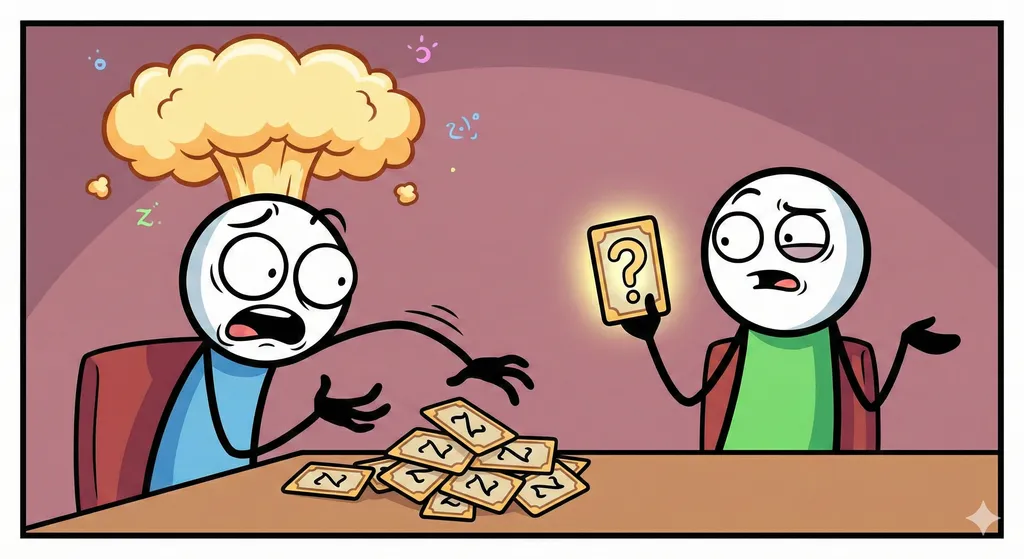
Ryan Migalla, an indie designer, has unveiled 'Quickdraw,' a micro-dueling game that dares to deliver the strategic punch of a full-fledged Trading Card Game with an astonishingly lean 18 cards. This isn't just another small box; it's a gauntlet thrown down at the feet of an industry often defined by endless chase rares and ever-expanding card pools. As veteran players, we know the allure of a robust meta and intricate deck construction, but we also feel the weight of its financial and time commitment. Quickdraw, as Migalla outlines on his design blog, aims to sever that Gordian knot, offering the pure, unadulterated thrill of TCG play in a remarkably compact package.
The core mechanical innovation lies in what Migalla terms a 'double-edged team building and resource system.' With just 18 cards, this immediately suggests a design philosophy where every single card is multi-functional, a micro-engine unto itself. Imagine a hand of cards where each can be played for its primary effect, pitched for a resource, or perhaps even used to upgrade another card in a limited 'team' tableau. The 'double-edged' nature implies tough choices: using a card for immediate power might deny you a crucial long-term synergy, or building your 'team' might leave your immediate defenses vulnerable.
This isn't about collecting; it's about mastering a finite set. The 'deck design' aspect, with only 18 cards, likely translates into a pre-game drafting or selection process from a slightly larger pool, or perhaps the 18 cards *are* your deck, and the mastery comes from understanding their interplay. The 'asymmetric opponent' suggests either varied starting conditions or unique character cards that fundamentally alter playstyles. We're talking about a system where every point of resource generation, every damage dealt, every defensive posture is magnified. It's the precision of a Swiss watch, where one gear out of place brings the whole mechanism to a halt. The depth here isn't in volume, but in the intricate web of interactions that 18 carefully crafted cards can generate. It’s a testament to elegant design, demanding players to truly understand their tools, not just acquire more of them. For a deeper dive into minimalist game design, check out 'The Game Design Workshop'
Quickdraw, in its current description, is a game almost entirely devoid of explicit lore. And frankly, that's part of its genius. In a design space so constrained, every word, every piece of art, every thematic tie-in must earn its place. The absence of a sprawling narrative isn't a flaw; it's a feature. This allows the mechanics themselves to become the story. The 'dueling' aspect implies two combatants, two opposing forces, and the 'team building' suggests a group of operatives or champions. The narrative emerges from the play: the desperate gambit to draw a specific card, the calculated sacrifice, the perfectly executed combo that turns the tide.
This minimalist approach also offers GMs and players a blank canvas. Imagine reskinning Quickdraw for a quick skirmish in a grimdark future, a high-stakes magical duel in a fantasy realm, or even a corporate espionage battle. The skeletal framework supports countless thematic overlays, making it incredibly versatile for those who love to inject their own narrative. It’s the ultimate proof that sometimes, less truly is more, especially when the 'more' comes from the players' imaginations rather than an overburdened rulebook.
How does this translate to the table? For TCG veterans, Quickdraw promises a refreshing palate cleanser. It’s the high-level strategic thinking without the homework of memorizing hundreds of cards or the sting of opening another dud booster. Games will likely be swift, intense, and deeply cerebral. Every turn will feel impactful, every decision weighted. The 'iterating against an asymmetric opponent' suggests a dynamic meta that evolves not through card releases, but through player mastery and adaptation to a fixed, yet complex, ruleset.
This is a game for the player who loves to dissect, to optimize, to truly understand the elegant machinery of a system. It’s not for those who crave endless novelty through new product drops, but for those who find satisfaction in plumbing the depths of a finely tuned engine. Quickdraw isn't just a game; it's a statement about design efficiency and player agency. It reminds us that the joy of discovery and competitive iteration doesn't require an open wallet, but an open mind. If Migalla’s vision holds, Quickdraw could be a revelation for the micro-game genre and a much-needed antidote to TCG bloat.
Related Stories
Winter's Chill: Wondrous Creatures: Winterfall's Strategic Depth
Veridian Studios' Wondrous Creatures: Winterfall expansion introduces a harsh new climate to Starbeak Island. Players must adapt their strategies, manage new en
Taiki Shinzawa's Ghosts of Christmas: A Temporal Trick-Taking Masterpiece
Taiki Shinzawa's 'Ghosts of Christmas' reinvents trick-taking, transforming it into a multi-layered strategic dance. This game challenges players to navigate te
The Ring That Didn't Rule: Why LotR MTG's Signature Mechanic Fell Flat
Mark Rosewater's post-mortem on The Lord of the Rings: Tales of Middle-earth reveals a surprising design misstep: the 'Ring tempts you' mechanic. Despite initia