
Tactical Sketching: Why Small Maps Elevate TTRPGs
The Crit Sheet investigates the growing trend of 'Tactical Sketching,' a map philosophy championed by games like Threshold & Torchlight. We break down how drawing small, imperfect maps can revolutionize your table's pacing and immersion.
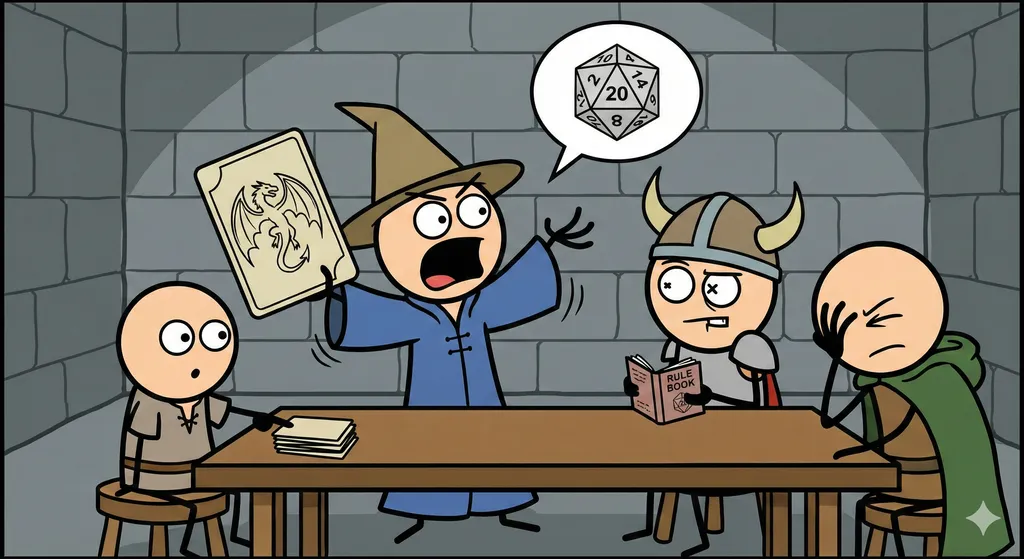
The recent buzz around Forge & Scroll Studios’ upcoming Threshold & Torchlight RPG isn't just about its elegant d6 dice pool system; it’s about a design philosophy that challenges the very notion of what a battle map *should* be. The movement, which we've dubbed 'Tactical Sketching,' echoes the venerable advice of Sly Flourish: embrace the small, the hand-drawn, the imperfect. This isn't a new concept, but its deliberate integration into a modern indie title signals a powerful shift back towards core TTRPG principles.
At its crunchiest, Tactical Sketching redefines the GM's role in spatial representation. Instead of elaborate, pre-printed battle maps or digital VTT assets laden with intricate detail, the GM quickly sketches only the immediately relevant features of an encounter area. Think key obstacles, cover points, and general dimensions – a few lines, a couple of circles, and perhaps an 'X' for a treasure chest. This isn't theatre of the mind, nor is it a fully rendered diorama; it's a potent middle ground. Mechanics like movement rates in Threshold & Torchlight are clarified by the sketch, but not overly constrained. A player declaring their character moves 'to the overturned cart for cover' instantly understands the spatial relationship because the cart is a prominent, if crudely drawn, feature. Line of sight becomes a quick ruling based on the visible elements, rather than pixel-perfect calculation. This approach drastically cuts down on GM prep time, allowing for more dynamic, on-the-fly encounter design. It also subtly shifts the cognitive load: players are encouraged to actively visualize and fill in the blanks, rather than passively consume a pre-rendered scene. The map becomes a shared mental construct, guided by the GM’s quick strokes, rather than a definitive, immutable truth.
From a lore perspective, the philosophy of Tactical Sketching aligns perfectly with the gritty, exploratory nature of games like Threshold & Torchlight RPG. Imagine a desperate band of adventurers delving into forgotten ruins or navigating a shadowed forest. They wouldn’t have access to perfectly rendered blueprints or satellite imagery. Their understanding of the immediate environment would be piecemeal, based on quick glances, whispered warnings, and vital landmarks. A quickly sketched map, imperfect and focused only on the immediate dangers and opportunities, mirrors this in-world reality. It reinforces the sense of urgency, the unknown, and the need for improvisation that is central to many classic fantasy narratives. This isn't about simulating reality with perfect fidelity; it's about evoking the *feeling* of being in that reality. The 'lore' here isn't about dragons and ancient empires, but about the very *experience* of adventuring – raw, immediate, and often, uncertain. It speaks to the OSR ethos of player skill over character sheet statistics, extending that to environmental awareness.
So, is this good for the game? Absolutely, for the right tables. Tactical Sketching fosters a more collaborative and imaginative play experience. GMs are freed from the tyranny of endlessly detailed maps, allowing them to focus on pacing, narrative, and engaging NPCs. Players, in turn, become more active participants in visualizing the environment, leading to deeper immersion and more creative tactical solutions. It reduces analysis paralysis often associated with overly complex battlefields, keeping the action flowing. While some players undoubtedly prefer highly detailed visual aids, the 'small map' approach offers a potent alternative, especially for GMs who prioritize improvisation and a swift narrative pace. It's a return to the roots of TTRPGs, where imagination was the primary engine, and the tools were simple, yet infinitely versatile. For those looking to streamline their sessions and inject a dose of spontaneous creativity, embracing Tactical Sketching, as championed by the core rulebook for Threshold & Torchlight, is a worthwhile endeavor.
Top Pick: The Crit Sheet's GM Toolkit: Improvised Encounters
For mastering on-the-fly game design.
Check Price on Amazon →Related Stories
Beyond Genres: Tagging TTRPGs for Clarity and Discovery
Sly Flourish's discussion on 'Defining RPGs with Tags' offers a vital framework for categorizing TTRPGs. This deep dive explores how a precise tagging system ca
Cabin Fever: A Pirate Borg GM's Treasure Trove
Limithron's Cabin Fever offers an expansive collection of community-created content for Pirate Borg, proving the system's adaptability. This deep dive explores
Elric's Rebirth: Two New RPGs Challenge the Throne
The Young Kingdoms beckon anew as Free League's Dragonbane and Goodman Games' Dungeon Crawl Classics both announce adaptations of Michael Moorcock's iconic anti