
The Armageddon Anomaly: How GW Finally Delivered on 40k
Games Workshop's recent Warhammer 40,000 Armageddon launch defied expectations, delivering product smoothly to retailers. This unexpected success signals a potential shift in how the publisher approaches enthusiast market distribution.
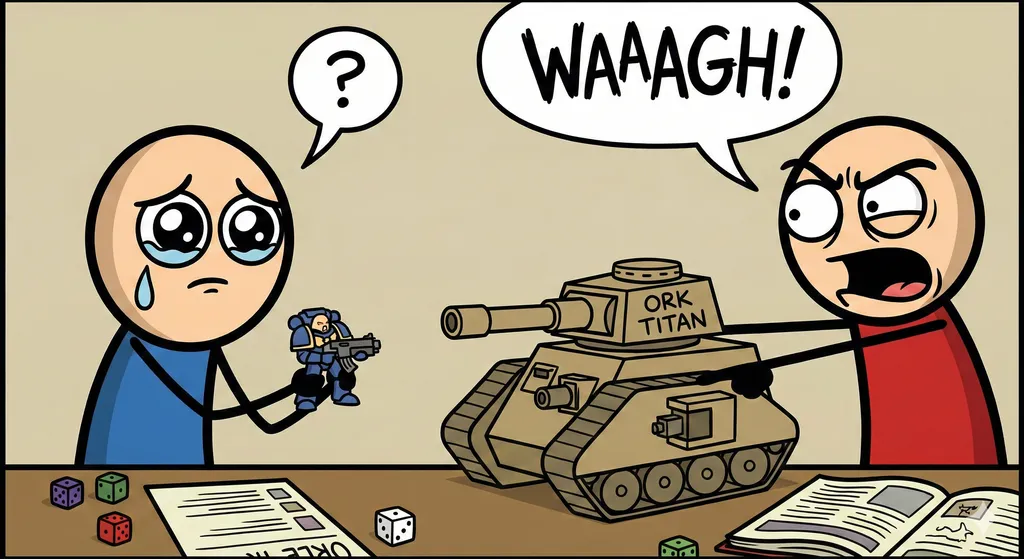
The recent launch of the Warhammer 40,000 Armageddon box from Games Workshop has sent a ripple of pleasant surprise through the tabletop community. For years, the release of high-demand products from the venerable publisher has been a fraught exercise in anticipation, frustration, and often, disappointment. Retailers would brace for the inevitable allocation pain, receiving a fraction of their requested stock, while players would enter a digital Hunger Games for pre-orders, often losing out to bots or opportunistic scalpers. Yet, with Armageddon, something different happened: stores received the stock they actually asked for, and the shelves, for once, felt adequately supplied.
This isn't merely good news; it's a critical shift in the *mechanics* of engagement. For the longest time, the acquisition of new Warhammer 40,000 products felt like an additional, unwelcome layer of strategy required before the game even began. The 'allocation lottery' was a core, albeit unwritten, mechanic of the hobby. Stores, the lifeblood of our local communities, were routinely short-changed, struggling to meet player demand and often losing sales to online giants or the secondary market. This created artificial scarcity, driving up prices and fostering a sense of anxiety around new releases. When a new unit datasheet dropped, or a compelling new faction was introduced, the immediate concern wasn't its battlefield efficacy, but whether one could even *obtain* the models to field it. A smooth launch, where product meets demand, fundamentally alters this. It means that the *game mechanics* of a new unit, a new scenario, or a new faction are actually accessible to players without an artificial barrier. It represents a functional improvement in the system by which we, as players, interact with the very content the designers craft. The ability to simply walk into a store and pick up the new Steel Legion units for your Armageddon campaign is, in itself, a crucial mechanical improvement to the hobby.
Beyond the logistical crunch, the setting of Armageddon itself holds immense *lore* significance within the grimdark future of Warhammer 40,000. It is a world synonymous with unending war, a crucible where the Imperium's finest — the Space Marines, the Imperial Guard, and legendary figures like Commissar Yarrick — have repeatedly clashed with the greenskin tide of Ghazghkull Thraka. To launch a product centered on Armageddon is to tap into decades of narrative depth: siege warfare, the resilience of humanity, and the sheer brutality of the 41st millennium. For players, being able to readily acquire models, rulebooks, or campaign supplements tied to such an iconic conflict means they can immediately immerse themselves in this rich history. It's not just about new models; it's about enacting those legendary battles on their own tabletops, adding a new chapter to the sagas of the Emperor's chosen or the rampaging Orks. The lore becomes tangible, playable, and immediate, rather than a wistful promise held hostage by supply chain woes.
So, what does this mean for the *table feel*? In short: everything. A smooth launch removes a significant layer of pre-game frustration. Players can focus on list building, painting, and strategizing, rather than chasing down elusive boxes. Game Masters planning narrative campaigns or store owners organizing leagues can do so with confidence, knowing that participants will actually have access to the necessary components. This fosters a healthier, more engaged community. When players feel respected and supported by the publisher, their enthusiasm for the game grows. It cultivates goodwill, encourages participation in new content, and ultimately, leads to more games being played. The 'table feel' isn't just about the dice rolls and strategic decisions; it begins the moment a player decides to engage with a new product. If that initial engagement is positive, the entire gaming experience benefits immeasurably. This Armageddon launch wasn't just a product release; it was a testament to what's possible when the focus shifts back to the player experience, allowing us all to simply enjoy the grimdark future we love.
Top Pick: Warhammer 40,000 Core Rulebook
Essential for understanding the grimdark future
Check Price on Amazon →Related Stories
GW's Summer Previews Outshine 11th Ed. Reveal: A Deep Dive
Games Workshop's Summer Previews delivered compelling mechanics and lore, starkly contrasting the underwhelming '11th Edition' reveal. This analysis explores ho
Bourbon & Bolters: A New Paradigm for Warhammer Retreats
Bourbon & Bolters offers a unique, all-inclusive Warhammer tournament experience. This deep dive explores its mechanics, thematic resonance, and impact on the t
Warhammer 40,000: Contemplating the '11th Edition' Quake
The mere whisper of a new Warhammer 40,000 edition, even satirically, provokes deep thought on the game's future. We dissect what an 11th Edition would truly me