
The Crit Sheet: Humble GMing & Shared Tabletop Discovery
Sly Flourish's timeless insight reminds us that the best Game Masters don't dictate, but learn alongside their players. This collaborative approach fosters incredible table experiences and empowers shared narrative ownership.
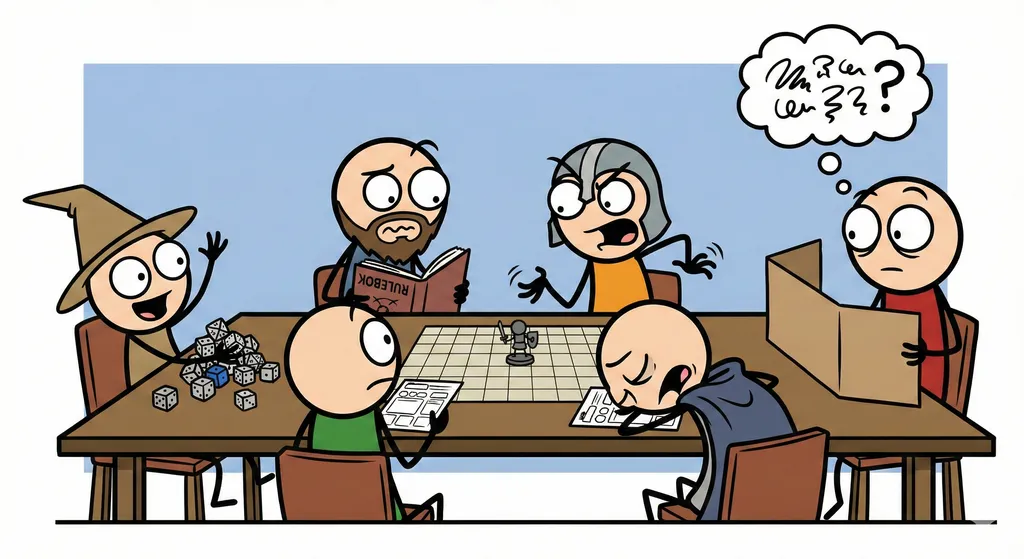
The foundational philosophy articulated by Sly Flourish in his enduring 'Let's Learn Together' article, originally from 2015, isn't just sage advice for Game Masters; it's a profound design principle for the very *act* of running a tabletop roleplaying game. Drawing inspiration from Bob Ross's unassuming mentorship, Sly Flourish posits that the most effective leaders—and by extension, the most inspiring GMs—don't assume omniscient authority. Instead, they invite everyone to learn, discover, and create together. This isn't corporate fluff; it's a mechanical and philosophical cornerstone that elevates a game from a GM's monologue to a shared saga.
Consider the often-contentious realm of rules adjudication, the very crunch of our hobby. A GM operating under the 'learn together' ethos doesn't just pull a ruling from on high or retreat to the rulebook for a silent consultation. Instead, they might vocalize their uncertainty: "This is an interesting edge case. How do you all interpret this? What feels most narratively satisfying *and* mechanically fair here?" This isn't about abdication of GM responsibility; it's about distributed cognition. It leverages the collective intelligence of the table. In a 5th Edition game, when a player attempts an improvised action not explicitly covered by the three pillars, a 'learning together' GM might ask, "What skill do you think best represents that? What's the stakes here?" This transparent negotiation empowers players, transforming them from passive recipients of rulings into active participants in the game's very operating system. It’s akin to how a veteran Commander player might consult the table on a complex stack interaction, not because they don't know, but to ensure everyone's on the same page and invested in the outcome. This approach breeds trust and a shared understanding of the game's internal logic, making every dice roll, every Advantage or Disadvantage, feel earned and understood.
Beyond the raw mechanics, this philosophy profoundly shapes the lore and narrative. The very fabric of your campaign's setting becomes a collaborative tapestry, richer and more vibrant for every thread woven by a player. When a GM genuinely asks, "What does your character's hometown look like? What ancient rivalry scars this region?" they aren't just filling in blanks; they're inviting co-authorship. The world of your Shadowdark dungeon crawl or your sprawling Pathfinder Adventure Path gains depth when player backstories aren't just static elements but active inputs into the living world. NPCs react with more nuance because the GM is genuinely curious about how player actions will ripple through the established lore, rather than just waiting for players to hit pre-scripted plot points. This emergent storytelling means that the 'fluff' isn't just background dressing; it's a dynamic, evolving entity shaped by every individual at the table. It fosters a sense of belonging to the world, rather than merely visiting it, making the stakes feel intrinsically personal.
So, is this good for the game? Unequivocally, yes. The table transforms from a lecture hall into a vibrant workshop where every player is an apprentice designer, a contributing lore master, and a co-conspirator in the unfolding drama. It reduces GM burnout by shifting the burden of absolute knowledge from one person to a collective, allowing the GM to enjoy the surprises and discoveries alongside their players. Campaigns run with this ethos are often more memorable, more unique, and possess a depth of player investment that pre-planned narratives struggle to achieve. It fosters a less adversarial environment, even in games with competitive elements, by emphasizing shared journey over individual performance. For any Game Master looking to deepen their craft and truly unlock the collaborative magic of TTRPGs, embracing the principles of 'learning together' is not just a technique; it's a paradigm shift.
Top Pick: Return of the Lazy Dungeon Master
For refining your GM prep with a focus on emergent play and collaborative storytelling
Check Price on Amazon →Related Stories
Slaying Quantum Ogres: Flexible Prep, Real Player Agency
The dreaded 'Quantum Ogre' threatens player agency by moving encounters. Sly Flourish's 'Eight Steps' offers a robust methodology to build dynamic, responsive c
The Narrative Power of Non-Mechanical Outcomes
Sly Flourish challenges GMs to embrace fictional outcomes over strict mechanics for every roll. This approach enriches TTRPGs, fostering deeper immersion and mo
The Modular 5e: Crafting Your Perfect Tabletop Engine
Sly Flourish's observations on 'House Rules from Various 5es' highlight 5th Edition's unexpected strength: its modularity. We dissect how veteran Game Masters l