
The Fat Sack's Return: Fueling Wargaming's Creative Engine
The return of the fabled "Fat Sack of Bits" ignites a crucial discussion on tabletop creativity and the thriving secondary market for miniature components. We dissect how these raw materials empower players to sculpt unique narratives and enhance their wargaming experience.
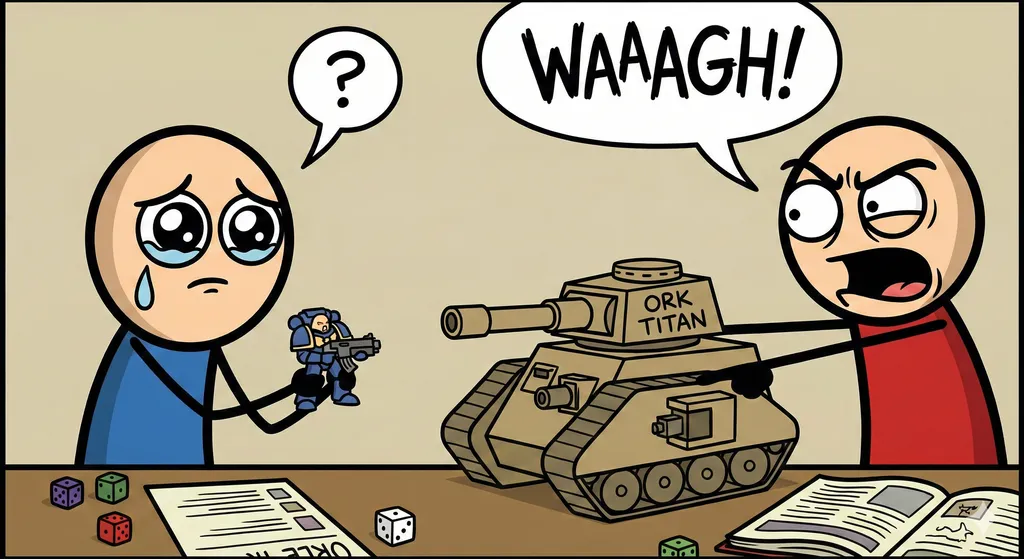
The recent announcement from Spikey Bits heralds the return of the venerable 'Fat Sack of Bits,' a treasure trove of miniature components and conversion parts that has long been a staple of the wargaming community. While not an official Games Workshop product, the 'Fat Sack' — and the broader ecosystem it represents — is an undeniable force in shaping the Warhammer 40,000 landscape. This isn't just about discounted plastic; it's about the very soul of hobby creativity, the unsung mechanics of kitbashing, and the rich narrative tapestry players weave outside the official canon.
For the uninitiated, a 'Fat Sack of Bits' is precisely what it sounds like: a random assortment of sprue remnants, individual limbs, weapons, heads, and various detritus from countless kits. Its 'mechanics' are entirely player-driven, a testament to the ingenuity of the hobbyist. The immediate impact is on customization. Players can acquire specific, often rare, components to complete conversions, repair damaged models, or simply inject unique character into their armies without purchasing entire new kits.
Consider the competitive scene. A well-executed conversion, born from a meticulously sourced bit, can signify a specific loadout or unit variant with crystal clarity on the tabletop, avoiding proxy confusion. An Ork player might find the perfect 'shoota' arm to differentiate a unit of Flash Gitz, or an Imperial Guard commander might finally source enough specific Cadian command bits to build a truly unique general for their regiment. This isn't just aesthetic; it’s about tactical clarity and the ability to represent bespoke unit entries from Forge World or older codexes without breaking the bank. The 'Fat Sack' facilitates the personal meta, allowing players to experiment with niche builds or visually represent house rules more effectively. It’s a direct challenge to the 'build-it-as-the-box-shows' mentality, empowering players to truly own their army's identity. This also extends to custom terrain pieces, providing invaluable small details to bring battlefields to life.
Beyond the practical applications, the 'Fat Sack' profoundly impacts the lore, not as an official decree, but as a vibrant, living extension of the Warhammer 40,000 universe. Every kitbashed model tells a story. That Space Marine with a unique helmet or an Ork with a scavenged Imperial weapon isn't just a variant; it's a veteran of countless battles, a testament to battlefield salvage, or a relic from a forgotten campaign. The lore of the 41st Millennium is one of endless war, desperate improvisation, and bizarre mutations. What better way to embody this than through models built from disparate parts, mimicking the very nature of a universe constantly rebuilding itself from the wreckage?
A custom Inquisitor, cobbled together from a dozen different kits, embodies the eclectic nature of the Ordo Xenos far more effectively than a single factory-stamped miniature. A unique Chaos Lord, bearing trophies from multiple factions, feels like a true champion of the Dark Gods, his history etched into every piece of his armour. This secondary market of bits fosters a deeper engagement with the setting, encouraging players to delve into the minutiae of lore to justify their conversions, often leading to incredibly rich background stories for individual models. It transforms static lore into dynamic, player-driven narratives, enriching the shared universe from the ground up.
Is the recurring 'Fat Sack of Bits' a boon for the game? Unequivocally, yes. For all the corporate machinations and standardized releases, the heart of wargaming lies in creativity and community. The 'Fat Sack' supports both. It democratizes access to conversion parts, making bespoke armies more attainable for players on a budget. It fosters a culture of kitbashing and unique model creation, pushing the boundaries of what's possible within the hobby.
On the table, this translates to a richer, more visually engaging experience. Facing an opponent's army that clearly has hours of personal investment and unique storytelling baked into each model is simply more inspiring than a parade of identical, out-of-the-box units. It sparks conversation, encourages appreciation for craftsmanship, and ultimately strengthens the bonds within the community.
While some purists might argue for strict adherence to official models, the very spirit of Warhammer 40,000 — a grimdark future where every piece of scrap is repurposed and every warrior is unique in their struggle — is perfectly captured by the 'Fat Sack' philosophy. It's a vital artery in the hobby, pumping fresh ideas and personal flair into the veins of our armies. It’s not just bits; it’s potential, waiting to be unleashed.
Top Pick: Green Stuff World Liquid Green Stuff
Essential for seamless kitbash conversions and filling gaps between disparate bits.
Check Price on Amazon →Related Stories
The Mystery Box: Value Proposition or Hobby Hoarder's Gamble?
Spikey Bits's 'Massive New Mystery Miniatures Box' is back, promising double value for $69. We delve into the mechanics and lore of this collecting phenomenon,
Chaos Rises: 40k's Next Grand Legionary Refresh Looms Large
Whispers of a massive 2026 Chaos refresh for Warhammer 40,000 are circulating, promising new models and rules. We break down what these rumors could mean for th
Warhammer 40k 11th Ed: Starter Set Rumors, A New Era Looms
Whispers of Warhammer 40,000 11th Edition's starter set are circulating, signaling potential shifts for Games Workshop's flagship. We dissect what these early m