
The Four Doors: A Masterclass in Iterative Card Game Design
Matt Leacock and Matt Riddle's The Four Doors emerges from a fascinating five-game evolutionary journey. This deep dive explores how a complex design process forged a refined tabletop experience.
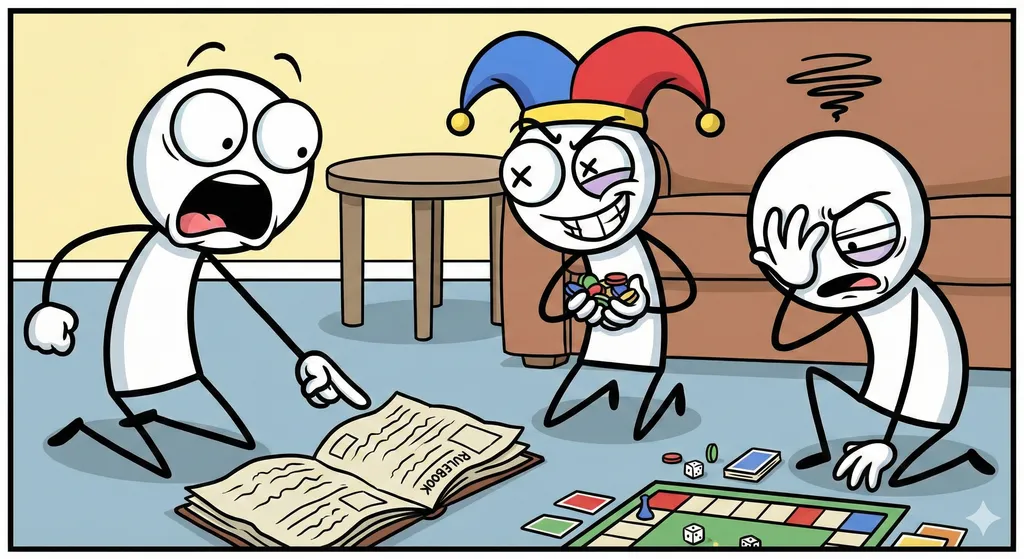
The unveiling of Matt Leacock and Matt Riddle's latest collaboration, The Four Doors, isn't just another card game release; it's a profound lesson in the often-invisible art of iterative design. For anyone who has ever pondered the genesis of a truly elegant system, Leacock and Riddle offer a rare glimpse behind the curtain, revealing a meandering path that saw no fewer than five distinct games and four different publishers contribute to what, on its surface, might appear to be a straightforward tabletop experience. This isn't just about a new product; it's about the relentless pursuit of mechanical perfection.
At its core, The Four Doors stands as a testament to evolution, a refinement engine in game design. We learn that its lineage traces back to Matt Riddle and Ben Pinchback’s The Goonies: Adventure Card Game, a significant touchstone. This history suggests that The Four Doors likely inherits and vastly improves upon mechanics centered around cooperative play, narrative progression, or objective fulfillment through card manipulation. The "four doors" themselves are not merely thematic window dressing; they are, in all likelihood, structural pillars of the gameplay.
Consider the implications of five iterations: each "door" could represent a distinct phase of play, a branching strategic path, or perhaps even a modular set of challenges that players must navigate. This isn't a game built on a single, fragile premise. Instead, it's a consolidation of proven concepts, stress-tested and honed over years by multiple creative minds. We can anticipate mechanics that are robust, elegantly interwoven, and resistant to the common pitfalls of first-draft designs. Perhaps players collectively unlock these doors by achieving specific card combinations, managing resources, or overcoming escalating threats. The successive improvements mentioned by the designers strongly imply a game where player choices feel meaningful, where the consequences of opening one "door" over another are palpable, and where the core engine has been stripped of unnecessary cruft, leaving only the essential, engaging interactions. This deep-seated iteration means the game isn't just functional; it's engineered to be engaging.
While specific lore for The Four Doors remains to be fully unveiled, the very title evokes a potent sense of mystery, choice, and consequence. Imagine a forgotten labyrinth or an ancient archive, where four distinct portals guard untold secrets or perilous challenges. Each "door" could represent a different school of magic, a divergent timeline, or a moral dilemma that shapes the narrative arc of the game. Players aren't just playing cards; they are explorers, scholars, or heroes collectively navigating these thresholds. The setting likely encourages collaborative storytelling, where the "fluff" emerges organically from the "crunch" of which door to approach first, what resources to commit, and which risks to take. This isn't about rigid lore dictating play, but rather providing a compelling framework within which player decisions weave their own unique narrative tapestry, reflecting the very journey of the game's design – a path with many branches and eventual convergence.
So, what does this iterative design process mean for us, the players, at the table? It spells out a promise of exceptional polish and depth. When a game has been through five different versions, tested by multiple designers and publishers, it signals an experience that has had its rough edges smoothed, its imbalances corrected, and its core fun factor amplified. The Four Doors isn't likely to surprise with entirely novel mechanics, but rather to delight with how flawlessly its familiar elements interact.
Expect a game that feels incredibly tight, where every card play and every decision about which "door" to engage carries weight and consequence. The table feel will likely be one of focused engagement, where players are deeply invested in solving the puzzle presented by the doors. If its progenitor, The Goonies, is any indication, expect a strong cooperative element, fostering intense discussion, shared triumphs, and collective defeats. This isn't a game to be rushed; it's one to be savored, its elegant systems revealing new strategic layers with each play. For Game Masters and seasoned players accustomed to dissecting game engines, The Four Doors offers a masterclass in how subtle mechanical tweaks, refined over years, can elevate a concept from good to truly great. It’s a game built not just to be played, but to be admired for its journey.
Top Pick: The Four Doors
A refined example of iterative game design excellence.
Check Price on Amazon →Related Stories
The Elusive Joy of Corps of Discovery Duo
Joy Cormier and Sen-Foong Lim's Corps of Discovery Duo is a cooperative deduction game for two. We dissect if its clever premise delivers a satisfying experienc
Five Families: Friese's Bold Bet on Broken Promises
Friedemann Friese's Five Families attempts to blend confrontational auctions with area control, but struggles with its execution. Despite its flaws, it offers a

The Ground Between: WW1 Wargaming, No Fat, Just Fun
Felix Sonne's 'The Ground Between' offers a free, low-complexity Print and Play hex-and-counter wargame set on the Western Front of World War 1. This editorial