
The Imperium's Unofficial Tongue: Decoding 40k Slang
Goonhammer's deep dive into Warhammer 40,000 slang reveals a fascinating layer of community communication. We dissect how this informal language shapes play and identity at the table.
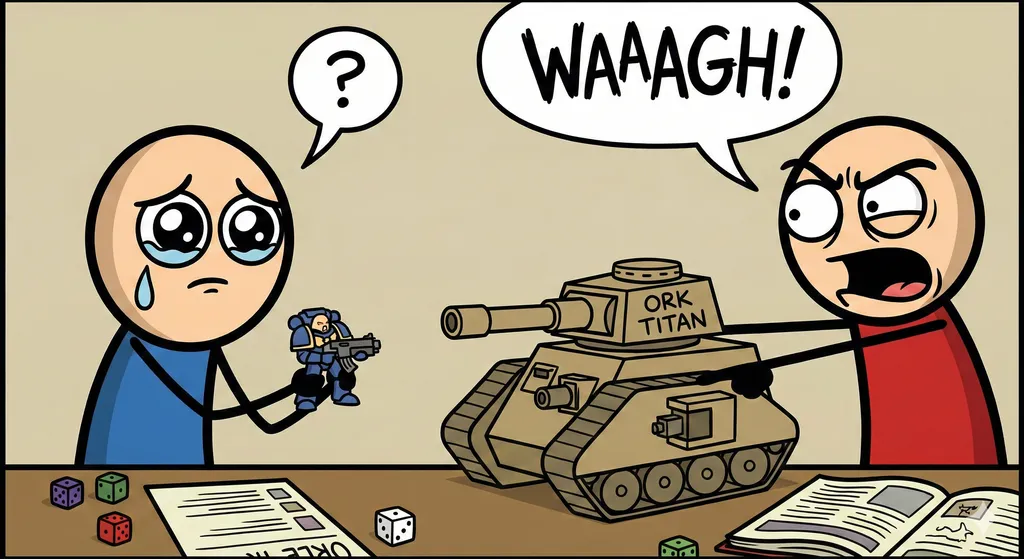
Goonhammer recently pulled back the curtain on the esoteric lexicon that defines much of the Warhammer 40,000 community, a project spearheaded by Campbell that shines a light on the unofficial language of Games Workshop's flagship wargame. This isn't about a new codex or a rules errata; it's about the organic, often bewildering, shorthand that veterans deploy with casual confidence, a dialect as dense and sprawling as the Imperium itself. For those of us who've spent decades pushing plastic across tabletops, this compilation isn't just amusing; it's a vital ethnographic study of how a complex game fosters its own unique subculture through shared terminology.
At its core, this "secret language" functions as a powerful, albeit informal, mechanical shortcut. Consider the sheer volume of rules, unit profiles, and strategic interactions in a typical game of Warhammer 40,000. Describing a "Terminator brick with an attached Librarian, backed by a Redemptor Dreadnought, pushing up the middle to contest an objective" is verbose. Slang compresses this into something like "the death star is pushing for the midfield objective." This isn't merely about brevity; it's about conveying a concept of play, a known synergy, or a common tactic with a single, loaded term. "Alpha strike" isn't just a turn one assault; it implies a specific type of list construction, deployment, and target priority designed to cripple an opponent immediately. "Chaff" units aren't just cheap models; they are tactical expendables designed to absorb fire or tie up threats. These terms are born from thousands of hours of play, emerging as efficient descriptors for complex interactions that the official rules, by their nature, cannot fully capture. They streamline tactical discussion, allowing players to communicate intricate game states and intentions with a precision that belies their informal origin. The slang becomes a meta-mechanic, a layer of communication built atop the explicit rules, enabling a faster, more fluid exchange of ideas within the established meta.
While not "lore" in the sense of new narrative developments from Games Workshop, this community lexicon represents a fascinating, emergent layer of player-generated "fluff." Just as the Imperium's vast bureaucracy invents endless, often byzantine, titles and designations for its functionaries and war machines, so too has the 40k community crafted its own internal mythology. The names given to units – "boyz" for Orks, "gants" for Termagants, "crons" for Necrons – aren't just abbreviations; they often carry an affectionate, or sometimes derogatory, weight that reflects the community's relationship with those factions. A "Knight Castellan" might be called a "big stompy robot," a term that perfectly encapsulates its battlefield role and the awe/frustration it inspires. This slang creates a shared cultural landscape, a "lore" of the player base itself. It's the oral tradition of the tabletop, passed down through forum posts, battle reports, and local club banter. It contextualizes units not just by their stat block but by their perceived role, their common exploits, and the collective experience of playing with or against them. It's the community's way of adding character and narrative depth to the cold, hard mechanics of the game, a collective world-building exercise that happens organically, enriching the grimdark setting with a layer of human, often humorous, experience. It’s the whisper network of the 41st millennium, a secret handshake among those who truly understand the cosmic horror and absurd joy of Warhammer 40,000.
So, is this proliferation of slang good for Warhammer 40,000? Absolutely, but with caveats. For veteran players, it's an undeniable boon. It fosters camaraderie, speeds up tactical discussions, and provides a sense of belonging to a shared culture. When a fellow player casually refers to "dropping the hammer" or "screening the artillery," you instantly understand the implication, the intended action, and the strategic layer beneath the surface. This shared vocabulary makes the game feel richer, more nuanced, and more deeply communal. However, for new players, this can be an impenetrable wall. Imagine walking into your first game or browsing a forum and encountering terms like "MSU," "ITC," "T-shirt saves," or "obj sec" without context. It's bewildering, an immediate barrier to entry that can alienate newcomers before they even grasp the core rules. The onus falls on the veteran community to be mindful, to code-switch when necessary, and to gently introduce new players to this fascinating, if at times opaque, linguistic landscape. When properly managed, this slang enriches the table, allowing for sophisticated strategic discourse and reinforcing the bonds of a passionate community. It’s a testament to the depth of Warhammer 40,000 that its players have developed such a complex, expressive, and often hilarious, internal language. Understanding this language is almost as crucial as understanding the core rules for truly engaging with the wider Wargaming community. Combat Patrol
Top Pick: Core Rulebook (Warhammer 40,000)
Essential for understanding the game's foundational concepts, which slang often abbreviates.
Check Price on Amazon →Related Stories
The Imperium's Edge: Dissecting 10th Edition's Shifting 40K Meta
Goonhammer's 'Competitive Innovations' series offers a vital look into Warhammer 40,000's 10th Edition tournament landscape. We analyze how current meta trends
Chaos Unleashed: The Renegade Warband Detachment Deep Dive
Games Workshop's latest update to Warhammer 40,000 introduces the Renegade Warband Detachment for Chaos Space Marines. We dissect its mechanics and lore to asse
Beyond the Dice: Mastering 40K's Positional Chess Game
Goonhammer's latest "40K Fundamentals" article dissects the critical interplay of movement and positioning in Warhammer 40,000. We examine how these core skills