
The Unseen Rules: Mastering GM/Player Dialogue
True TTRPG collaboration extends beyond character actions, delving into the vital GM/player dynamic. This deep dive unpacks how transparent communication elevates every session, transforming good tables into legendary ones.
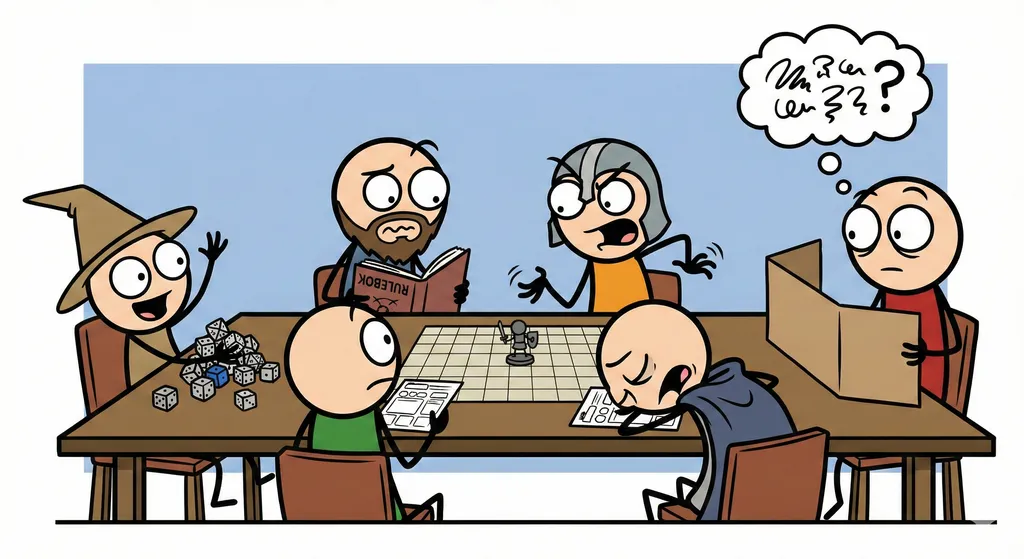
The venerable TTRPG institution, Gnome Stew, recently dropped ‘GM/Player Interactions, Part 1,’ a piece that, while foundational, warrants a deeper look through the lens of lived experience at the table. It’s not about the roll of the dice, but the dialogue *around* the dice; the unspoken social contract that underpins every narrative we collectively weave. This isn't about what the Big Bad Villain says to their lieutenants, but how *we*, as players and GMs, communicate to make that villain's schemes, or the heroes' triumphs, truly resonate.
At its core, the 'mechanics' of GM/player interaction are not found in a stat block, but in the explicit and implicit protocols governing information flow and decision-making. We’re talking about the *meta-game* mechanics that ensure the game engine runs smoothly. Consider the **Information Economy**: How is information exchanged at your table? Is the Game Master providing just enough, or too much, prompting analysis rather than rote action? Are players asking precise questions about the environment or their objectives, or making vague statements that leave too much to GM interpretation? The mechanic here is the iterative question-and-answer loop. A player states, “I search the room.” A GM’s best response isn’t just, “Roll Perception.” It’s, “What are you specifically searching for? What’s your character’s intent?” This isn’t just flavor; it’s the mechanical input/output of collaborative storytelling.
Then there’s the **Adjudication Process**. Players state intent, GMs adjudicate. This involves setting Difficulty Classes, determining applicable skills, and interpreting results. A transparent adjudication process, where the GM explains *why* a particular roll or rule applies (or doesn't), is a critical mechanical interaction that builds trust. It's a 'roll for agreement' on the interpretation of the rules, fostering a sense of fairness and shared understanding. Furthermore, **Expectation Alignment** forms the 'soft' mechanics. A well-executed Session Zero Guide isn't just for setting boundaries; it's a foundational *mechanic* for aligning player and GM expectations about tone, genre, and play style. Without this, the game’s internal engine will inevitably sputter. Finally, **Feedback Loops** – post-session debriefs or even mid-session check-ins – are mechanical tools. “Are we enjoying this? Is this challenge level right?” These aren't just chats; they are *system maintenance* checks on the collaboration engine.
The 'fluff' of GM/player interaction isn't about dragons or ancient empires; it's about the emergent narrative and the shared understanding that builds the *table's unique world*. Every table develops its own **Table’s Canon** – the shared history of its campaigns, the in-jokes, the established house rules (which become their own form of ‘lore’). This collective memory is a direct result of ongoing, iterative GM/player interactions. It's the unique narrative tapestry woven from countless conversations, decisions, and dice rolls. This leads to **Collaborative Worldbuilding**: when a player asks, “Are there any dwarven strongholds in this mountain range?” and the GM responds, perhaps even asking for player input (“What do *you* know about dwarven strongholds here?”), they are collaboratively building the world’s lore. The GM provides the scaffolding, but the players often add intricate details through their inquiries and character backstories. This interaction weaves character lore directly into world lore. Finally, **Character Agency as Narrative Engine** sees a player’s choice to pursue a personal quest, to found a guild, or to delve into a specific part of their backstory, not just as a character action but as a profound prompt for the GM to integrate new narrative threads into the established world. This interaction enriches the game’s “fluff” by making it deeply personal and reactive, creating a more robust and engaging setting.
So, is this good for the game? It is absolutely essential. Mastering these unseen rules of interaction leads directly to better immersion, significantly less frustration, and ultimately, stronger, more memorable campaigns. It prevents those dreaded “gotcha” moments and fosters a profound sense of trust and creative freedom at the table. When these interactions are handled with care and transparency, the game *feels* more collaborative, more engaging, and inherently fairer. It transforms a group of individuals rolling dice into a true collective of storytellers.
Top Pick: Return of the Lazy Dungeon Master
For practical, actionable advice on streamlining GM preparation and fostering player engagement
Check Price on Amazon →Related Stories
The Narrative Power of Non-Mechanical Outcomes
Sly Flourish challenges GMs to embrace fictional outcomes over strict mechanics for every roll. This approach enriches TTRPGs, fostering deeper immersion and mo
Aethelgard: Echoes Delivers Grim Consequences to the Table
Mythforged Games' 'Aethelgard: Echoes of the Sundered Realm' promises a dark fantasy TTRPG where every choice echoes through the world. Its innovative mechanics
Beyond Tropes: Aetherial Bonds Brings Omegaverse to D&D 5e
Mythos Forge Publishing's 'Aetherial Bonds' introduces Omegaverse mechanics to D&D 5th Edition. We examine how pheromones, pair bonding, and secondary genders c