
UA Villainy Unleashed: Dark Paths for D&D's Anti-Heroes
Wizards of the Coast has dropped another Unearthed Arcana, 'Villainous Options 2,' expanding morally complex player choices for Dungeons & Dragons 5th Edition. This installment brings intriguing pathways for Barbarians, Monks, and Warlocks, challenging traditional heroic archetypes.
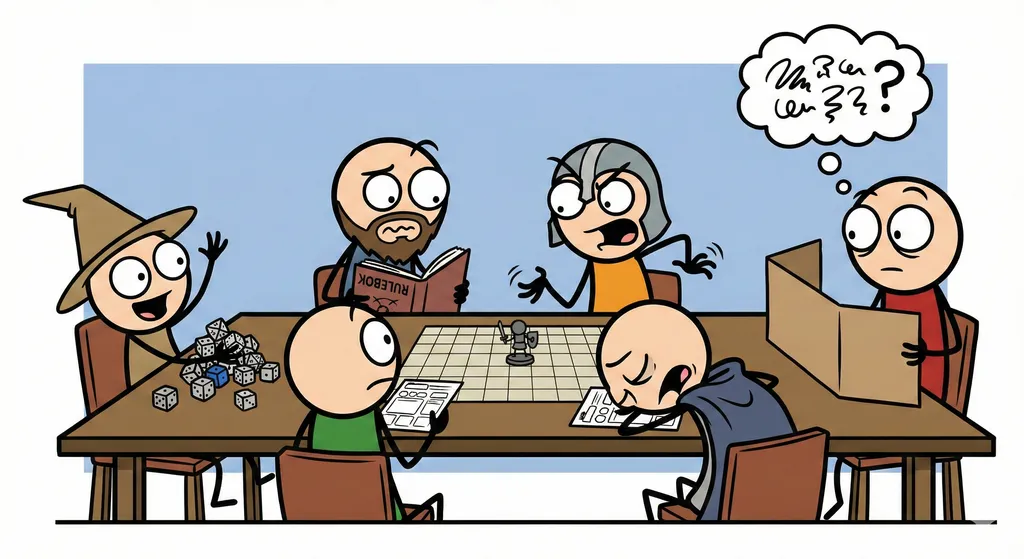
The latest Unearthed Arcana, "Villainous Options 2," from Wizards of the Coast, offers a fascinating glimpse into Dungeons & Dragons 5th Edition's potential future, specifically for players who relish characters with a darker edge. This follow-up to the initial "Villainous Options" broadens the scope, providing new subclass concepts for the Barbarian, Monk, and Warlock, pushing the boundaries of what 'hero' truly means at the table.
Let's cut right to the crunch. The Barbarian's Path of Lament is perhaps the most immediately evocative. The core concept—fueling rage with regret and sorrow—is a mechanical and narrative goldmine. Instead of primal fury born from instinct or wildness, this Barbarian draws power from deep-seated emotional wounds. Mechanically, I envision this manifesting as a powerful, almost self-destructive, burst. Perhaps a feature like 'Echoes of Regret' allows the Barbarian to weaponize their despair, granting temporary hit points that scale with damage taken, or a 'Wail of Despair' that imposes a fear condition on nearby enemies, reflecting their emotional agony. The true genius lies in its interaction with the core Rage mechanic; it transforms a simple aggression into a cathartic release of internal torment, adding a layer of tragic complexity to every swing.
For the Monk, while not explicitly detailed in the initial source, a 'Way of the Corrupting Ki' or 'Path of the Shadowed Fist' would be a natural fit for 'Villainous Options.' Imagine a Monk who twists their inner spiritual energy not for balance or healing, but for control and degradation. Mechanically, this could mean a 'Ki Drain' ability, siphoning temporary hit points or even a resource like Bardic Inspiration from opponents with a successful unarmed strike. Or perhaps 'Whispers of Doubt,' an action to impose disadvantage on an enemy's saving throws by subtly manipulating their fears with corrupted ki. This isn't just about punching harder; it's about subverting the very essence of monastic discipline for selfish, perhaps even cruel, ends.
The Warlock, already a class steeped in dark pacts, finds new depths in 'Villainous Options 2.' A 'Pact of the Abyssal Whisper' or 'Patron of the Tyrant's Dominion' could grant powers far more insidious than typical Warlock fare. Beyond Eldritch Blast, consider invocations like 'Soul Harvest,' allowing the Warlock to gain temporary hit points or even a bonus spell slot upon reducing an enemy to 0 hit points. Or a unique patron spell list focused on mind control, despair, and environmental corruption, like summoning minor fiends or blighting small areas. The Warlock's inherent bargain with power is already morally ambiguous; these options simply turn the dial up to eleven, demanding greater sacrifices and granting more overtly malevolent abilities. Every pact comes at a cost, and these villainous options promise a truly steep price.
Now, let's talk fluff. The Path of Lament Barbarian isn't just angry; they're heartbroken, betrayed, or burdened by past mistakes. This allows for phenomenal roleplaying. Instead of a simple brute, you have a character wrestling with their inner demons, using their pain as a weapon. This is a Barbarian who might weep openly after a battle, or whose rage is cold and precise rather than wild. Similarly, a Monk of the Corrupting Ki isn't just a martial artist; they're a manipulator, a spiritual predator who has found power in forbidden truths. Their discipline is a cage for others, not a path to enlightenment. And the Warlock? These options offer patrons whose demands are not just for power, but for active participation in their schemes of conquest or corruption. This isn't just about borrowing magic; it's about becoming an active agent of malevolence in the world. These concepts provide a rich tapestry for GMs to weave into their narratives, creating compelling antagonists or deeply conflicted player characters. For players, it's an invitation to explore shades of grey beyond the standard hero's journey, making every decision weigh heavier.
So, what's the verdict for the table? These "Villainous Options" are a net positive for Dungeons & Dragons 5th Edition, provided the table is mature enough to handle the themes. They offer immense potential for character depth and narrative complexity. For Game Masters, these subclasses present ready-made concepts for memorable NPCs, rival adventurers, or even the tragic backstory of a major villain. For players, they unlock archetypes previously difficult to embody within the existing subclass framework without significant homebrew. They challenge the notion that every player character must be a paragon of virtue. However, GMs should be prepared to discuss expectations with their players. A 'villainous' character doesn't automatically mean a disruptive one; the challenge lies in playing a morally compromised character who still contributes to the party's goals, even if their methods are questionable. It pushes players to think beyond simple good-vs-evil and embrace the nuanced motivations that make for truly unforgettable stories. These options enhance the game by adding layers of dramatic tension and powerful storytelling tools, inviting players to truly delve into the consequences of power.
Top Pick: Tasha's Cauldron of Everything
Excellent options for character customization and GM tools for adapting existing subclasses
Check Price on Amazon →Related Stories
Kobold Press's Fey & Elves Bundle: A 5E GM's Essential Toolkit
The Humble Book Bundle featuring Kobold Press's Elves & Fey content for D&D 5th Edition offers a trove of unique mechanics and lore. We dissect how this collect
Cocks' Crossover Push: D&D's Identity Crisis or New Horizon?
Chris Cocks confirms an intensified focus on Dungeons & Dragons crossover products, sparking debate among veteran players. We dissect the mechanical and lore im
Dragon Reflections Unleashes Potent Draconic Resonance
EN World's Dragon Reflections #104 introduces a compelling new system, 'The Draconic Resonance Protocol.' It weaves ancient draconic power directly into campaig