
11th Edition's Early Meta & The Pre-Painted Terrain Divide
Warhammer 40,000 11th Edition's launch stirs the pot with early 'unbeatable' lists dominating discussion, alongside a heated debate over Games Workshop's push for pre-painted terrain. This analysis delves into the mechanical implications of new rulesets and the evolving landscape of hobby accessibility versus traditional craft.
The launch of Warhammer 40,000 11th Edition by Games Workshop has, predictably, ignited the twin infernos of competitive meta-chasing and the ongoing debate surrounding hobby accessibility, specifically with the burgeoning market of pre-painted terrain. As veterans of the grimdark future, we’ve witnessed this cycle many times: a new edition drops, the community scrambles to optimize, and somewhere, a new product line challenges established hobby norms. This time, the conversation feels particularly charged, impacting both the competitive circuit and the casual player’s experience at the table.
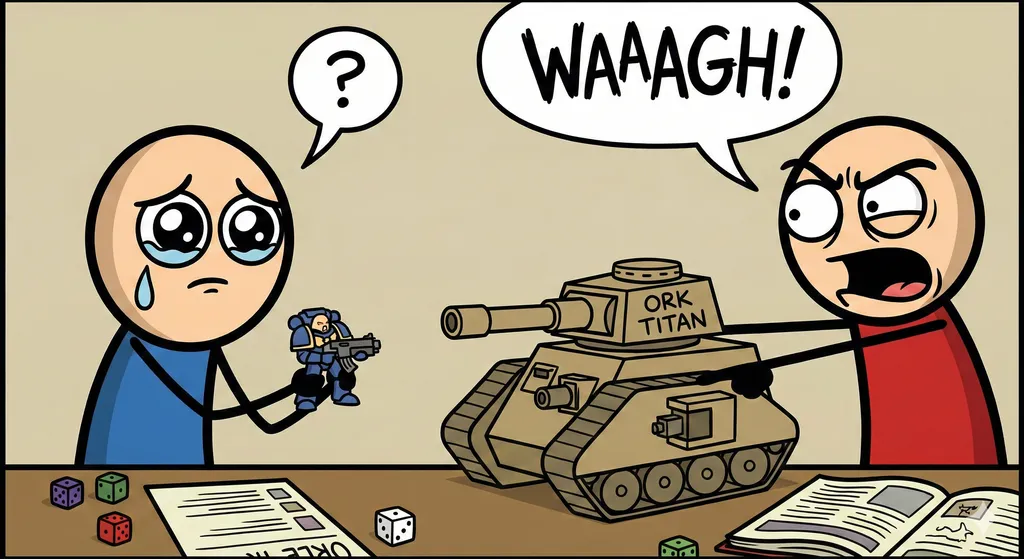
First, let’s crunch the numbers on these so-called “unbeatable armies” emerging in the nascent stages of Warhammer 40,000 11th Edition. It’s a tale as old as time: a new ruleset, fresh codexes, and revised points values inevitably create unforeseen synergies. Players, ever ingenious, quickly identify units or detachments that, when combined, achieve disproportionate efficiency. Perhaps it’s a specific unit’s output coupled with a powerful stratagem, or a character’s aura amplifying an already potent core. The current buzz suggests certain faction combinations are exhibiting a level of resilience or damage potential that feels difficult to counter without mirror-matching or extreme counter-meta builds. This isn't necessarily a design flaw, but rather an emergent property of a complex system being stress-tested by thousands of players simultaneously. The true “unbeatable” list is a myth; what we’re seeing are optimized power curves that demand specific answers, creating a temporary bottleneck in list diversity until FAQs and balance passes inevitably arrive.
Then there's the terrain. Games Workshop’s increasing foray into pre-painted terrain has sparked a far more fundamental debate within the hobby. Mechanically, pre-painted terrain offers a consistent battlefield. For tournaments, this could standardize line-of-sight and cover, leveling the playing field and reducing disputes. A complete, aesthetically coherent table can be set up in minutes, a boon for event organizers and players eager to get dice rolling. However, the controversy heats up when discussing the cost-to-value proposition and the very soul of the hobby. These kits often carry a premium price, a cost some argue doesn't justify the often-basic paint schemes compared to what a dedicated hobbyist could achieve. The argument isn't about the *existence* of such products, but their prominence and the perceived shift in Games Workshop’s focus from the DIY painting experience.
From a lore perspective, the concept of “unbeatable” forces in Warhammer 40,000 11th Edition resonates with the setting’s brutal nature. The Imperium’s endless wars, the xenos’ relentless expansion, the daemons’ insidious corruption – all are characterized by moments of overwhelming, terrifying power. A Tyranid swarm that feels unstoppable or a Necron phalanx that grinds opponents to dust perfectly reflects the grimdark reality where survival is often a matter of facing impossible odds. The meta, in a strange way, mirrors the lore’s narrative of overwhelming threats and desperate struggles. As for pre-painted terrain, a fully realized battlefield, whether bespoke or factory-finished, enhances immersion. It transforms a tabletop into a war-torn urban ruin or an alien jungle, providing a vital visual context to the unfolding narrative of battle. The concern, then, isn't about the immersion itself, but about the *personal* connection to that immersive space.
So, what’s the verdict for the table? The early appearance of dominant lists in Warhammer 40,000 11th Edition is a predictable growing pain. It’s frustrating for players who crave diverse matchups, but it’s also a temporary state. Games Workshop has a history of addressing these imbalances, albeit sometimes at a pace that tests the patience of the competitive scene. Players should view this as an opportunity to innovate, to find the counter-meta, or simply to enjoy the ride as the edition evolves. Citadel Contrast Paints The pre-painted terrain, however, represents a deeper ideological rift. On one hand, it lowers the barrier to entry, making the full Warhammer experience more accessible to those without the time, skill, or inclination to paint. This is undeniably good for growing the player base. On the other, it can feel like a corporate encroachment on a core tenet of the hobby: the joy of creation, the pride in a hand-painted army fighting on a hand-crafted battlefield. The controversy isn't just about the product; it’s about what it signifies for the future of the hobby – a balance between mass-market appeal and the artisanal spirit that built this community. Ultimately, both issues highlight the ongoing tension between a rapidly expanding publisher and its passionate, diverse player base.
Top Pick: Army Painter Speedpaint Metallics
For quick, effective base coating on new armies.
Check Price on Amazon →Related Stories
40K's Shifting Sands: Points, Power, and the Pursuit of Balance
Games Workshop’s latest Warhammer 40,000 rules and points updates demand a critical look. We dissect how these changes redefine list-building and battlefield st
The Iron Gauntlet: GW's Latest 3D Printing Enforcement
Games Workshop's recent crackdown on 3D printing creator PropaneProd has ignited a fiery debate within the community. This incident puts a harsh spotlight on th
Armored Apex: Decoding GW's Latest Tyranid Tail Tease
Games Workshop's latest Rumor Engine reveals a segmented, armored tail, sparking speculation across the Warhammer community. This deep dive explores the potenti