
Beyond the Algorithm: D&D's Audience Demands Artistry
Hasbro's CEO confirms AI isn't used in D&D's creation, citing the game's unique audience. This editorial explores the implications for creative integrity and the future of TTRPG design.
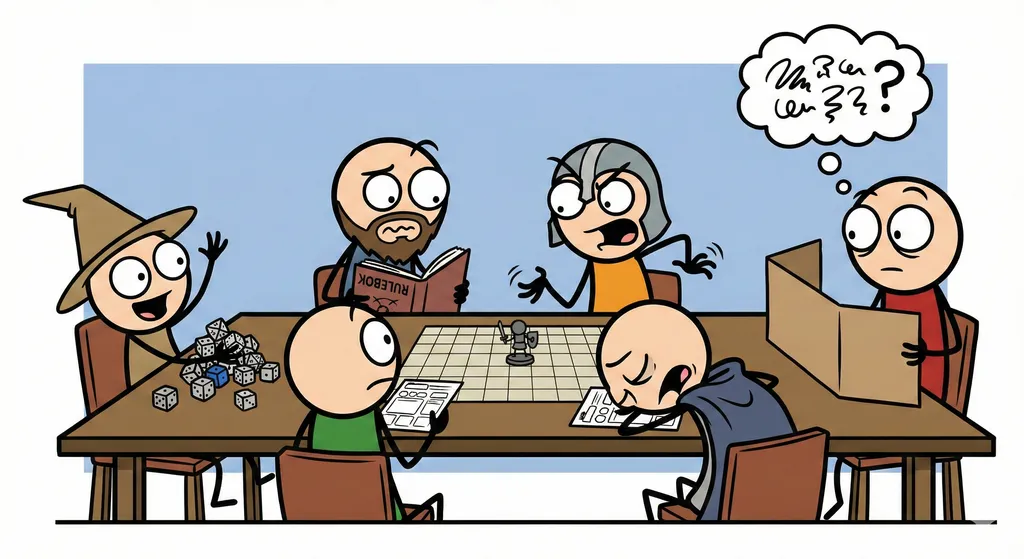
The recent statement from Hasbro's CEO, Chris Cocks, regarding the non-use of Artificial Intelligence in Dungeons & Dragons' development isn't just a corporate talking point from Wizards of the Coast; it's a profound acknowledgment of what makes our hobby tick. In an era where technological integration is often seen as an inevitable march, this declaration stands as a bulwark for the handcrafted, human-centric essence of tabletop roleplaying games.
At its core, D&D's mechanics – the crunch that defines gameplay – are not merely numerical calculations; they are carefully sculpted frameworks designed to evoke specific feelings and facilitate emergent storytelling. Consider the intricate dance of action economy in 5th Edition, the deliberate pacing of a combat encounter, or the nuanced interplay of skill checks and saving throws. These aren't simply data points to be optimized by an algorithm. They are the result of countless hours of human ideation, iterative design, rigorous playtesting, and a deep understanding of player psychology. A human designer iterates not just on efficiency, but on *fun*, on *narrative impact*, on the subtle ways a rule can encourage creativity or challenge expectations. AI, in its current state, excels at pattern recognition and optimization within defined parameters, but it struggles with the subjective, often contradictory, and deeply human elements that forge a truly engaging game system. The very spirit of D&D's mechanics, from the simplest d20 roll to the most complex spell description, relies on an understanding of human aspiration, challenge, and triumph that no AI can yet replicate.
The lore of Dungeons & Dragons, the rich fluff that gives our adventures meaning, presents an even more compelling argument for human authorship. The sprawling multiverses, the nuanced cultures of Faerûn or Eberron, the epic sagas woven into every adventure path – these are not just collections of facts. They are tapestries of imagination, imbued with thematic resonance, emotional depth, and cultural touchstones that only human experience can provide. When a Dungeon Master describes the ancient, sorrowful history of a dragon, or a player crafts a backstory that intertwines with the forgotten lore of a kingdom, it's a deeply personal, often improvisational act of co-creation. An AI might generate a million unique monsters or a thousand forgotten cities, but without the guiding hand of a storyteller who understands pathos, irony, and the human condition, that content often feels vast yet hollow. The audience of D&D isn't just consuming lore; they are actively participating in its evolution, making the world their own. This requires a living, breathing narrative engine, not a deterministic one. For a deeper dive into design philosophy, check out The Monsters Know What They're Doing, which exemplifies the human touch in monster tactics.
So, what does this mean for the table feel, for the actual play experience? It means trust. It means that when we crack open a new D&D sourcebook, we can be confident that the content within – the rules, the monsters, the world lore – has been crafted by human minds who understand and cherish the game's unique blend of mechanics and narrative. It reinforces the idea that D&D is a collaborative art form, a shared act of imagination where the human element is paramount, from the designers to the Dungeon Masters to the players themselves. This commitment to human authorship safeguards the authenticity and soul of the game, ensuring that the magic we find at our tables remains genuinely magical, born of connection and creativity, not code. It’s a resounding affirmation that for Dungeons & Dragons, the audience isn't just a market segment; it's a community of passionate storytellers who demand artistry, not automation.
Top Pick: Mordenkainen Presents: Monsters of the Multiverse
For its nuanced monster design and lore that feels distinctly hand-crafted, showcasing the depth human creativity brings to the game.
Check Price on Amazon →Related Stories
D&D's Seasonal Shift: Organized Play Reimagined for 2026
Wizards of the Coast unveils its 2026 D&D Seasons and a revised Organized Play structure. We break down what this means for your campaigns, character progressio
D&D 2024 Officially 5.5e: The Edition That Wasn't (Quite)
Wizards of the Coast has finally clarified the nature of the D&D 2024 update, confirming it as '5.5e'. This official designation signals a significant revision
D&D Finally Embraces Its 5.5e Identity, Ending Branding Chaos
Wizards of the Coast's long-awaited D&D iteration finally receives a sensible name: 5.5e. This move promises mechanical refinement and lore continuity, benefiti